

182
6 Charge and Energy Transfer Processes
(P bim < 1), they will feed an outgoing flux Φ out . The larger the Φ out is, the smaller
the net flux Φ and the gradient d N X /dr. On the contrary, Φ in is not affected by the
bimolecular process. Φ cannot depend on R in a steady state, otherwise the number
of X molecules in a spherical layer would change in time. Then, we can connect Φ
to the asymptotic concentration of X, N X (∞), by a simple integral:
N X (∞) = N X (R) +
∞
R
dN X
d R d R
=
= N X (R) +
Φ
4π D
∞
R
R
−2 d R
= N X (R) +
Φ
4π D R
.
(6.8)
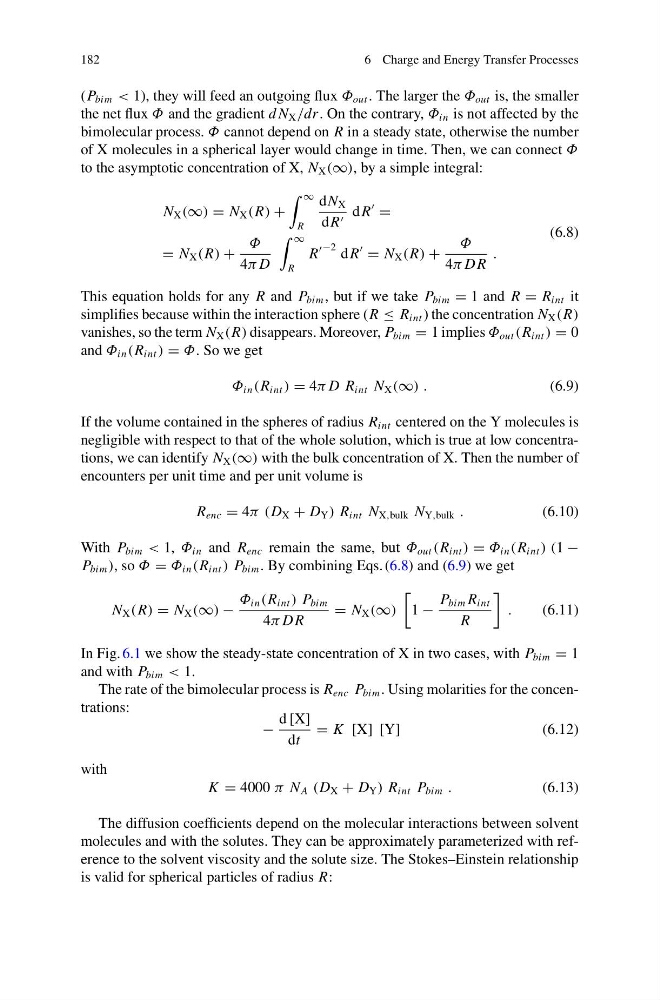
This equation holds for any R and P bim , but if we take P bim = 1 and R = R int it
simplifies because within the interaction sphere (R ≤ R int ) the concentration N X (R)
vanishes, so the term N X (R) disappears. Moreover, P bim = 1 implies Φ out (R int ) = 0
and Φ in (R int ) = Φ. So we get
Φ in (R int ) = 4π D R int N X (∞) .
(6.9)
If the volume contained in the spheres of radius R int centered on the Y molecules is
negligible with respect to that of the whole solution, which is true at low concentrations, we can identify N X (∞) with the bulk concentration of X. Then the number of
encounters per unit time and per unit volume is
R enc = 4π (D X + D Y ) R int N X,bulk N Y,bulk .
(6.10)
With P bim < 1, Φ in and R enc remain the same, but Φ out (R int ) = Φ in (R int ) (1 −
P bim ), so Φ = Φ in (R int ) P bim . By combining Eqs. (6.8) and (6.9) we get
N X (R) = N X (∞) −
Φ in (R int ) P bim
4π D R
= N X (∞)
1 −
P bim R int
R
.
(6.11)
In Fig. 6.1 we show the steady-state concentration of X in two cases, with P bim = 1
and with P bim < 1.
The rate of the bimolecular process is R enc P bim . Using molarities for the concentrations:
−
d [X]
dt
= K [X] [Y]
(6.12)
with
K = 4000 π N A (D X + D Y ) R int P bim .
(6.13)
The diffusion coefficients depend on the molecular interactions between solvent
molecules and with the solutes. They can be approximately parameterized with reference to the solvent viscosity and the solute size. The Stokes–Einstein relationship
is valid for spherical particles of radius R:
6 Charge and Energy Transfer Processes
(P bim < 1), they will feed an outgoing flux Φ out . The larger the Φ out is, the smaller
the net flux Φ and the gradient d N X /dr. On the contrary, Φ in is not affected by the
bimolecular process. Φ cannot depend on R in a steady state, otherwise the number
of X molecules in a spherical layer would change in time. Then, we can connect Φ
to the asymptotic concentration of X, N X (∞), by a simple integral:
N X (∞) = N X (R) +
∞
R
dN X
d R d R
=
= N X (R) +
Φ
4π D
∞
R
R
−2 d R
= N X (R) +
Φ
4π D R
.
(6.8)
This equation holds for any R and P bim , but if we take P bim = 1 and R = R int it
simplifies because within the interaction sphere (R ≤ R int ) the concentration N X (R)
vanishes, so the term N X (R) disappears. Moreover, P bim = 1 implies Φ out (R int ) = 0
and Φ in (R int ) = Φ. So we get
Φ in (R int ) = 4π D R int N X (∞) .
(6.9)
If the volume contained in the spheres of radius R int centered on the Y molecules is
negligible with respect to that of the whole solution, which is true at low concentrations, we can identify N X (∞) with the bulk concentration of X. Then the number of
encounters per unit time and per unit volume is
R enc = 4π (D X + D Y ) R int N X,bulk N Y,bulk .
(6.10)
With P bim < 1, Φ in and R enc remain the same, but Φ out (R int ) = Φ in (R int ) (1 −
P bim ), so Φ = Φ in (R int ) P bim . By combining Eqs. (6.8) and (6.9) we get
N X (R) = N X (∞) −
Φ in (R int ) P bim
4π D R
= N X (∞)
1 −
P bim R int
R
.
(6.11)
In Fig. 6.1 we show the steady-state concentration of X in two cases, with P bim = 1
and with P bim < 1.
The rate of the bimolecular process is R enc P bim . Using molarities for the concentrations:
−
d [X]
dt
= K [X] [Y]
(6.12)
with
K = 4000 π N A (D X + D Y ) R int P bim .
(6.13)
The diffusion coefficients depend on the molecular interactions between solvent
molecules and with the solutes. They can be approximately parameterized with reference to the solvent viscosity and the solute size. The Stokes–Einstein relationship
is valid for spherical particles of radius R: