

168
5 Fast Nonadiabatic Dynamics
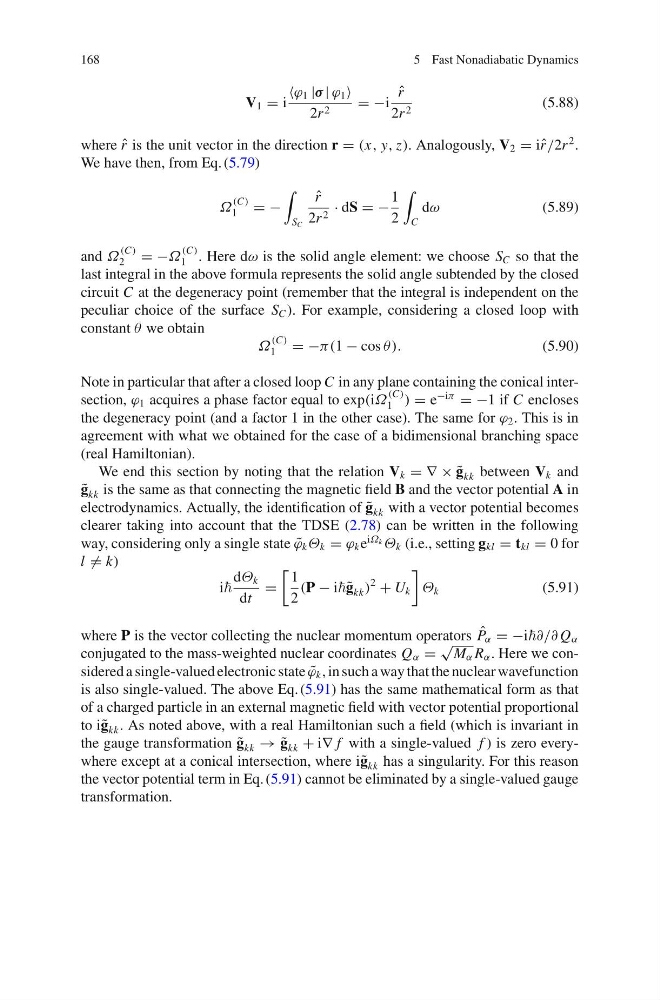
V 1 = i
ϕ 1 |σ | ϕ 1
2r 2
= −i
ˆ
r
2r 2
(5.88)
where ˆ
r is the unit vector in the direction r = (x, y, z). Analogously, V 2 = iˆ r/2r
2 .
We have then, from Eq. (5.79)
Ω
(C)
1
= −
S C
ˆ
r
2r 2 · dS = −
1
2
C
dω
(5.89)
and Ω
(C)
2
= −Ω
(C)
1 . Here dω is the solid angle element: we choose S C so that the
last integral in the above formula represents the solid angle subtended by the closed
circuit C at the degeneracy point (remember that the integral is independent on the
peculiar choice of the surface S C ). For example, considering a closed loop with
constant θ we obtain
Ω
(C)
1
= −π(1 − cos θ).
(5.90)
Note in particular that after a closed loop C in any plane containing the conical intersection, ϕ 1 acquires a phase factor equal to exp(iΩ
(C)
1 ) = e
−iπ
= −1 if C encloses
the degeneracy point (and a factor 1 in the other case). The same for ϕ 2 . This is in
agreement with what we obtained for the case of a bidimensional branching space
(real Hamiltonian).
We end this section by noting that the relation V k = ∇ × ˜
g kk between V k and
˜
g kk is the same as that connecting the magnetic field B and the vector potential A in
electrodynamics. Actually, the identification of ˜
g kk with a vector potential becomes
clearer taking into account that the TDSE (2.78) can be written in the following
way, considering only a single state ˜
ϕ k Θ k = ϕ k e
iΩ k Θ k (i.e., setting g kl = t kl = 0 for
l = k)
i
dΘ k
dt
=
1
2
(P − i˜ g kk )
2
+ U k
Θ k
(5.91)
where P is the vector collecting the nuclear momentum operators ˆ
P α = −i∂/∂ Q α
conjugated to the mass-weighted nuclear coordinates Q α =
√
M α R α . Here we considered a single-valued electronic state ˜
ϕ k , in such a way that the nuclear wavefunction
is also single-valued. The above Eq. (5.91) has the same mathematical form as that
of a charged particle in an external magnetic field with vector potential proportional
to i˜ g kk . As noted above, with a real Hamiltonian such a field (which is invariant in
the gauge transformation ˜
g kk → ˜
g kk + i∇ f with a single-valued f ) is zero everywhere except at a conical intersection, where i˜ g kk has a singularity. For this reason
the vector potential term in Eq. (5.91) cannot be eliminated by a single-valued gauge
transformation.
5 Fast Nonadiabatic Dynamics
V 1 = i
ϕ 1 |σ | ϕ 1
2r 2
= −i
ˆ
r
2r 2
(5.88)
where ˆ
r is the unit vector in the direction r = (x, y, z). Analogously, V 2 = iˆ r/2r
2 .
We have then, from Eq. (5.79)
Ω
(C)
1
= −
S C
ˆ
r
2r 2 · dS = −
1
2
C
dω
(5.89)
and Ω
(C)
2
= −Ω
(C)
1 . Here dω is the solid angle element: we choose S C so that the
last integral in the above formula represents the solid angle subtended by the closed
circuit C at the degeneracy point (remember that the integral is independent on the
peculiar choice of the surface S C ). For example, considering a closed loop with
constant θ we obtain
Ω
(C)
1
= −π(1 − cos θ).
(5.90)
Note in particular that after a closed loop C in any plane containing the conical intersection, ϕ 1 acquires a phase factor equal to exp(iΩ
(C)
1 ) = e
−iπ
= −1 if C encloses
the degeneracy point (and a factor 1 in the other case). The same for ϕ 2 . This is in
agreement with what we obtained for the case of a bidimensional branching space
(real Hamiltonian).
We end this section by noting that the relation V k = ∇ × ˜
g kk between V k and
˜
g kk is the same as that connecting the magnetic field B and the vector potential A in
electrodynamics. Actually, the identification of ˜
g kk with a vector potential becomes
clearer taking into account that the TDSE (2.78) can be written in the following
way, considering only a single state ˜
ϕ k Θ k = ϕ k e
iΩ k Θ k (i.e., setting g kl = t kl = 0 for
l = k)
i
dΘ k
dt
=
1
2
(P − i˜ g kk )
2
+ U k
Θ k
(5.91)
where P is the vector collecting the nuclear momentum operators ˆ
P α = −i∂/∂ Q α
conjugated to the mass-weighted nuclear coordinates Q α =
√
M α R α . Here we considered a single-valued electronic state ˜
ϕ k , in such a way that the nuclear wavefunction
is also single-valued. The above Eq. (5.91) has the same mathematical form as that
of a charged particle in an external magnetic field with vector potential proportional
to i˜ g kk . As noted above, with a real Hamiltonian such a field (which is invariant in
the gauge transformation ˜
g kk → ˜
g kk + i∇ f with a single-valued f ) is zero everywhere except at a conical intersection, where i˜ g kk has a singularity. For this reason
the vector potential term in Eq. (5.91) cannot be eliminated by a single-valued gauge
transformation.