

150
5 Fast Nonadiabatic Dynamics
in their Taylor development at Q x , as in Eq. (5.28). Moreover, the approximation of
constant nuclear velocity v is correct if the time δ Q/v ≈ |H 12 /Fv| needed to cross
the strong interaction region is small enough.
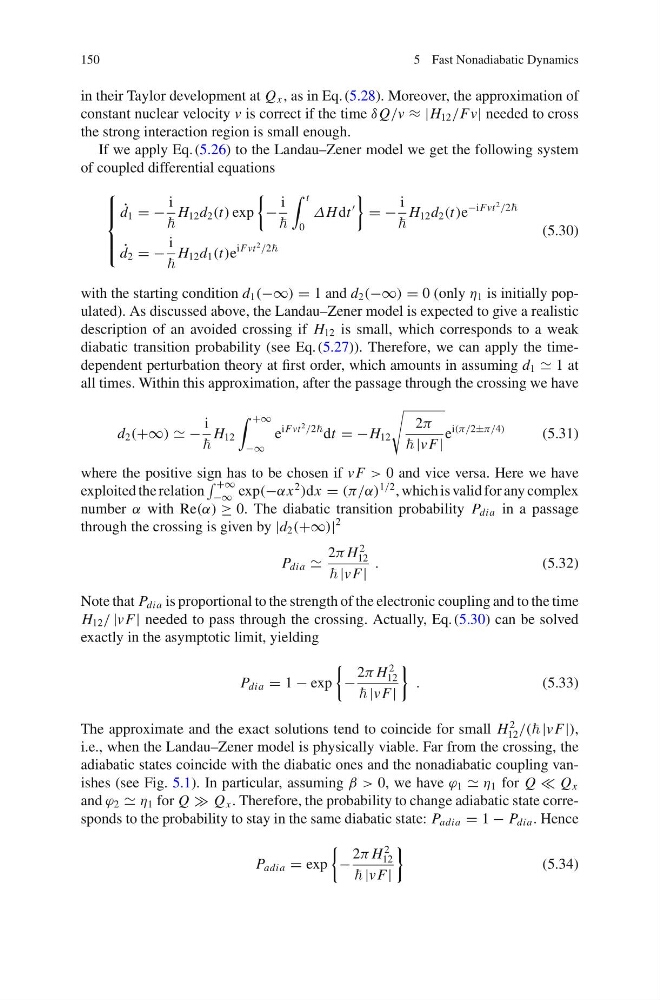
If we apply Eq. (5.26) to the Landau–Zener model we get the following system
of coupled differential equations
⎧
⎪ ⎪ ⎨
⎪ ⎪ ⎩
˙
d 1 = −
i
H 12 d 2 (t) exp
−
i
t
0
ΔH dt
= −
i
H 12 d 2 (t)e
−iFvt
2 /2
˙
d 2 = −
i
H 12 d 1 (t)e
iFvt
2 /2
(5.30)
with the starting condition d 1 (−∞) = 1 and d 2 (−∞) = 0 (only η 1 is initially populated). As discussed above, the Landau–Zener model is expected to give a realistic
description of an avoided crossing if H 12 is small, which corresponds to a weak
diabatic transition probability (see Eq. (5.27)). Therefore, we can apply the timedependent perturbation theory at first order, which amounts in assuming d 1 1 at
all times. Within this approximation, after the passage through the crossing we have
d 2 (+∞) −
i
H 12
+∞
−∞
e
iFvt
2 /2 dt = −H 12
2π
|vF|
e
i(π/2±π/4)
(5.31)
where the positive sign has to be chosen if vF > 0 and vice versa. Here we have
exploited the relation
+∞
−∞ exp(−αx
2
)dx = (π/α)
1/2 , which is valid for any complex
number α with Re(α) ≥ 0. The diabatic transition probability P dia in a passage
through the crossing is given by |d 2 (+∞)|
2
P dia
2π H
2
12
|vF|
.
(5.32)
Note that P dia is proportional to the strength of the electronic coupling and to the time
H 12 / |vF| needed to pass through the crossing. Actually, Eq. (5.30) can be solved
exactly in the asymptotic limit, yielding
P dia = 1 − exp
−
2π H
2
12
|vF|
.
(5.33)
The approximate and the exact solutions tend to coincide for small H
2
12 /( |vF|),
i.e., when the Landau–Zener model is physically viable. Far from the crossing, the
adiabatic states coincide with the diabatic ones and the nonadiabatic coupling vanishes (see Fig. 5.1). In particular, assuming β > 0, we have ϕ 1 η 1 for Q Q x
and ϕ 2 η 1 for Q Q x . Therefore, the probability to change adiabatic state corresponds to the probability to stay in the same diabatic state: P adia = 1 − P dia . Hence
P adia = exp
−
2π H
2
12
|vF|
(5.34)
5 Fast Nonadiabatic Dynamics
in their Taylor development at Q x , as in Eq. (5.28). Moreover, the approximation of
constant nuclear velocity v is correct if the time δ Q/v ≈ |H 12 /Fv| needed to cross
the strong interaction region is small enough.
If we apply Eq. (5.26) to the Landau–Zener model we get the following system
of coupled differential equations
⎧
⎪ ⎪ ⎨
⎪ ⎪ ⎩
˙
d 1 = −
i
H 12 d 2 (t) exp
−
i
t
0
ΔH dt
= −
i
H 12 d 2 (t)e
−iFvt
2 /2
˙
d 2 = −
i
H 12 d 1 (t)e
iFvt
2 /2
(5.30)
with the starting condition d 1 (−∞) = 1 and d 2 (−∞) = 0 (only η 1 is initially populated). As discussed above, the Landau–Zener model is expected to give a realistic
description of an avoided crossing if H 12 is small, which corresponds to a weak
diabatic transition probability (see Eq. (5.27)). Therefore, we can apply the timedependent perturbation theory at first order, which amounts in assuming d 1 1 at
all times. Within this approximation, after the passage through the crossing we have
d 2 (+∞) −
i
H 12
+∞
−∞
e
iFvt
2 /2 dt = −H 12
2π
|vF|
e
i(π/2±π/4)
(5.31)
where the positive sign has to be chosen if vF > 0 and vice versa. Here we have
exploited the relation
+∞
−∞ exp(−αx
2
)dx = (π/α)
1/2 , which is valid for any complex
number α with Re(α) ≥ 0. The diabatic transition probability P dia in a passage
through the crossing is given by |d 2 (+∞)|
2
P dia
2π H
2
12
|vF|
.
(5.32)
Note that P dia is proportional to the strength of the electronic coupling and to the time
H 12 / |vF| needed to pass through the crossing. Actually, Eq. (5.30) can be solved
exactly in the asymptotic limit, yielding
P dia = 1 − exp
−
2π H
2
12
|vF|
.
(5.33)
The approximate and the exact solutions tend to coincide for small H
2
12 /( |vF|),
i.e., when the Landau–Zener model is physically viable. Far from the crossing, the
adiabatic states coincide with the diabatic ones and the nonadiabatic coupling vanishes (see Fig. 5.1). In particular, assuming β > 0, we have ϕ 1 η 1 for Q Q x
and ϕ 2 η 1 for Q Q x . Therefore, the probability to change adiabatic state corresponds to the probability to stay in the same diabatic state: P adia = 1 − P dia . Hence
P adia = exp
−
2π H
2
12
|vF|
(5.34)