

5.3 Landau–Zener Rule
149
quantum/classical approximation the second derivative couplings t
(α)
kl do not play
any role. The phase factor exp[−i(γ l − γ k )] is a dephasing term, which oscillates
rapidly in time when the energy difference U l − U k is large, leading to very small
integrated transition probabilities between states well separated in energy.
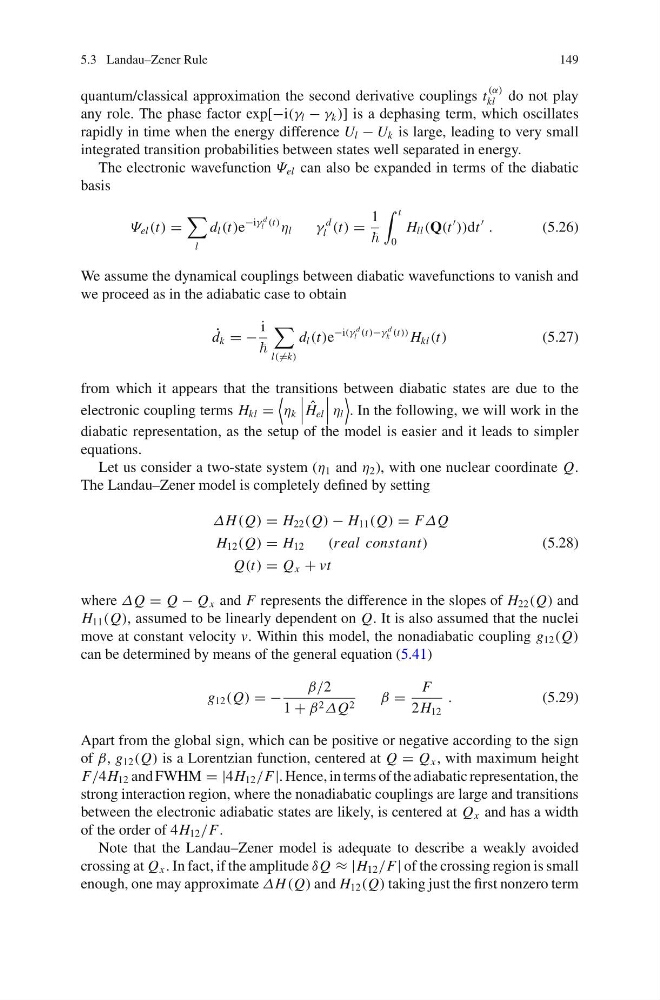
The electronic wavefunction Ψ el can also be expanded in terms of the diabatic
basis
Ψ el (t) =
l
d l (t)e
−iγ
d
l (t)
η l
γ
d
l (t) =
1
t
0
H ll (Q(t
))dt
.
(5.26)
We assume the dynamical couplings between diabatic wavefunctions to vanish and
we proceed as in the adiabatic case to obtain
˙
d k = −
i
l( =k)
d l (t)e
−i(γ
d
l (t)−γ
d
k (t)) H kl (t)
(5.27)
from which it appears that the transitions between diabatic states are due to the
electronic coupling terms H kl =
η k
ˆ
H el
η l
. In the following, we will work in the
diabatic representation, as the setup of the model is easier and it leads to simpler
equations.
Let us consider a two-state system (η 1 and η 2 ), with one nuclear coordinate Q.
The Landau–Zener model is completely defined by setting
ΔH (Q) = H 22 (Q) − H 11 (Q) = FΔQ
H 12 (Q) = H 12
(real constant)
Q(t) = Q x + vt
(5.28)
where ΔQ = Q − Q x and F represents the difference in the slopes of H 22 (Q) and
H 11 (Q), assumed to be linearly dependent on Q. It is also assumed that the nuclei
move at constant velocity v. Within this model, the nonadiabatic coupling g 12 (Q)
can be determined by means of the general equation (5.41)
g 12 (Q) = −
β/2
1 + β 2 ΔQ 2
β =
F
2H 12
.
(5.29)
Apart from the global sign, which can be positive or negative according to the sign
of β, g 12 (Q) is a Lorentzian function, centered at Q = Q x , with maximum height
F/4H 12 and FWHM = |4H 12 /F|. Hence, in terms of the adiabatic representation, the
strong interaction region, where the nonadiabatic couplings are large and transitions
between the electronic adiabatic states are likely, is centered at Q x and has a width
of the order of 4H 12 /F.
Note that the Landau–Zener model is adequate to describe a weakly avoided
crossing at Q x . In fact, if the amplitude δ Q ≈ |H 12 /F| of the crossing region is small
enough, one may approximate ΔH (Q) and H 12 (Q) taking just the first nonzero term
149
quantum/classical approximation the second derivative couplings t
(α)
kl do not play
any role. The phase factor exp[−i(γ l − γ k )] is a dephasing term, which oscillates
rapidly in time when the energy difference U l − U k is large, leading to very small
integrated transition probabilities between states well separated in energy.
The electronic wavefunction Ψ el can also be expanded in terms of the diabatic
basis
Ψ el (t) =
l
d l (t)e
−iγ
d
l (t)
η l
γ
d
l (t) =
1
t
0
H ll (Q(t
))dt
.
(5.26)
We assume the dynamical couplings between diabatic wavefunctions to vanish and
we proceed as in the adiabatic case to obtain
˙
d k = −
i
l( =k)
d l (t)e
−i(γ
d
l (t)−γ
d
k (t)) H kl (t)
(5.27)
from which it appears that the transitions between diabatic states are due to the
electronic coupling terms H kl =
η k
ˆ
H el
η l
. In the following, we will work in the
diabatic representation, as the setup of the model is easier and it leads to simpler
equations.
Let us consider a two-state system (η 1 and η 2 ), with one nuclear coordinate Q.
The Landau–Zener model is completely defined by setting
ΔH (Q) = H 22 (Q) − H 11 (Q) = FΔQ
H 12 (Q) = H 12
(real constant)
Q(t) = Q x + vt
(5.28)
where ΔQ = Q − Q x and F represents the difference in the slopes of H 22 (Q) and
H 11 (Q), assumed to be linearly dependent on Q. It is also assumed that the nuclei
move at constant velocity v. Within this model, the nonadiabatic coupling g 12 (Q)
can be determined by means of the general equation (5.41)
g 12 (Q) = −
β/2
1 + β 2 ΔQ 2
β =
F
2H 12
.
(5.29)
Apart from the global sign, which can be positive or negative according to the sign
of β, g 12 (Q) is a Lorentzian function, centered at Q = Q x , with maximum height
F/4H 12 and FWHM = |4H 12 /F|. Hence, in terms of the adiabatic representation, the
strong interaction region, where the nonadiabatic couplings are large and transitions
between the electronic adiabatic states are likely, is centered at Q x and has a width
of the order of 4H 12 /F.
Note that the Landau–Zener model is adequate to describe a weakly avoided
crossing at Q x . In fact, if the amplitude δ Q ≈ |H 12 /F| of the crossing region is small
enough, one may approximate ΔH (Q) and H 12 (Q) taking just the first nonzero term