

124
4 Wavepacket Dynamics and Geometrical Relaxation
Morse potentials
harmonic potentials
vertical excitation
χ e,40
χ e,24
χ g,0
internuclear distance R, bohr
energy, eV
12
10
8
6
4
2
6
5
4
3
2
1
0
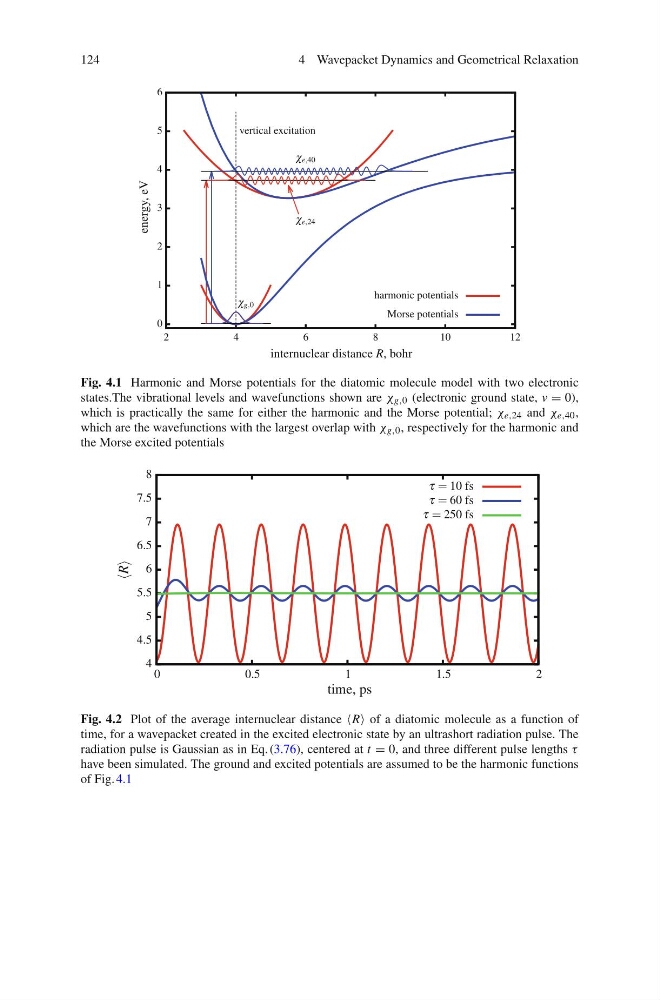
Fig. 4.1 Harmonic and Morse potentials for the diatomic molecule model with two electronic
states.The vibrational levels and wavefunctions shown are χ g,0 (electronic ground state, v = 0),
which is practically the same for either the harmonic and the Morse potential; χ e,24 and χ e,40 ,
which are the wavefunctions with the largest overlap with χ g,0 , respectively for the harmonic and
the Morse excited potentials
τ = 250 fs
τ = 60 fs
τ = 10 fs
time, ps
R
2
1.5
1
0.5
0
8
7.5
7
6.5
6
5.5
5
4.5
4
Fig. 4.2 Plot of the average internuclear distance R of a diatomic molecule as a function of
time, for a wavepacket created in the excited electronic state by an ultrashort radiation pulse. The
radiation pulse is Gaussian as in Eq. (3.76), centered at t = 0, and three different pulse lengths τ
have been simulated. The ground and excited potentials are assumed to be the harmonic functions
of Fig. 4.1
4 Wavepacket Dynamics and Geometrical Relaxation
Morse potentials
harmonic potentials
vertical excitation
χ e,40
χ e,24
χ g,0
internuclear distance R, bohr
energy, eV
12
10
8
6
4
2
6
5
4
3
2
1
0
Fig. 4.1 Harmonic and Morse potentials for the diatomic molecule model with two electronic
states.The vibrational levels and wavefunctions shown are χ g,0 (electronic ground state, v = 0),
which is practically the same for either the harmonic and the Morse potential; χ e,24 and χ e,40 ,
which are the wavefunctions with the largest overlap with χ g,0 , respectively for the harmonic and
the Morse excited potentials
τ = 250 fs
τ = 60 fs
τ = 10 fs
time, ps
R
2
1.5
1
0.5
0
8
7.5
7
6.5
6
5.5
5
4.5
4
Fig. 4.2 Plot of the average internuclear distance R of a diatomic molecule as a function of
time, for a wavepacket created in the excited electronic state by an ultrashort radiation pulse. The
radiation pulse is Gaussian as in Eq. (3.76), centered at t = 0, and three different pulse lengths τ
have been simulated. The ground and excited potentials are assumed to be the harmonic functions
of Fig. 4.1