

3.11 Excited State Decay to a Quasi-continuum
111
coupling
weak
coupling
weak
G| |B
large
G| |D
small
G| |D
small
|D
|B
|D
|G
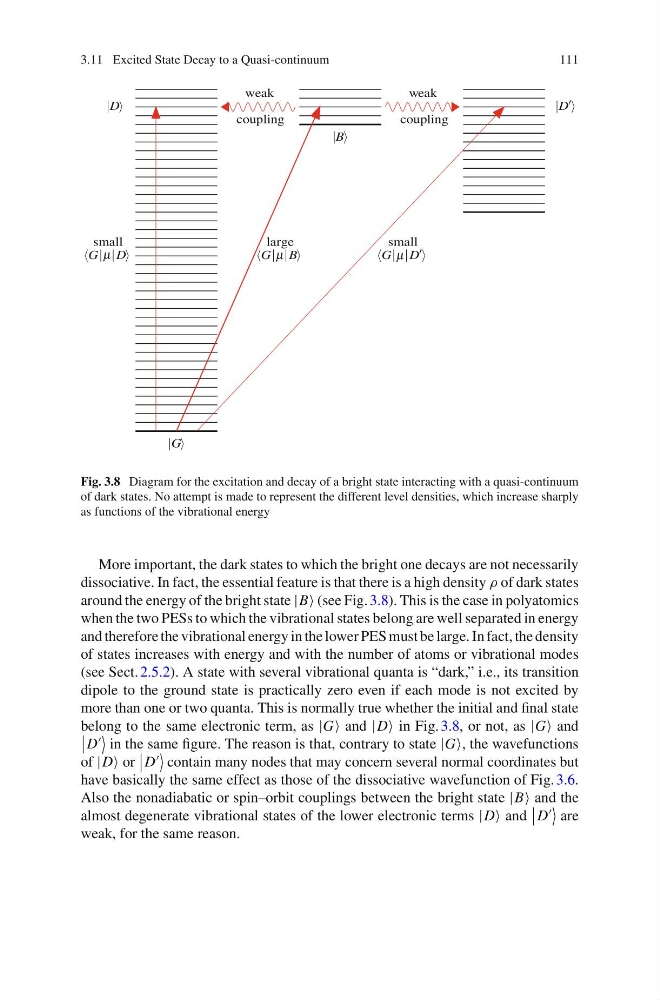
Fig. 3.8 Diagram for the excitation and decay of a bright state interacting with a quasi-continuum
of dark states. No attempt is made to represent the different level densities, which increase sharply
as functions of the vibrational energy
More important, the dark states to which the bright one decays are not necessarily
dissociative. In fact, the essential feature is that there is a high density ρ of dark states
around the energy of the bright state |B (see Fig. 3.8). This is the case in polyatomics
when the two PESs to which the vibrational states belong are well separated in energy
and therefore the vibrational energy in the lower PES must be large. In fact, the density
of states increases with energy and with the number of atoms or vibrational modes
(see Sect. 2.5.2). A state with several vibrational quanta is “dark,” i.e., its transition
dipole to the ground state is practically zero even if each mode is not excited by
more than one or two quanta. This is normally true whether the initial and final state
belong to the same electronic term, as |G and |D in Fig. 3.8, or not, as |G and
D
in the same figure. The reason is that, contrary to state |G, the wavefunctions
of |D or
D
contain many nodes that may concern several normal coordinates but
have basically the same effect as those of the dissociative wavefunction of Fig. 3.6.
Also the nonadiabatic or spin–orbit couplings between the bright state |B and the
almost degenerate vibrational states of the lower electronic terms |D and
D
are
weak, for the same reason.
111
coupling
weak
coupling
weak
G| |B
large
G| |D
small
G| |D
small
|D
|B
|D
|G
Fig. 3.8 Diagram for the excitation and decay of a bright state interacting with a quasi-continuum
of dark states. No attempt is made to represent the different level densities, which increase sharply
as functions of the vibrational energy
More important, the dark states to which the bright one decays are not necessarily
dissociative. In fact, the essential feature is that there is a high density ρ of dark states
around the energy of the bright state |B (see Fig. 3.8). This is the case in polyatomics
when the two PESs to which the vibrational states belong are well separated in energy
and therefore the vibrational energy in the lower PES must be large. In fact, the density
of states increases with energy and with the number of atoms or vibrational modes
(see Sect. 2.5.2). A state with several vibrational quanta is “dark,” i.e., its transition
dipole to the ground state is practically zero even if each mode is not excited by
more than one or two quanta. This is normally true whether the initial and final state
belong to the same electronic term, as |G and |D in Fig. 3.8, or not, as |G and
D
in the same figure. The reason is that, contrary to state |G, the wavefunctions
of |D or
D
contain many nodes that may concern several normal coordinates but
have basically the same effect as those of the dissociative wavefunction of Fig. 3.6.
Also the nonadiabatic or spin–orbit couplings between the bright state |B and the
almost degenerate vibrational states of the lower electronic terms |D and
D
are
weak, for the same reason.