

3.7 Vibrational Structure of Electronic Spectra
99
occurs for large molecules and in condensed phase. In all cases, the broadness of
the electronic band is an indication of how much the PESs differ. The only sub-band
the absorption and fluorescence spectra have in common normally corresponds to
the 0-0 transition between S 0 and S 1 , which can be easily identified if both spectra have been recorded. The frequency of this transition corresponds to the energy
difference between the minima of S 0 and S 1 (the “adiabatic” energy difference), in
the approximation of neglecting the change in the zero point energies between the
two PESs. As a last remark, we remind the basic asymmetry between absorption
and spontaneous emission: when using monochromatic light, the former occurs at a
well-defined frequency with little uncertainty, while the latter unavoidably produces
the whole spectrum.
3.8 Excitation by Radiation Pulses
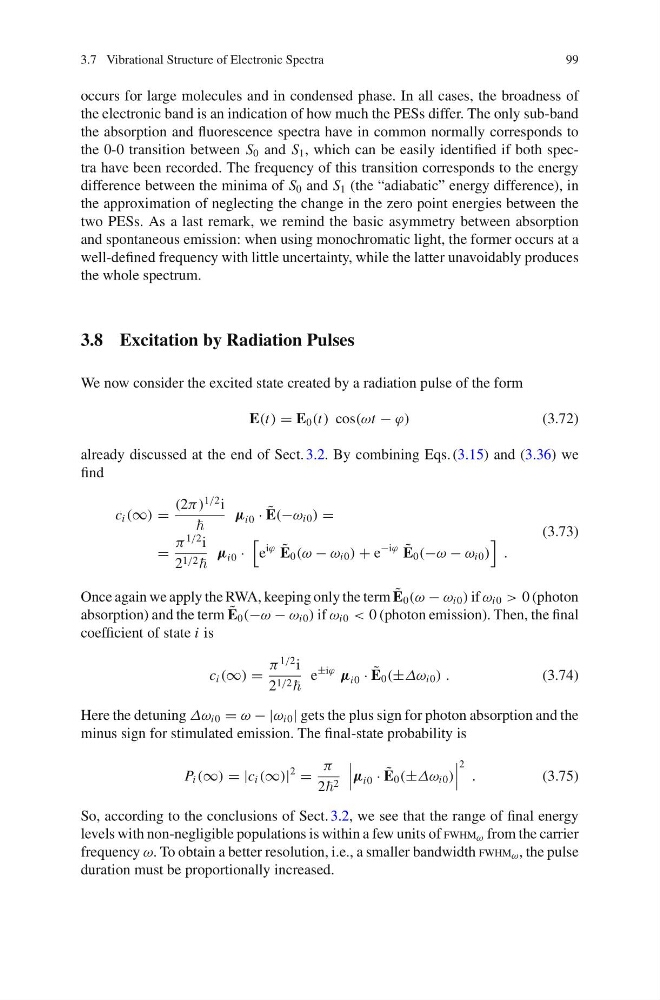
We now consider the excited state created by a radiation pulse of the form
E(t) = E 0 (t) cos(ωt − ϕ)
(3.72)
already discussed at the end of Sect. 3.2. By combining Eqs. (3.15) and (3.36) we
find
c i (∞) =
(2π)
1/2 i
µ i0 · ˜
E(−ω i0 ) =
=
π
1/2 i
2 1/2
µ i0 ·
e
iϕ ˜
E 0 (ω − ω i0 ) + e
−iϕ ˜
E 0 (−ω − ω i0 )
.
(3.73)
Once again we apply the RWA, keeping only the term ˜
E 0 (ω − ω i0 ) if ω i0 > 0 (photon
absorption) and the term ˜
E 0 (−ω − ω i0 ) if ω i0 < 0 (photon emission). Then, the final
coefficient of state i is
c i (∞) =
π
1/2 i
2 1/2
e
±iϕ
µ i0 · ˜
E 0 (±Δω i0 ) .
(3.74)
Here the detuning Δω i0 = ω − |ω i0 | gets the plus sign for photon absorption and the
minus sign for stimulated emission. The final-state probability is
P i (∞) = |c i (∞)|
2
=
π
2 2
µ i0 · ˜
E 0 (±Δω i0 )
2 .
(3.75)
So, according to the conclusions of Sect. 3.2, we see that the range of final energy
levels with non-negligible populations is within a few units of FWHM ω from the carrier
frequency ω. To obtain a better resolution, i.e., a smaller bandwidth FWHM ω , the pulse
duration must be proportionally increased.
99
occurs for large molecules and in condensed phase. In all cases, the broadness of
the electronic band is an indication of how much the PESs differ. The only sub-band
the absorption and fluorescence spectra have in common normally corresponds to
the 0-0 transition between S 0 and S 1 , which can be easily identified if both spectra have been recorded. The frequency of this transition corresponds to the energy
difference between the minima of S 0 and S 1 (the “adiabatic” energy difference), in
the approximation of neglecting the change in the zero point energies between the
two PESs. As a last remark, we remind the basic asymmetry between absorption
and spontaneous emission: when using monochromatic light, the former occurs at a
well-defined frequency with little uncertainty, while the latter unavoidably produces
the whole spectrum.
3.8 Excitation by Radiation Pulses
We now consider the excited state created by a radiation pulse of the form
E(t) = E 0 (t) cos(ωt − ϕ)
(3.72)
already discussed at the end of Sect. 3.2. By combining Eqs. (3.15) and (3.36) we
find
c i (∞) =
(2π)
1/2 i
µ i0 · ˜
E(−ω i0 ) =
=
π
1/2 i
2 1/2
µ i0 ·
e
iϕ ˜
E 0 (ω − ω i0 ) + e
−iϕ ˜
E 0 (−ω − ω i0 )
.
(3.73)
Once again we apply the RWA, keeping only the term ˜
E 0 (ω − ω i0 ) if ω i0 > 0 (photon
absorption) and the term ˜
E 0 (−ω − ω i0 ) if ω i0 < 0 (photon emission). Then, the final
coefficient of state i is
c i (∞) =
π
1/2 i
2 1/2
e
±iϕ
µ i0 · ˜
E 0 (±Δω i0 ) .
(3.74)
Here the detuning Δω i0 = ω − |ω i0 | gets the plus sign for photon absorption and the
minus sign for stimulated emission. The final-state probability is
P i (∞) = |c i (∞)|
2
=
π
2 2
µ i0 · ˜
E 0 (±Δω i0 )
2 .
(3.75)
So, according to the conclusions of Sect. 3.2, we see that the range of final energy
levels with non-negligible populations is within a few units of FWHM ω from the carrier
frequency ω. To obtain a better resolution, i.e., a smaller bandwidth FWHM ω , the pulse
duration must be proportionally increased.