

5.4 Dynamic Facility Layout
85
5.4.2 MISOCO Formulation
In this section we extend the MISOCO formulation for the UA-FLP presented in
Sect. 4.2 to its dynamic version. We consider the same variables as before but
duplicated for each period, and we add to the objective function terms for the
rearrangement costs. We also have to control the position and shape changes of
the departments.
We assume that we are given the following data:
• c t
ij is the unit flow cost from department i to department j in period t;
• C
t
i is the cost of changing department i at the beginning of period t;
• h min
i
and h max
i
are lower and upper bounds on the height of department i;
• w min
i
and w
max
i
are lower and upper bounds on the width of department i;
• w F , h F are the width and height of the facility;
• A i is the required area for department i;
• ρ i is the upper bound on the aspect ratio of department i.
The variables are as follows:
• (x t
i , y t
i ) are the coordinates of the centre of department i in period t;
• d x t
ij + d y t
ij gives the rectilinear distance between departments i and j in period
t;
• w t
i , h t
i are the width and height of department i in period t;
• α t
ij , β t
ij determine the relative positions between departments i and j in period
t, with the same interpretation as in Sect. 4.2;
• r t
i is equal to 1 if department i is changed at the beginning of period t, and 0
otherwise.
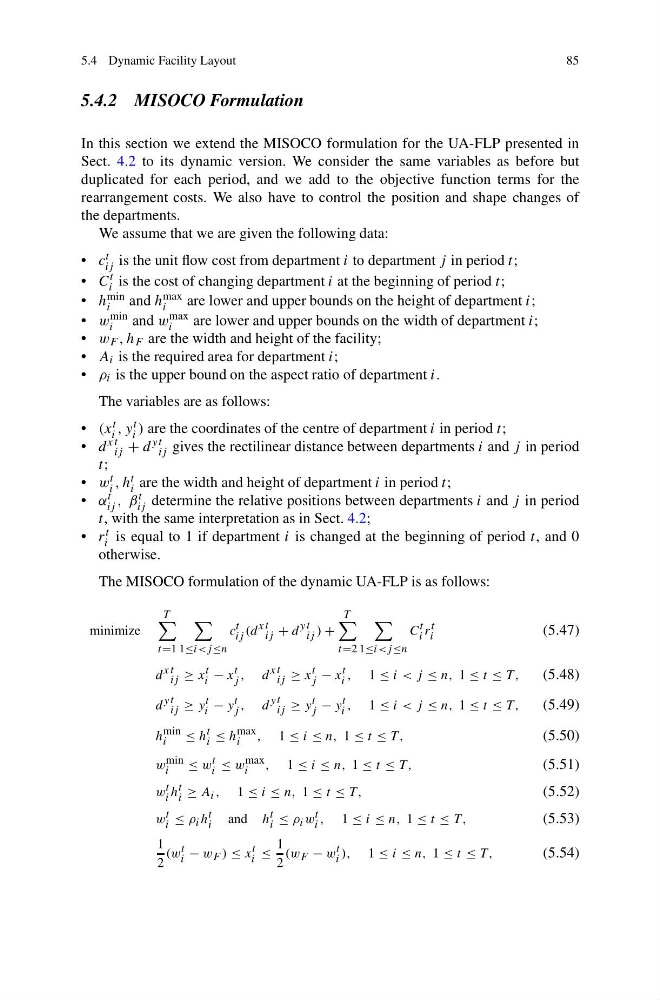
The MISOCO formulation of the dynamic UA-FLP is as follows:
minimize
T
t =1
1≤i
ij (d x t
ij + d y t
ij ) +
T
t =2
1≤i
i r t
i
(5.47)
d x t
ij ≥ x t
i − x t
j , d x t
ij ≥ x t
j − x t
i , 1 ≤ i < j ≤ n, 1 ≤ t ≤ T ,
(5.48)
d y t
ij ≥ y t
i − y t
j , d y t
ij ≥ y t
j − y t
i , 1 ≤ i < j ≤ n, 1 ≤ t ≤ T ,
(5.49)
h min
i
≤ h t
i ≤ h max
i , 1 ≤ i ≤ n, 1 ≤ t ≤ T ,
(5.50)
w min
i
≤ w t
i ≤ w max
i
, 1 ≤ i ≤ n, 1 ≤ t ≤ T ,
(5.51)
w t
i h t
i ≥ A i , 1 ≤ i ≤ n, 1 ≤ t ≤ T ,
(5.52)
w t
i ≤ ρ i h t
i and h t
i ≤ ρ i w t
i , 1 ≤ i ≤ n, 1 ≤ t ≤ T ,
(5.53)
1
2
(w t
i − w F ) ≤ x t
i ≤
1
2
(w F − w t
i ), 1 ≤ i ≤ n, 1 ≤ t ≤ T ,
(5.54)
85
5.4.2 MISOCO Formulation
In this section we extend the MISOCO formulation for the UA-FLP presented in
Sect. 4.2 to its dynamic version. We consider the same variables as before but
duplicated for each period, and we add to the objective function terms for the
rearrangement costs. We also have to control the position and shape changes of
the departments.
We assume that we are given the following data:
• c t
ij is the unit flow cost from department i to department j in period t;
• C
t
i is the cost of changing department i at the beginning of period t;
• h min
i
and h max
i
are lower and upper bounds on the height of department i;
• w min
i
and w
max
i
are lower and upper bounds on the width of department i;
• w F , h F are the width and height of the facility;
• A i is the required area for department i;
• ρ i is the upper bound on the aspect ratio of department i.
The variables are as follows:
• (x t
i , y t
i ) are the coordinates of the centre of department i in period t;
• d x t
ij + d y t
ij gives the rectilinear distance between departments i and j in period
t;
• w t
i , h t
i are the width and height of department i in period t;
• α t
ij , β t
ij determine the relative positions between departments i and j in period
t, with the same interpretation as in Sect. 4.2;
• r t
i is equal to 1 if department i is changed at the beginning of period t, and 0
otherwise.
The MISOCO formulation of the dynamic UA-FLP is as follows:
minimize
T
t =1
1≤i
ij (d x t
ij + d y t
ij ) +
T
t =2
1≤i
i r t
i
(5.47)
d x t
ij ≥ x t
i − x t
j , d x t
ij ≥ x t
j − x t
i , 1 ≤ i < j ≤ n, 1 ≤ t ≤ T ,
(5.48)
d y t
ij ≥ y t
i − y t
j , d y t
ij ≥ y t
j − y t
i , 1 ≤ i < j ≤ n, 1 ≤ t ≤ T ,
(5.49)
h min
i
≤ h t
i ≤ h max
i , 1 ≤ i ≤ n, 1 ≤ t ≤ T ,
(5.50)
w min
i
≤ w t
i ≤ w max
i
, 1 ≤ i ≤ n, 1 ≤ t ≤ T ,
(5.51)
w t
i h t
i ≥ A i , 1 ≤ i ≤ n, 1 ≤ t ≤ T ,
(5.52)
w t
i ≤ ρ i h t
i and h t
i ≤ ρ i w t
i , 1 ≤ i ≤ n, 1 ≤ t ≤ T ,
(5.53)
1
2
(w t
i − w F ) ≤ x t
i ≤
1
2
(w F − w t
i ), 1 ≤ i ≤ n, 1 ≤ t ≤ T ,
(5.54)