

84
5 Extensions and Related Problems
• replacement of production equipment;
• shorter product life cycles;
• changes in the production quantities and associated production schedules.
The dynamic facility layout problem (DFLP) considers the design of layouts over
several time periods, where demand volumes and product mix vary from one period
to another. In other words, the potential for future changes may motivate appropriate
planning, taking into account the expected changes in the costs and the additional
rearrangement costs.
The general idea of the formulations we present below is to extend previous models from the single-period to the multi-period case. In principle, every mathematical
optimization model presented in this book can be similarly extended to obtain its
dynamic version.
5.4.1 QAP Formulation
We start by extending the QAP model (5.2–5.5). All the data considered previously
is now assumed to be given for each period of a planning horizon of T periods. In
addition, we must account for the rearrangement costs, so we let C t
ilk denote the cost
of changing department i from location l to location k in time period t. The binary
variables are
x
t
ik =
1, if department i is assigned to location k at period t,
0, otherwise.
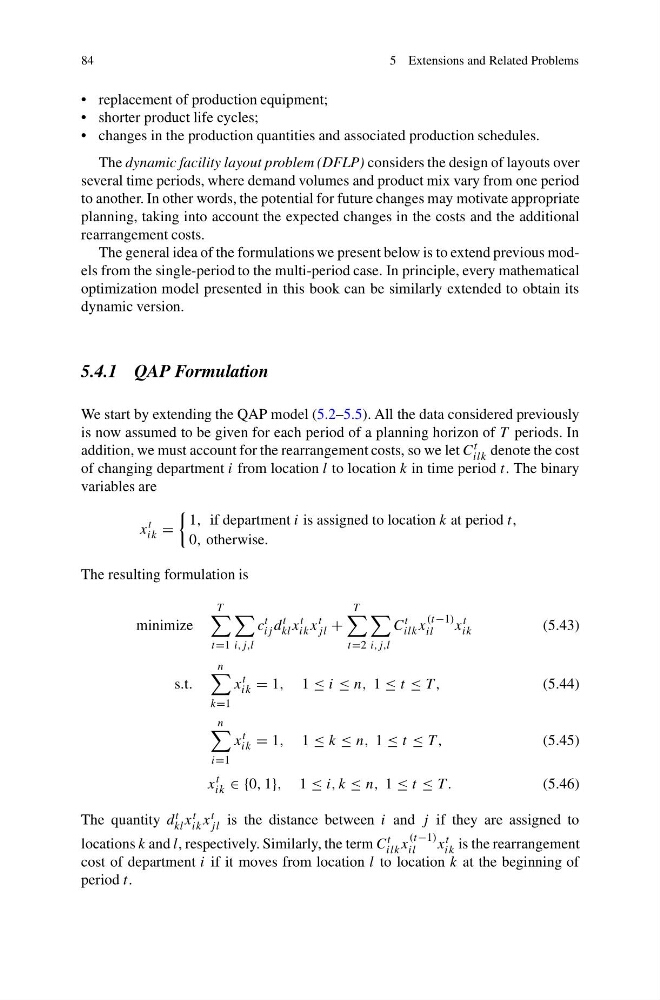
The resulting formulation is
minimize
T
t =1
i,j,l
c
t
ij d
t
kl x
t
ik x
t
jl +
T
t =2
i,j,l
C
t
ilk x
(t −1)
il
x
t
ik
(5.43)
s.t.
n
k=1
x
t
ik = 1, 1 ≤ i ≤ n, 1 ≤ t ≤ T ,
(5.44)
n
i=1
x
t
ik = 1, 1 ≤ k ≤ n, 1 ≤ t ≤ T ,
(5.45)
x
t
ik ∈ {0, 1}, 1 ≤ i, k ≤ n, 1 ≤ t ≤ T .
(5.46)
The quantity d t
kl x t
ik x t
jl is the distance between i and j if they are assigned to
locations k and l, respectively. Similarly, the term C t
ilk x
(t −1)
il
x t
ik is the rearrangement
cost of department i if it moves from location l to location k at the beginning of
period t.
5 Extensions and Related Problems
• replacement of production equipment;
• shorter product life cycles;
• changes in the production quantities and associated production schedules.
The dynamic facility layout problem (DFLP) considers the design of layouts over
several time periods, where demand volumes and product mix vary from one period
to another. In other words, the potential for future changes may motivate appropriate
planning, taking into account the expected changes in the costs and the additional
rearrangement costs.
The general idea of the formulations we present below is to extend previous models from the single-period to the multi-period case. In principle, every mathematical
optimization model presented in this book can be similarly extended to obtain its
dynamic version.
5.4.1 QAP Formulation
We start by extending the QAP model (5.2–5.5). All the data considered previously
is now assumed to be given for each period of a planning horizon of T periods. In
addition, we must account for the rearrangement costs, so we let C t
ilk denote the cost
of changing department i from location l to location k in time period t. The binary
variables are
x
t
ik =
1, if department i is assigned to location k at period t,
0, otherwise.
The resulting formulation is
minimize
T
t =1
i,j,l
c
t
ij d
t
kl x
t
ik x
t
jl +
T
t =2
i,j,l
C
t
ilk x
(t −1)
il
x
t
ik
(5.43)
s.t.
n
k=1
x
t
ik = 1, 1 ≤ i ≤ n, 1 ≤ t ≤ T ,
(5.44)
n
i=1
x
t
ik = 1, 1 ≤ k ≤ n, 1 ≤ t ≤ T ,
(5.45)
x
t
ik ∈ {0, 1}, 1 ≤ i, k ≤ n, 1 ≤ t ≤ T .
(5.46)
The quantity d t
kl x t
ik x t
jl is the distance between i and j if they are assigned to
locations k and l, respectively. Similarly, the term C t
ilk x
(t −1)
il
x t
ik is the rearrangement
cost of department i if it moves from location l to location k at the beginning of
period t.