

74
2 The Quantum Approach to the Two-Body Problem
which satisfy the boundary equations. The system of N equations that results can be
written as
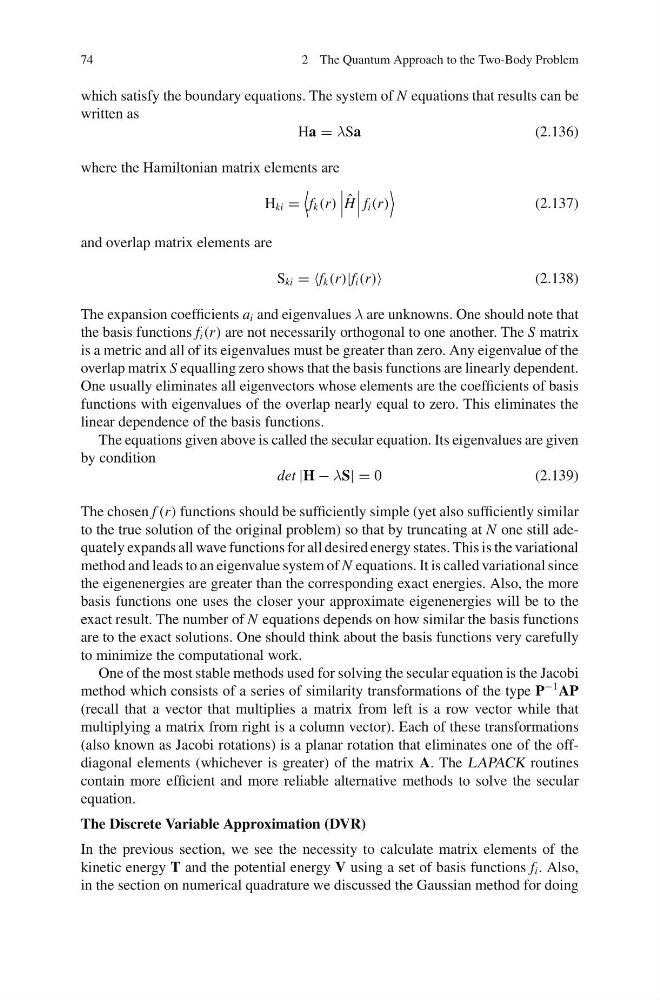
Ha = λSa
(2.136)
where the Hamiltonian matrix elements are
H ki =
f k (r)
ˆ
H
f i (r)
(2.137)
and overlap matrix elements are
S ki = f k (r)|f i (r)
(2.138)
The expansion coefficients a i and eigenvalues λ are unknowns. One should note that
the basis functions f i (r) are not necessarily orthogonal to one another. The S matrix
is a metric and all of its eigenvalues must be greater than zero. Any eigenvalue of the
overlap matrix S equalling zero shows that the basis functions are linearly dependent.
One usually eliminates all eigenvectors whose elements are the coefficients of basis
functions with eigenvalues of the overlap nearly equal to zero. This eliminates the
linear dependence of the basis functions.
The equations given above is called the secular equation. Its eigenvalues are given
by condition
det |H − λS| = 0
(2.139)
The chosen f (r) functions should be sufficiently simple (yet also sufficiently similar
to the true solution of the original problem) so that by truncating at N one still adequately expands all wave functions for all desired energy states. This is the variational
method and leads to an eigenvalue system of N equations. It is called variational since
the eigenenergies are greater than the corresponding exact energies. Also, the more
basis functions one uses the closer your approximate eigenenergies will be to the
exact result. The number of N equations depends on how similar the basis functions
are to the exact solutions. One should think about the basis functions very carefully
to minimize the computational work.
One of the most stable methods used for solving the secular equation is the Jacobi
method which consists of a series of similarity transformations of the type P
−1 AP
(recall that a vector that multiplies a matrix from left is a row vector while that
multiplying a matrix from right is a column vector). Each of these transformations
(also known as Jacobi rotations) is a planar rotation that eliminates one of the offdiagonal elements (whichever is greater) of the matrix A. The LAPACK routines
contain more efficient and more reliable alternative methods to solve the secular
equation.
The Discrete Variable Approximation (DVR)
In the previous section, we see the necessity to calculate matrix elements of the
kinetic energy T and the potential energy V using a set of basis functions f i . Also,
in the section on numerical quadrature we discussed the Gaussian method for doing
2 The Quantum Approach to the Two-Body Problem
which satisfy the boundary equations. The system of N equations that results can be
written as
Ha = λSa
(2.136)
where the Hamiltonian matrix elements are
H ki =
f k (r)
ˆ
H
f i (r)
(2.137)
and overlap matrix elements are
S ki = f k (r)|f i (r)
(2.138)
The expansion coefficients a i and eigenvalues λ are unknowns. One should note that
the basis functions f i (r) are not necessarily orthogonal to one another. The S matrix
is a metric and all of its eigenvalues must be greater than zero. Any eigenvalue of the
overlap matrix S equalling zero shows that the basis functions are linearly dependent.
One usually eliminates all eigenvectors whose elements are the coefficients of basis
functions with eigenvalues of the overlap nearly equal to zero. This eliminates the
linear dependence of the basis functions.
The equations given above is called the secular equation. Its eigenvalues are given
by condition
det |H − λS| = 0
(2.139)
The chosen f (r) functions should be sufficiently simple (yet also sufficiently similar
to the true solution of the original problem) so that by truncating at N one still adequately expands all wave functions for all desired energy states. This is the variational
method and leads to an eigenvalue system of N equations. It is called variational since
the eigenenergies are greater than the corresponding exact energies. Also, the more
basis functions one uses the closer your approximate eigenenergies will be to the
exact result. The number of N equations depends on how similar the basis functions
are to the exact solutions. One should think about the basis functions very carefully
to minimize the computational work.
One of the most stable methods used for solving the secular equation is the Jacobi
method which consists of a series of similarity transformations of the type P
−1 AP
(recall that a vector that multiplies a matrix from left is a row vector while that
multiplying a matrix from right is a column vector). Each of these transformations
(also known as Jacobi rotations) is a planar rotation that eliminates one of the offdiagonal elements (whichever is greater) of the matrix A. The LAPACK routines
contain more efficient and more reliable alternative methods to solve the secular
equation.
The Discrete Variable Approximation (DVR)
In the previous section, we see the necessity to calculate matrix elements of the
kinetic energy T and the potential energy V using a set of basis functions f i . Also,
in the section on numerical quadrature we discussed the Gaussian method for doing