

72
2 The Quantum Approach to the Two-Body Problem
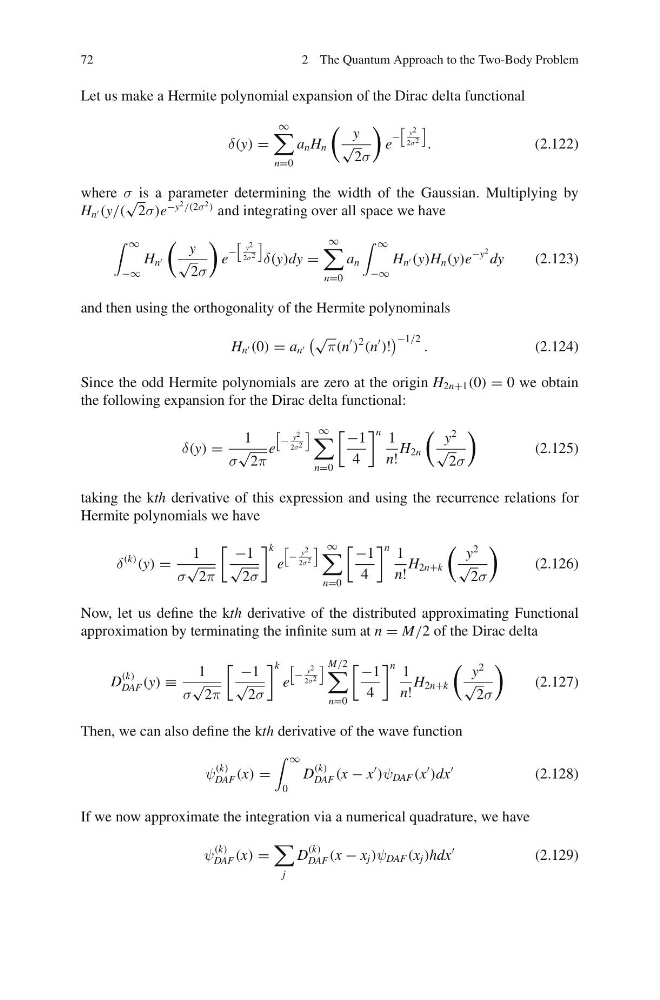
Let us make a Hermite polynomial expansion of the Dirac delta functional
δ(y) =
∞
n=0
a n H n
y
√
2σ
e
−
y 2
2σ 2
.
(2.122)
where σ is a parameter determining the width of the Gaussian. Multiplying by
H n (y/(
√
2σ)e
−y
2 /(2σ
2 ) and integrating over all space we have
∞
−∞
H n
y
√
2σ
e
−
y 2
2σ 2
δ(y)dy =
∞
n=0
a n
∞
−∞
H n (y)H n (y)e
−y
2 dy
(2.123)
and then using the orthogonality of the Hermite polynominals
H n (0) = a n
√
π(n
)
2
(n
)!
−1/2 .
(2.124)
Since the odd Hermite polynomials are zero at the origin H 2n+1 (0) = 0 we obtain
the following expansion for the Dirac delta functional:
δ(y) =
1
σ
√
2π
e
−
y 2
2σ 2
∞
n=0
−1
4
n 1
n!
H 2n
y
2
√
2σ
(2.125)
taking the kth derivative of this expression and using the recurrence relations for
Hermite polynomials we have
δ
(k)
(y) =
1
σ
√
2π
−1
√
2σ
k
e
−
y 2
2σ 2
∞
n=0
−1
4
n 1
n!
H 2n+k
y
2
√
2σ
(2.126)
Now, let us define the kth derivative of the distributed approximating Functional
approximation by terminating the infinite sum at n = M/2 of the Dirac delta
D
(k)
DAF (y) ≡
1
σ
√
2π
−1
√
2σ
k
e
−
y 2
2σ 2
M/2
n=0
−1
4
n 1
n!
H 2n+k
y
2
√
2σ
(2.127)
Then, we can also define the kth derivative of the wave function
ψ
(k)
DAF (x) =
∞
0
D
(k)
DAF (x − x
)ψ DAF (x
)dx
(2.128)
If we now approximate the integration via a numerical quadrature, we have
ψ
(k)
DAF (x) =
j
D
(k)
DAF (x − x j )ψ DAF (x j )hdx
(2.129)
2 The Quantum Approach to the Two-Body Problem
Let us make a Hermite polynomial expansion of the Dirac delta functional
δ(y) =
∞
n=0
a n H n
y
√
2σ
e
−
y 2
2σ 2
.
(2.122)
where σ is a parameter determining the width of the Gaussian. Multiplying by
H n (y/(
√
2σ)e
−y
2 /(2σ
2 ) and integrating over all space we have
∞
−∞
H n
y
√
2σ
e
−
y 2
2σ 2
δ(y)dy =
∞
n=0
a n
∞
−∞
H n (y)H n (y)e
−y
2 dy
(2.123)
and then using the orthogonality of the Hermite polynominals
H n (0) = a n
√
π(n
)
2
(n
)!
−1/2 .
(2.124)
Since the odd Hermite polynomials are zero at the origin H 2n+1 (0) = 0 we obtain
the following expansion for the Dirac delta functional:
δ(y) =
1
σ
√
2π
e
−
y 2
2σ 2
∞
n=0
−1
4
n 1
n!
H 2n
y
2
√
2σ
(2.125)
taking the kth derivative of this expression and using the recurrence relations for
Hermite polynomials we have
δ
(k)
(y) =
1
σ
√
2π
−1
√
2σ
k
e
−
y 2
2σ 2
∞
n=0
−1
4
n 1
n!
H 2n+k
y
2
√
2σ
(2.126)
Now, let us define the kth derivative of the distributed approximating Functional
approximation by terminating the infinite sum at n = M/2 of the Dirac delta
D
(k)
DAF (y) ≡
1
σ
√
2π
−1
√
2σ
k
e
−
y 2
2σ 2
M/2
n=0
−1
4
n 1
n!
H 2n+k
y
2
√
2σ
(2.127)
Then, we can also define the kth derivative of the wave function
ψ
(k)
DAF (x) =
∞
0
D
(k)
DAF (x − x
)ψ DAF (x
)dx
(2.128)
If we now approximate the integration via a numerical quadrature, we have
ψ
(k)
DAF (x) =
j
D
(k)
DAF (x − x j )ψ DAF (x j )hdx
(2.129)