

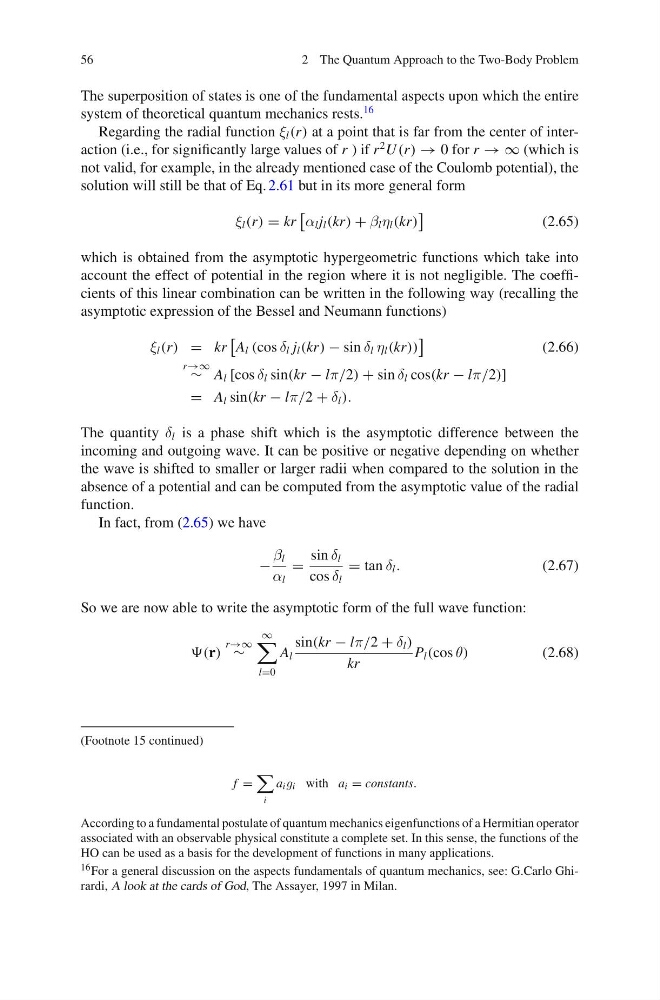
56
2 The Quantum Approach to the Two-Body Problem
The superposition of states is one of the fundamental aspects upon which the entire
system of theoretical quantum mechanics rests.
16
Regarding the radial function ξ l (r) at a point that is far from the center of interaction (i.e., for significantly large values of r ) if r
2 U (r) → 0 for r → ∞ (which is
not valid, for example, in the already mentioned case of the Coulomb potential), the
solution will still be that of Eq. 2.61 but in its more general form
ξ l (r) = kr
α l j l (kr) + β l η l (kr)
(2.65)
which is obtained from the asymptotic hypergeometric functions which take into
account the effect of potential in the region where it is not negligible. The coefficients of this linear combination can be written in the following way (recalling the
asymptotic expression of the Bessel and Neumann functions)
ξ l (r) = kr
A l (cos δ l j l (kr) − sin δ l η l (kr))
(2.66)
r→∞
∼ A l [cos δ l sin(kr − lπ/2) + sin δ l cos(kr − lπ/2)]
= A l sin(kr − lπ/2 + δ l ).
The quantity δ l is a phase shift which is the asymptotic difference between the
incoming and outgoing wave. It can be positive or negative depending on whether
the wave is shifted to smaller or larger radii when compared to the solution in the
absence of a potential and can be computed from the asymptotic value of the radial
function.
In fact, from (2.65) we have
−
β l
α l
=
sin δ l
cos δ l
= tan δ l .
(2.67)
So we are now able to write the asymptotic form of the full wave function:
(r)
r→∞
∼
∞
l=0
A l
sin(kr − lπ/2 + δ l )
kr
P l (cos θ)
(2.68)
(Footnote 15 continued)
f =
i
a i g i with a i = constants.
According to a fundamental postulate of quantum mechanics eigenfunctions of a Hermitian operator
associated with an observable physical constitute a complete set. In this sense, the functions of the
HO can be used as a basis for the development of functions in many applications.
16 For a general discussion on the aspects fundamentals of quantum mechanics, see: G.Carlo Ghirardi, A look at the cards of God, The Assayer, 1997 in Milan.
2 The Quantum Approach to the Two-Body Problem
The superposition of states is one of the fundamental aspects upon which the entire
system of theoretical quantum mechanics rests.
16
Regarding the radial function ξ l (r) at a point that is far from the center of interaction (i.e., for significantly large values of r ) if r
2 U (r) → 0 for r → ∞ (which is
not valid, for example, in the already mentioned case of the Coulomb potential), the
solution will still be that of Eq. 2.61 but in its more general form
ξ l (r) = kr
α l j l (kr) + β l η l (kr)
(2.65)
which is obtained from the asymptotic hypergeometric functions which take into
account the effect of potential in the region where it is not negligible. The coefficients of this linear combination can be written in the following way (recalling the
asymptotic expression of the Bessel and Neumann functions)
ξ l (r) = kr
A l (cos δ l j l (kr) − sin δ l η l (kr))
(2.66)
r→∞
∼ A l [cos δ l sin(kr − lπ/2) + sin δ l cos(kr − lπ/2)]
= A l sin(kr − lπ/2 + δ l ).
The quantity δ l is a phase shift which is the asymptotic difference between the
incoming and outgoing wave. It can be positive or negative depending on whether
the wave is shifted to smaller or larger radii when compared to the solution in the
absence of a potential and can be computed from the asymptotic value of the radial
function.
In fact, from (2.65) we have
−
β l
α l
=
sin δ l
cos δ l
= tan δ l .
(2.67)
So we are now able to write the asymptotic form of the full wave function:
(r)
r→∞
∼
∞
l=0
A l
sin(kr − lπ/2 + δ l )
kr
P l (cos θ)
(2.68)
(Footnote 15 continued)
f =
i
a i g i with a i = constants.
According to a fundamental postulate of quantum mechanics eigenfunctions of a Hermitian operator
associated with an observable physical constitute a complete set. In this sense, the functions of the
HO can be used as a basis for the development of functions in many applications.
16 For a general discussion on the aspects fundamentals of quantum mechanics, see: G.Carlo Ghirardi, A look at the cards of God, The Assayer, 1997 in Milan.