

36
1 From the Phenomenology of Chemical Reactions …
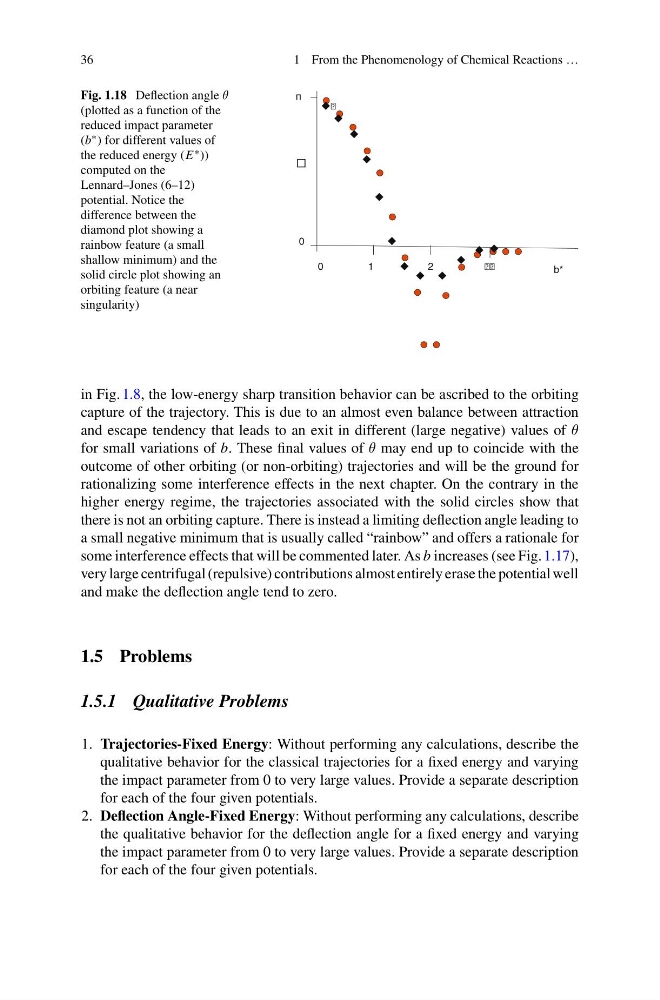
Fig. 1.18 Deflection angle θ
(plotted as a function of the
reduced impact parameter
(b ∗ ) for different values of
the reduced energy (E ∗ ))
computed on the
Lennard–Jones (6–12)
potential. Notice the
difference between the
diamond plot showing a
rainbow feature (a small
shallow minimum) and the
solid circle plot showing an
orbiting feature (a near
singularity)
b*
0
0
1
2
in Fig. 1.8, the low-energy sharp transition behavior can be ascribed to the orbiting
capture of the trajectory. This is due to an almost even balance between attraction
and escape tendency that leads to an exit in different (large negative) values of θ
for small variations of b. These final values of θ may end up to coincide with the
outcome of other orbiting (or non-orbiting) trajectories and will be the ground for
rationalizing some interference effects in the next chapter. On the contrary in the
higher energy regime, the trajectories associated with the solid circles show that
there is not an orbiting capture. There is instead a limiting deflection angle leading to
a small negative minimum that is usually called “rainbow” and offers a rationale for
some interference effects that will be commented later. As b increases (see Fig. 1.17),
very large centrifugal (repulsive) contributions almost entirely erase the potential well
and make the deflection angle tend to zero.
1.5 Problems
1.5.1 Qualitative Problems
1. Trajectories-Fixed Energy: Without performing any calculations, describe the
qualitative behavior for the classical trajectories for a fixed energy and varying
the impact parameter from 0 to very large values. Provide a separate description
for each of the four given potentials.
2. Deflection Angle-Fixed Energy: Without performing any calculations, describe
the qualitative behavior for the deflection angle for a fixed energy and varying
the impact parameter from 0 to very large values. Provide a separate description
for each of the four given potentials.
1 From the Phenomenology of Chemical Reactions …
Fig. 1.18 Deflection angle θ
(plotted as a function of the
reduced impact parameter
(b ∗ ) for different values of
the reduced energy (E ∗ ))
computed on the
Lennard–Jones (6–12)
potential. Notice the
difference between the
diamond plot showing a
rainbow feature (a small
shallow minimum) and the
solid circle plot showing an
orbiting feature (a near
singularity)
b*
0
0
1
2
in Fig. 1.8, the low-energy sharp transition behavior can be ascribed to the orbiting
capture of the trajectory. This is due to an almost even balance between attraction
and escape tendency that leads to an exit in different (large negative) values of θ
for small variations of b. These final values of θ may end up to coincide with the
outcome of other orbiting (or non-orbiting) trajectories and will be the ground for
rationalizing some interference effects in the next chapter. On the contrary in the
higher energy regime, the trajectories associated with the solid circles show that
there is not an orbiting capture. There is instead a limiting deflection angle leading to
a small negative minimum that is usually called “rainbow” and offers a rationale for
some interference effects that will be commented later. As b increases (see Fig. 1.17),
very large centrifugal (repulsive) contributions almost entirely erase the potential well
and make the deflection angle tend to zero.
1.5 Problems
1.5.1 Qualitative Problems
1. Trajectories-Fixed Energy: Without performing any calculations, describe the
qualitative behavior for the classical trajectories for a fixed energy and varying
the impact parameter from 0 to very large values. Provide a separate description
for each of the four given potentials.
2. Deflection Angle-Fixed Energy: Without performing any calculations, describe
the qualitative behavior for the deflection angle for a fixed energy and varying
the impact parameter from 0 to very large values. Provide a separate description
for each of the four given potentials.