

30
1 From the Phenomenology of Chemical Reactions …
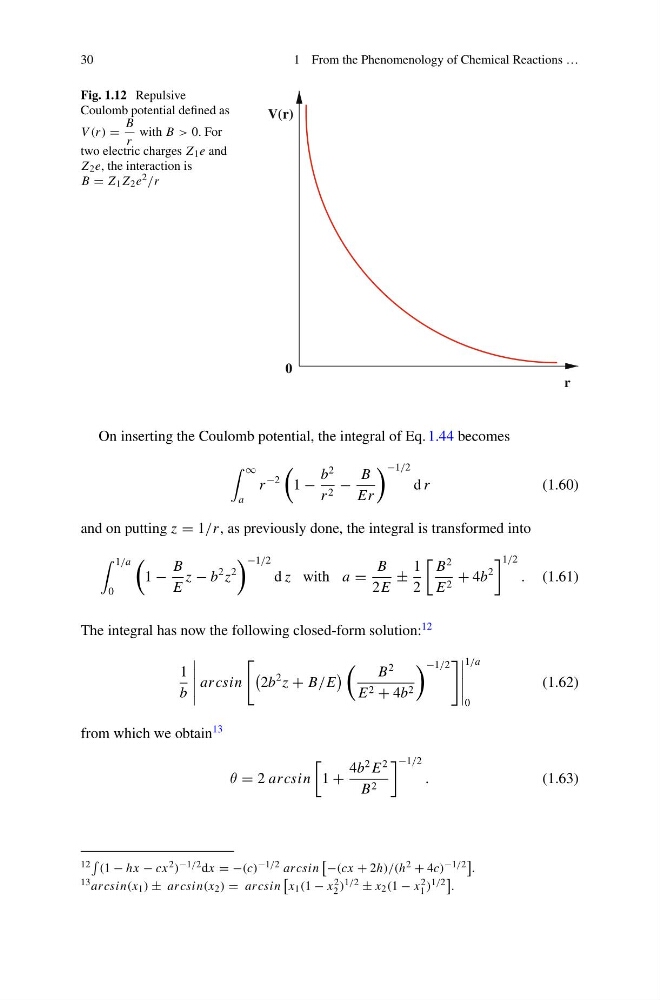
Fig. 1.12 Repulsive
Coulomb potential defined as
V (r ) =
B
r
with B > 0. For
two electric charges Z 1 e and
Z 2 e, the interaction is
B = Z 1 Z 2 e 2 /r
V(r)
r
0
On inserting the Coulomb potential, the integral of Eq. 1.44 becomes
∞
a
r
−2
1 −
b
2
r 2 −
B
Er
−1/2
d r
(1.60)
and on putting z = 1/r , as previously done, the integral is transformed into
1/a
0
1 −
B
E
z − b
2 z
2
−1/2
d z with a =
B
2E
±
1
2
B
2
E 2 + 4b
2
1/2
. (1.61)
The integral has now the following closed-form solution:
12
1
b
arcsin
2b
2 z + B/E
B
2
E 2 + 4b 2
−1/2
1/a
0
(1.62)
from which we obtain
13
θ = 2 arcsin
1 +
4b
2 E
2
B 2
−1/2
.
(1.63)
12
(1 − hx − cx 2 ) −1/2 dx = −(c) −1/2 arcsin
−(cx + 2h)/(h 2 + 4c) −1/2
.
13 arcsin(x 1 ) ± arcsin(x 2 ) = arcsin
x 1 (1 − x 2
2 ) 1/2 ± x 2 (1 − x 2
1 ) 1/2
.
1 From the Phenomenology of Chemical Reactions …
Fig. 1.12 Repulsive
Coulomb potential defined as
V (r ) =
B
r
with B > 0. For
two electric charges Z 1 e and
Z 2 e, the interaction is
B = Z 1 Z 2 e 2 /r
V(r)
r
0
On inserting the Coulomb potential, the integral of Eq. 1.44 becomes
∞
a
r
−2
1 −
b
2
r 2 −
B
Er
−1/2
d r
(1.60)
and on putting z = 1/r , as previously done, the integral is transformed into
1/a
0
1 −
B
E
z − b
2 z
2
−1/2
d z with a =
B
2E
±
1
2
B
2
E 2 + 4b
2
1/2
. (1.61)
The integral has now the following closed-form solution:
12
1
b
arcsin
2b
2 z + B/E
B
2
E 2 + 4b 2
−1/2
1/a
0
(1.62)
from which we obtain
13
θ = 2 arcsin
1 +
4b
2 E
2
B 2
−1/2
.
(1.63)
12
(1 − hx − cx 2 ) −1/2 dx = −(c) −1/2 arcsin
−(cx + 2h)/(h 2 + 4c) −1/2
.
13 arcsin(x 1 ) ± arcsin(x 2 ) = arcsin
x 1 (1 − x 2
2 ) 1/2 ± x 2 (1 − x 2
1 ) 1/2
.