

16
1 From the Phenomenology of Chemical Reactions …
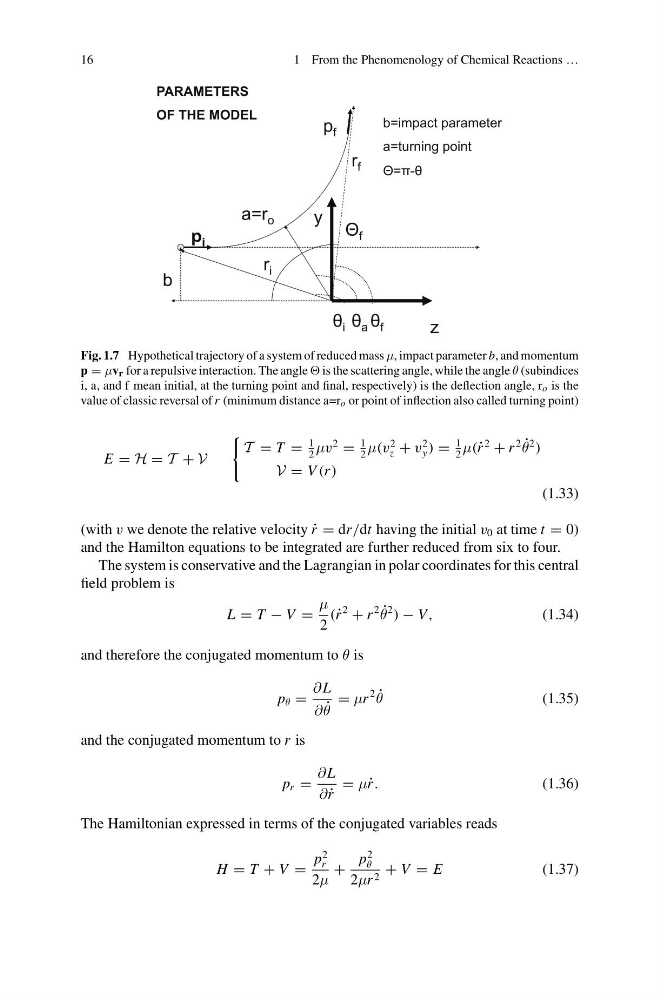
Fig. 1.7 Hypothetical trajectory of a system of reduced mass μ, impact parameter b, and momentum
p = μv r for a repulsive interaction. The angle is the scattering angle, while the angle θ (subindices
i, a, and f mean initial, at the turning point and final, respectively) is the deflection angle, r o is the
value of classic reversal of r (minimum distance a=r o or point of inflection also called turning point)
E = H = T + V
T = T =
1
2
μv
2
=
1
2
μ(v
2
z + v
2
y ) =
1
2
μ(˙ r
2
+ r
2 ˙
θ
2
)
V = V (r )
(1.33)
(with v we denote the relative velocity ˙
r = dr/dt having the initial v 0 at time t = 0)
and the Hamilton equations to be integrated are further reduced from six to four.
The system is conservative and the Lagrangian in polar coordinates for this central
field problem is
L = T − V =
μ
2
(˙ r
2
+ r
2 ˙
θ
2
) − V,
(1.34)
and therefore the conjugated momentum to θ is
p θ =
∂ L
∂ ˙
θ
= μr
2 ˙
θ
(1.35)
and the conjugated momentum to r is
p r =
∂ L
∂ ˙
r
= μ˙ r .
(1.36)
The Hamiltonian expressed in terms of the conjugated variables reads
H = T + V =
p
2
r
2μ
+
p
2
θ
2μr 2 + V = E
(1.37)
1 From the Phenomenology of Chemical Reactions …
Fig. 1.7 Hypothetical trajectory of a system of reduced mass μ, impact parameter b, and momentum
p = μv r for a repulsive interaction. The angle is the scattering angle, while the angle θ (subindices
i, a, and f mean initial, at the turning point and final, respectively) is the deflection angle, r o is the
value of classic reversal of r (minimum distance a=r o or point of inflection also called turning point)
E = H = T + V
T = T =
1
2
μv
2
=
1
2
μ(v
2
z + v
2
y ) =
1
2
μ(˙ r
2
+ r
2 ˙
θ
2
)
V = V (r )
(1.33)
(with v we denote the relative velocity ˙
r = dr/dt having the initial v 0 at time t = 0)
and the Hamilton equations to be integrated are further reduced from six to four.
The system is conservative and the Lagrangian in polar coordinates for this central
field problem is
L = T − V =
μ
2
(˙ r
2
+ r
2 ˙
θ
2
) − V,
(1.34)
and therefore the conjugated momentum to θ is
p θ =
∂ L
∂ ˙
θ
= μr
2 ˙
θ
(1.35)
and the conjugated momentum to r is
p r =
∂ L
∂ ˙
r
= μ˙ r .
(1.36)
The Hamiltonian expressed in terms of the conjugated variables reads
H = T + V =
p
2
r
2μ
+
p
2
θ
2μr 2 + V = E
(1.37)