

Appendix
199
1
r 2
d
dr
r
2 d
dr
=
d
2
dr 2 +
2
r
d
dr
=
1
r
d
2
dr 2 r
(A.10)
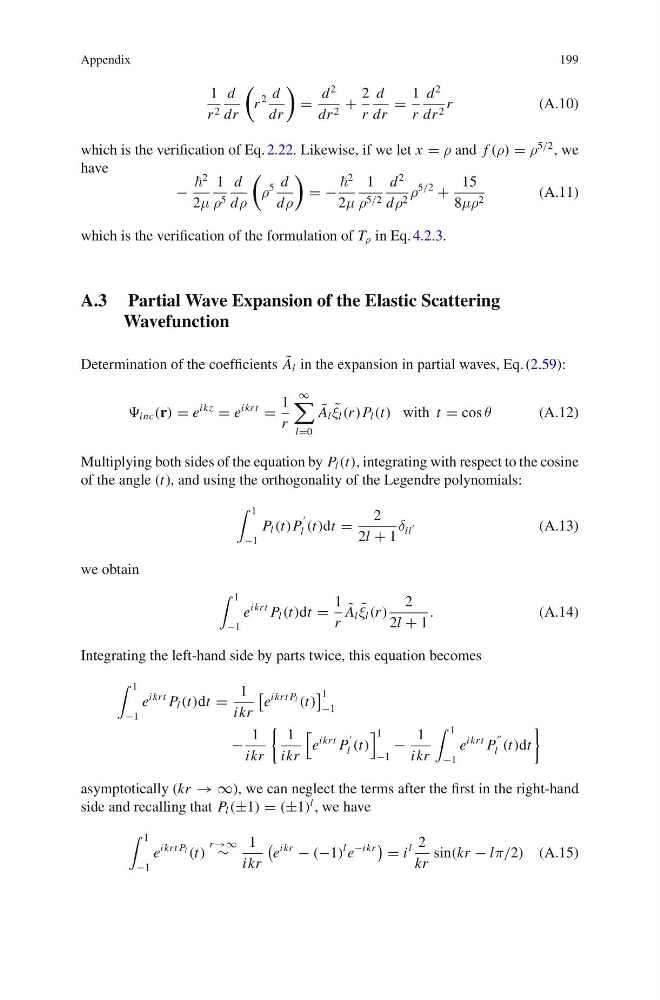
which is the verification of Eq. 2.22. Likewise, if we let x = ρ and f (ρ) = ρ
5/2 , we
have
−
2
2μ
1
ρ 5
d
dρ
ρ
5 d
dρ
= −
2
2μ
1
ρ 5/2
d
2
dρ 2 ρ
5/2
+
15
8μρ 2
(A.11)
which is the verification of the formulation of T ρ in Eq. 4.2.3.
A.3 Partial Wave Expansion of the Elastic Scattering
Wavefunction
Determination of the coefficients ˜
A l in the expansion in partial waves, Eq. (2.59):
inc (r) = e
ikz
= e
ikrt
=
1
r
∞
l=0
˜
A l ˜
ξ l (r )P l (t) with t = cos θ
(A.12)
Multiplying both sides of the equation by P l (t), integrating with respect to the cosine
of the angle (t), and using the orthogonality of the Legendre polynomials:
1
−1
P l (t)P
l (t)dt =
2
2l + 1
δ ll
(A.13)
we obtain
1
−1
e
ikrt P l (t)dt =
1
r
˜
A l ˜
ξ l (r )
2
2l + 1
.
(A.14)
Integrating the left-hand side by parts twice, this equation becomes
1
−1
e
ikrt P l (t)dt =
1
ikr
e
ikrt P l (t)
1
−1
−
1
ikr
1
ikr
e
ikrt P
l (t)
1
−1
−
1
ikr
1
−1
e
ikrt P
l (t)dt
asymptotically (kr → ∞), we can neglect the terms after the first in the right-hand
side and recalling that P l (±1) = (±1)
l , we have
1
−1
e
ikrt P l (t)
r →∞
∼
1
ikr
e
ikr
− (−1)
l e
−ikr
= i
l 2
kr
sin(kr − lπ/2) (A.15)
199
1
r 2
d
dr
r
2 d
dr
=
d
2
dr 2 +
2
r
d
dr
=
1
r
d
2
dr 2 r
(A.10)
which is the verification of Eq. 2.22. Likewise, if we let x = ρ and f (ρ) = ρ
5/2 , we
have
−
2
2μ
1
ρ 5
d
dρ
ρ
5 d
dρ
= −
2
2μ
1
ρ 5/2
d
2
dρ 2 ρ
5/2
+
15
8μρ 2
(A.11)
which is the verification of the formulation of T ρ in Eq. 4.2.3.
A.3 Partial Wave Expansion of the Elastic Scattering
Wavefunction
Determination of the coefficients ˜
A l in the expansion in partial waves, Eq. (2.59):
inc (r) = e
ikz
= e
ikrt
=
1
r
∞
l=0
˜
A l ˜
ξ l (r )P l (t) with t = cos θ
(A.12)
Multiplying both sides of the equation by P l (t), integrating with respect to the cosine
of the angle (t), and using the orthogonality of the Legendre polynomials:
1
−1
P l (t)P
l (t)dt =
2
2l + 1
δ ll
(A.13)
we obtain
1
−1
e
ikrt P l (t)dt =
1
r
˜
A l ˜
ξ l (r )
2
2l + 1
.
(A.14)
Integrating the left-hand side by parts twice, this equation becomes
1
−1
e
ikrt P l (t)dt =
1
ikr
e
ikrt P l (t)
1
−1
−
1
ikr
1
ikr
e
ikrt P
l (t)
1
−1
−
1
ikr
1
−1
e
ikrt P
l (t)dt
asymptotically (kr → ∞), we can neglect the terms after the first in the right-hand
side and recalling that P l (±1) = (±1)
l , we have
1
−1
e
ikrt P l (t)
r →∞
∼
1
ikr
e
ikr
− (−1)
l e
−ikr
= i
l 2
kr
sin(kr − lπ/2) (A.15)