

198
Appendix
Given the vectors |a and |b, their scalar product is given by
i a
∗
i · b i (in
matrix notation A
+
· B in which the matrices A and B must correspond to the same
basis {e i } i.e., |a = c a 1 · |e 1 + c a 2 · |e 2 + . . . c a n · |e n = E · C a and |b =
c b 1 · |e 1 + c b 2 · |e 2 + . . . c b n · |e n = E · C b with E representing the basis, C a and C b
the column vectors of coefficients) corresponding for a function to the integral (a sum
with an infinitesimal step) i.e., φ 1 |φ 2 corresponds to
φ
∗
1 · φ 2 dτ . More in general,
the scalar product of two matrices, say A and B, is a third matrix C whose elements
are defined as c i, j =
k a i,k b k, j . Scalar products are involved in important matrix
operations like those needed for carrying out a linear transformation from one basis
to another. This is performed by multiplying the matrix expressed in the previous
basis, say A, by a transformation matrix T to generate the matrix B expressed in the
new basis B = A · T (or equivalently BT
−1
= A).
A.2 Derivative Proof
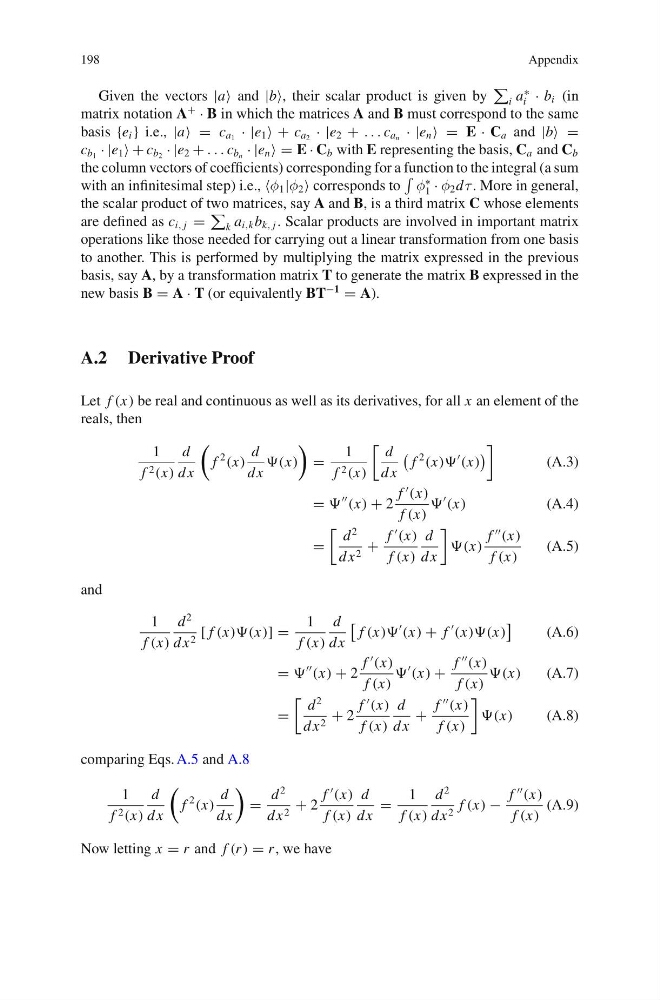
Let f (x) be real and continuous as well as its derivatives, for all x an element of the
reals, then
1
f 2 (x)
d
dx
f
2
(x)
d
dx
(x)
=
1
f 2 (x)
d
dx
f
2
(x))
(x)
(A.3)
=
(x) + 2
f
(x)
f (x)
(x)
(A.4)
=
d
2
dx 2 +
f
(x)
f (x)
d
dx
(x)
f
(x)
f (x)
(A.5)
and
1
f (x)
d
2
dx 2 [ f (x))(x)] =
1
f (x)
d
dx
f (x))
(x) + f
(x))(x)
(A.6)
=
(x) + 2
f
(x)
f (x)
(x) +
f
(x)
f (x)
(x)
(A.7)
=
d
2
dx 2 + 2
f
(x)
f (x)
d
dx
+
f
(x)
f (x)
(x)
(A.8)
comparing Eqs. A.5 and A.8
1
f 2 (x)
d
dx
f
2
(x)
d
dx
=
d
2
dx 2 + 2
f
(x)
f (x)
d
dx
=
1
f (x)
d
2
dx 2 f (x) −
f
(x)
f (x)
(A.9)
Now letting x = r and f (r ) = r , we have
Appendix
Given the vectors |a and |b, their scalar product is given by
i a
∗
i · b i (in
matrix notation A
+
· B in which the matrices A and B must correspond to the same
basis {e i } i.e., |a = c a 1 · |e 1 + c a 2 · |e 2 + . . . c a n · |e n = E · C a and |b =
c b 1 · |e 1 + c b 2 · |e 2 + . . . c b n · |e n = E · C b with E representing the basis, C a and C b
the column vectors of coefficients) corresponding for a function to the integral (a sum
with an infinitesimal step) i.e., φ 1 |φ 2 corresponds to
φ
∗
1 · φ 2 dτ . More in general,
the scalar product of two matrices, say A and B, is a third matrix C whose elements
are defined as c i, j =
k a i,k b k, j . Scalar products are involved in important matrix
operations like those needed for carrying out a linear transformation from one basis
to another. This is performed by multiplying the matrix expressed in the previous
basis, say A, by a transformation matrix T to generate the matrix B expressed in the
new basis B = A · T (or equivalently BT
−1
= A).
A.2 Derivative Proof
Let f (x) be real and continuous as well as its derivatives, for all x an element of the
reals, then
1
f 2 (x)
d
dx
f
2
(x)
d
dx
(x)
=
1
f 2 (x)
d
dx
f
2
(x))
(x)
(A.3)
=
(x) + 2
f
(x)
f (x)
(x)
(A.4)
=
d
2
dx 2 +
f
(x)
f (x)
d
dx
(x)
f
(x)
f (x)
(A.5)
and
1
f (x)
d
2
dx 2 [ f (x))(x)] =
1
f (x)
d
dx
f (x))
(x) + f
(x))(x)
(A.6)
=
(x) + 2
f
(x)
f (x)
(x) +
f
(x)
f (x)
(x)
(A.7)
=
d
2
dx 2 + 2
f
(x)
f (x)
d
dx
+
f
(x)
f (x)
(x)
(A.8)
comparing Eqs. A.5 and A.8
1
f 2 (x)
d
dx
f
2
(x)
d
dx
=
d
2
dx 2 + 2
f
(x)
f (x)
d
dx
=
1
f (x)
d
2
dx 2 f (x) −
f
(x)
f (x)
(A.9)
Now letting x = r and f (r ) = r , we have