

5.1 Toward More Complex Systems
157
Yet, the accuracy of the abovementioned PESs in describing the long-range interaction is far from being satisfactory. For this reason systematic attempts to provide
a ROBO formulation of the four-body N 2 + N 2 processes PESs [88, 89] have been
made by generalizing to four atoms the three-atom formulation. As discussed in
Sect. 3.4.4, a way of simplifying LM-LS methods may consist in embodying in the
procedure a criterion driving the selection of both c coefficients and f functions
by inspiration from the process relevance proposed in the many-process expansion,
MPE [34], method that articulates the PES in functional representations connecting
different asymptotic arrangements going through different tightly bound many-body
clusters (see Eq. 3.51). In this respect, the method tackles the problem of building
the PES in terms of approaching paths converging toward a dynamically controlled
sampling of the shorter range interactions. More in detail, in their present version
the MPE potentials exploit the versatility of the BO variables and:
1. Express the f functions of the LM-LS methods as long-range formulations of both
reactant and product channels of the considered processes in terms of either BO
or SRBO variables replacing the Lennard-Jones-like ones.
2. Use the BO or SRBO variables determined in this way in order to build a polynomial representation of the PES in the intermediate (stable or pseudostable) region
of the interaction.
3. Formulate the c coefficients in terms of angles of the (appropriately selected)
involved ROBOs linking existing bonds to the newly (even if only locally or
temporarily) formed ones. Criteria for driving their selection are based only on
a tentative evaluation of the local importance of the subset of bonds undergoing
distortion or (even if embryonal) formation.
To this end it is crucial to consider all the representations of the system (among
which it can switch) including full 4 body aggregation, full 4 body fragmentation
and all possible 3 and 2 body combinations. For all these processes one can always
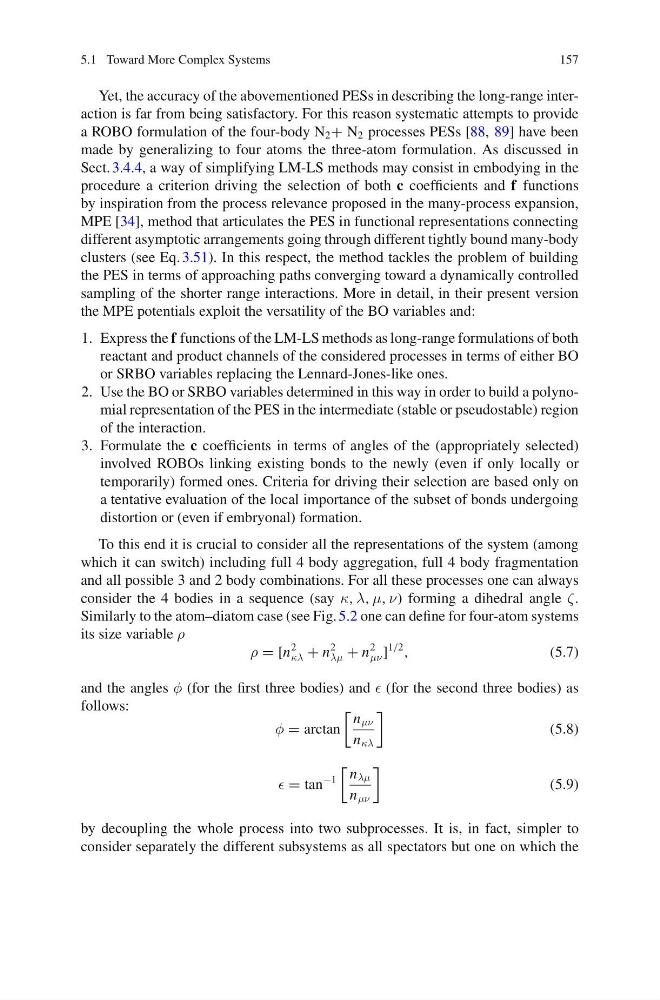
consider the 4 bodies in a sequence (say κ, λ, μ, ν) forming a dihedral angle ζ.
Similarly to the atom–diatom case (see Fig. 5.2 one can define for four-atom systems
its size variable ρ
ρ = [n
2
κλ + n
2
λμ + n
2
μν ]
1/2
,
(5.7)
and the angles φ (for the first three bodies) and (for the second three bodies) as
follows:
φ = arctan
n μν
n κλ
(5.8)
= tan
−1
n λμ
n μν
(5.9)
by decoupling the whole process into two subprocesses. It is, in fact, simpler to
consider separately the different subsystems as all spectators but one on which the
157
Yet, the accuracy of the abovementioned PESs in describing the long-range interaction is far from being satisfactory. For this reason systematic attempts to provide
a ROBO formulation of the four-body N 2 + N 2 processes PESs [88, 89] have been
made by generalizing to four atoms the three-atom formulation. As discussed in
Sect. 3.4.4, a way of simplifying LM-LS methods may consist in embodying in the
procedure a criterion driving the selection of both c coefficients and f functions
by inspiration from the process relevance proposed in the many-process expansion,
MPE [34], method that articulates the PES in functional representations connecting
different asymptotic arrangements going through different tightly bound many-body
clusters (see Eq. 3.51). In this respect, the method tackles the problem of building
the PES in terms of approaching paths converging toward a dynamically controlled
sampling of the shorter range interactions. More in detail, in their present version
the MPE potentials exploit the versatility of the BO variables and:
1. Express the f functions of the LM-LS methods as long-range formulations of both
reactant and product channels of the considered processes in terms of either BO
or SRBO variables replacing the Lennard-Jones-like ones.
2. Use the BO or SRBO variables determined in this way in order to build a polynomial representation of the PES in the intermediate (stable or pseudostable) region
of the interaction.
3. Formulate the c coefficients in terms of angles of the (appropriately selected)
involved ROBOs linking existing bonds to the newly (even if only locally or
temporarily) formed ones. Criteria for driving their selection are based only on
a tentative evaluation of the local importance of the subset of bonds undergoing
distortion or (even if embryonal) formation.
To this end it is crucial to consider all the representations of the system (among
which it can switch) including full 4 body aggregation, full 4 body fragmentation
and all possible 3 and 2 body combinations. For all these processes one can always
consider the 4 bodies in a sequence (say κ, λ, μ, ν) forming a dihedral angle ζ.
Similarly to the atom–diatom case (see Fig. 5.2 one can define for four-atom systems
its size variable ρ
ρ = [n
2
κλ + n
2
λμ + n
2
μν ]
1/2
,
(5.7)
and the angles φ (for the first three bodies) and (for the second three bodies) as
follows:
φ = arctan
n μν
n κλ
(5.8)
= tan
−1
n λμ
n μν
(5.9)
by decoupling the whole process into two subprocesses. It is, in fact, simpler to
consider separately the different subsystems as all spectators but one on which the