

2
1 From the Phenomenology of Chemical Reactions …
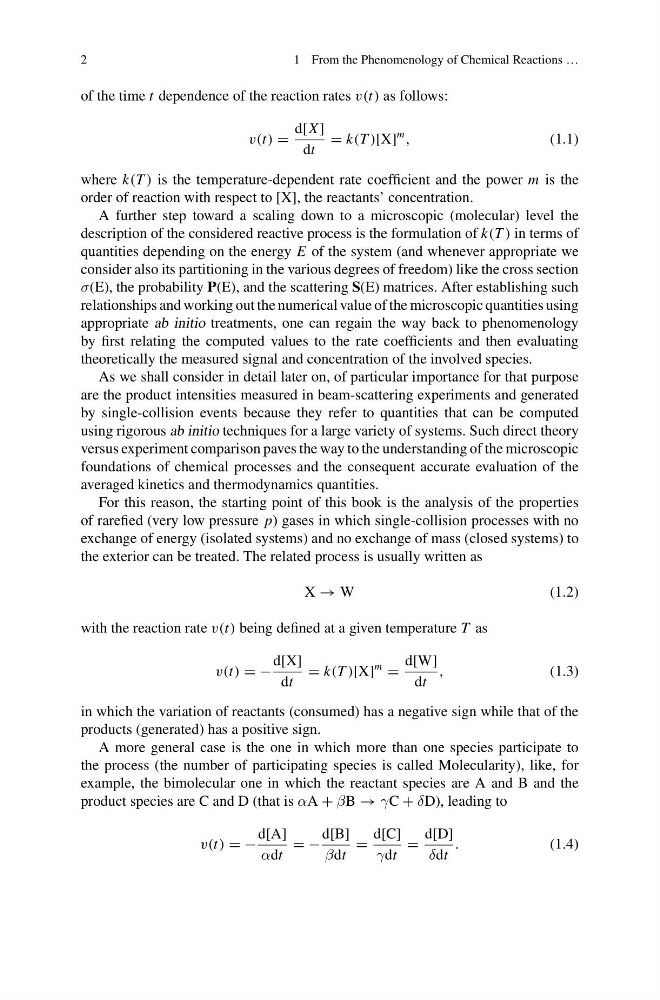
of the time t dependence of the reaction rates v(t) as follows:
v(t) =
d[X ]
dt
= k(T )[X]
m
,
(1.1)
where k(T ) is the temperature-dependent rate coefficient and the power m is the
order of reaction with respect to [X], the reactants’ concentration.
A further step toward a scaling down to a microscopic (molecular) level the
description of the considered reactive process is the formulation of k(T ) in terms of
quantities depending on the energy E of the system (and whenever appropriate we
consider also its partitioning in the various degrees of freedom) like the cross section
σ(E), the probability P(E), and the scattering S(E) matrices. After establishing such
relationships and working out the numerical value of the microscopic quantities using
appropriate ab initio treatments, one can regain the way back to phenomenology
by first relating the computed values to the rate coefficients and then evaluating
theoretically the measured signal and concentration of the involved species.
As we shall consider in detail later on, of particular importance for that purpose
are the product intensities measured in beam-scattering experiments and generated
by single-collision events because they refer to quantities that can be computed
using rigorous ab initio techniques for a large variety of systems. Such direct theory
versus experiment comparison paves the way to the understanding of the microscopic
foundations of chemical processes and the consequent accurate evaluation of the
averaged kinetics and thermodynamics quantities.
For this reason, the starting point of this book is the analysis of the properties
of rarefied (very low pressure p) gases in which single-collision processes with no
exchange of energy (isolated systems) and no exchange of mass (closed systems) to
the exterior can be treated. The related process is usually written as
X → W
( 1 . 2 )
with the reaction rate v(t) being defined at a given temperature T as
v(t) = −
d[X]
dt
= k(T )[X]
m
=
d[W]
dt
,
(1.3)
in which the variation of reactants (consumed) has a negative sign while that of the
products (generated) has a positive sign.
A more general case is the one in which more than one species participate to
the process (the number of participating species is called Molecularity), like, for
example, the bimolecular one in which the reactant species are A and B and the
product species are C and D (that is αA + βB → γC + δD), leading to
v(t) = −
d[A]
αdt
= −
d[B]
βdt
=
d[C]
γdt
=
d[D]
δdt
.
(1.4)
1 From the Phenomenology of Chemical Reactions …
of the time t dependence of the reaction rates v(t) as follows:
v(t) =
d[X ]
dt
= k(T )[X]
m
,
(1.1)
where k(T ) is the temperature-dependent rate coefficient and the power m is the
order of reaction with respect to [X], the reactants’ concentration.
A further step toward a scaling down to a microscopic (molecular) level the
description of the considered reactive process is the formulation of k(T ) in terms of
quantities depending on the energy E of the system (and whenever appropriate we
consider also its partitioning in the various degrees of freedom) like the cross section
σ(E), the probability P(E), and the scattering S(E) matrices. After establishing such
relationships and working out the numerical value of the microscopic quantities using
appropriate ab initio treatments, one can regain the way back to phenomenology
by first relating the computed values to the rate coefficients and then evaluating
theoretically the measured signal and concentration of the involved species.
As we shall consider in detail later on, of particular importance for that purpose
are the product intensities measured in beam-scattering experiments and generated
by single-collision events because they refer to quantities that can be computed
using rigorous ab initio techniques for a large variety of systems. Such direct theory
versus experiment comparison paves the way to the understanding of the microscopic
foundations of chemical processes and the consequent accurate evaluation of the
averaged kinetics and thermodynamics quantities.
For this reason, the starting point of this book is the analysis of the properties
of rarefied (very low pressure p) gases in which single-collision processes with no
exchange of energy (isolated systems) and no exchange of mass (closed systems) to
the exterior can be treated. The related process is usually written as
X → W
( 1 . 2 )
with the reaction rate v(t) being defined at a given temperature T as
v(t) = −
d[X]
dt
= k(T )[X]
m
=
d[W]
dt
,
(1.3)
in which the variation of reactants (consumed) has a negative sign while that of the
products (generated) has a positive sign.
A more general case is the one in which more than one species participate to
the process (the number of participating species is called Molecularity), like, for
example, the bimolecular one in which the reactant species are A and B and the
product species are C and D (that is αA + βB → γC + δD), leading to
v(t) = −
d[A]
αdt
= −
d[B]
βdt
=
d[C]
γdt
=
d[D]
δdt
.
(1.4)