

4.4 Basic Features of Atom–Diatom Reactions
145
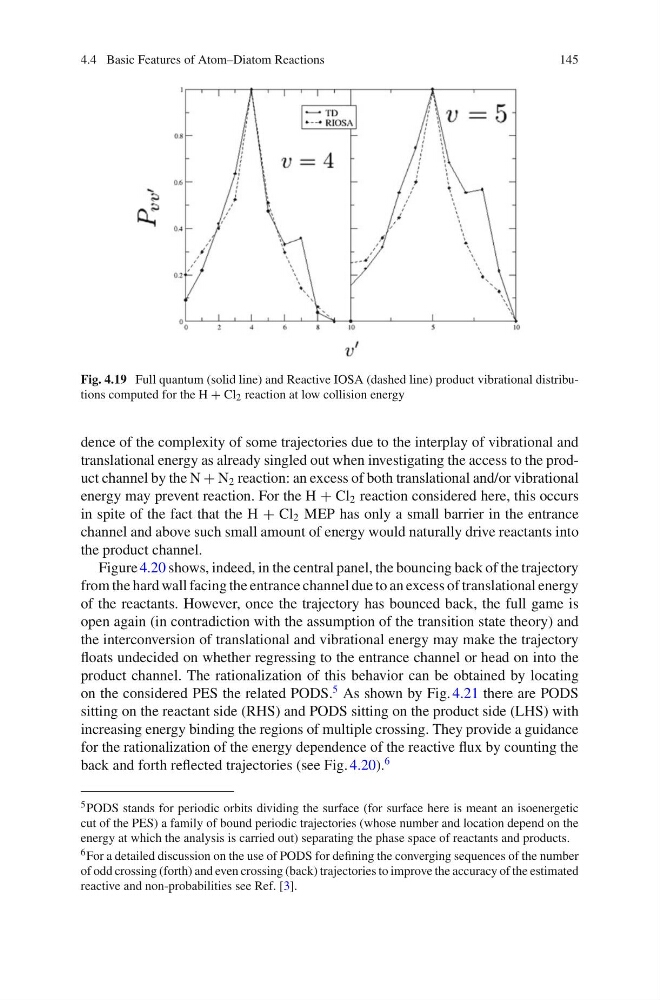
Fig. 4.19 Full quantum (solid line) and Reactive IOSA (dashed line) product vibrational distributions computed for the H + Cl 2 reaction at low collision energy
dence of the complexity of some trajectories due to the interplay of vibrational and
translational energy as already singled out when investigating the access to the product channel by the N + N 2 reaction: an excess of both translational and/or vibrational
energy may prevent reaction. For the H + Cl 2 reaction considered here, this occurs
in spite of the fact that the H + Cl 2 MEP has only a small barrier in the entrance
channel and above such small amount of energy would naturally drive reactants into
the product channel.
Figure 4.20 shows, indeed, in the central panel, the bouncing back of the trajectory
from the hard wall facing the entrance channel due to an excess of translational energy
of the reactants. However, once the trajectory has bounced back, the full game is
open again (in contradiction with the assumption of the transition state theory) and
the interconversion of translational and vibrational energy may make the trajectory
floats undecided on whether regressing to the entrance channel or head on into the
product channel. The rationalization of this behavior can be obtained by locating
on the considered PES the related PODS.
5 As shown by Fig. 4.21 there are PODS
sitting on the reactant side (RHS) and PODS sitting on the product side (LHS) with
increasing energy binding the regions of multiple crossing. They provide a guidance
for the rationalization of the energy dependence of the reactive flux by counting the
back and forth reflected trajectories (see Fig. 4.20).
6
5 PODS stands for periodic orbits dividing the surface (for surface here is meant an isoenergetic
cut of the PES) a family of bound periodic trajectories (whose number and location depend on the
energy at which the analysis is carried out) separating the phase space of reactants and products.
6 For a detailed discussion on the use of PODS for defining the converging sequences of the number
of odd crossing (forth) and even crossing (back) trajectories to improve the accuracy of the estimated
reactive and non-probabilities see Ref. [3].
145
Fig. 4.19 Full quantum (solid line) and Reactive IOSA (dashed line) product vibrational distributions computed for the H + Cl 2 reaction at low collision energy
dence of the complexity of some trajectories due to the interplay of vibrational and
translational energy as already singled out when investigating the access to the product channel by the N + N 2 reaction: an excess of both translational and/or vibrational
energy may prevent reaction. For the H + Cl 2 reaction considered here, this occurs
in spite of the fact that the H + Cl 2 MEP has only a small barrier in the entrance
channel and above such small amount of energy would naturally drive reactants into
the product channel.
Figure 4.20 shows, indeed, in the central panel, the bouncing back of the trajectory
from the hard wall facing the entrance channel due to an excess of translational energy
of the reactants. However, once the trajectory has bounced back, the full game is
open again (in contradiction with the assumption of the transition state theory) and
the interconversion of translational and vibrational energy may make the trajectory
floats undecided on whether regressing to the entrance channel or head on into the
product channel. The rationalization of this behavior can be obtained by locating
on the considered PES the related PODS.
5 As shown by Fig. 4.21 there are PODS
sitting on the reactant side (RHS) and PODS sitting on the product side (LHS) with
increasing energy binding the regions of multiple crossing. They provide a guidance
for the rationalization of the energy dependence of the reactive flux by counting the
back and forth reflected trajectories (see Fig. 4.20).
6
5 PODS stands for periodic orbits dividing the surface (for surface here is meant an isoenergetic
cut of the PES) a family of bound periodic trajectories (whose number and location depend on the
energy at which the analysis is carried out) separating the phase space of reactants and products.
6 For a detailed discussion on the use of PODS for defining the converging sequences of the number
of odd crossing (forth) and even crossing (back) trajectories to improve the accuracy of the estimated
reactive and non-probabilities see Ref. [3].