

144
4 The Treatment of Few-Body Reactions
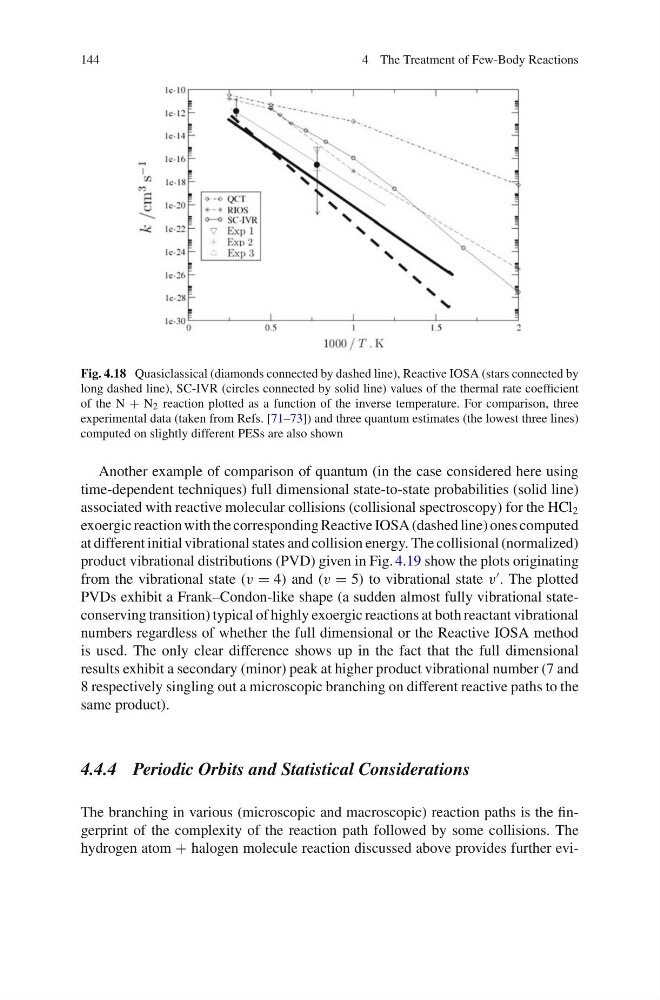
Fig. 4.18 Quasiclassical (diamonds connected by dashed line), Reactive IOSA (stars connected by
long dashed line), SC-IVR (circles connected by solid line) values of the thermal rate coefficient
of the N + N 2 reaction plotted as a function of the inverse temperature. For comparison, three
experimental data (taken from Refs. [71–73]) and three quantum estimates (the lowest three lines)
computed on slightly different PESs are also shown
Another example of comparison of quantum (in the case considered here using
time-dependent techniques) full dimensional state-to-state probabilities (solid line)
associated with reactive molecular collisions (collisional spectroscopy) for the HCl 2
exoergic reaction with the corresponding Reactive IOSA (dashed line) ones computed
at different initial vibrational states and collision energy. The collisional (normalized)
product vibrational distributions (PVD) given in Fig. 4.19 show the plots originating
from the vibrational state (v = 4) and (v = 5) to vibrational state v
. The plotted
PVDs exhibit a Frank–Condon-like shape (a sudden almost fully vibrational stateconserving transition) typical of highly exoergic reactions at both reactant vibrational
numbers regardless of whether the full dimensional or the Reactive IOSA method
is used. The only clear difference shows up in the fact that the full dimensional
results exhibit a secondary (minor) peak at higher product vibrational number (7 and
8 respectively singling out a microscopic branching on different reactive paths to the
same product).
4.4.4 Periodic Orbits and Statistical Considerations
The branching in various (microscopic and macroscopic) reaction paths is the fingerprint of the complexity of the reaction path followed by some collisions. The
hydrogen atom + halogen molecule reaction discussed above provides further evi-
4 The Treatment of Few-Body Reactions
Fig. 4.18 Quasiclassical (diamonds connected by dashed line), Reactive IOSA (stars connected by
long dashed line), SC-IVR (circles connected by solid line) values of the thermal rate coefficient
of the N + N 2 reaction plotted as a function of the inverse temperature. For comparison, three
experimental data (taken from Refs. [71–73]) and three quantum estimates (the lowest three lines)
computed on slightly different PESs are also shown
Another example of comparison of quantum (in the case considered here using
time-dependent techniques) full dimensional state-to-state probabilities (solid line)
associated with reactive molecular collisions (collisional spectroscopy) for the HCl 2
exoergic reaction with the corresponding Reactive IOSA (dashed line) ones computed
at different initial vibrational states and collision energy. The collisional (normalized)
product vibrational distributions (PVD) given in Fig. 4.19 show the plots originating
from the vibrational state (v = 4) and (v = 5) to vibrational state v
. The plotted
PVDs exhibit a Frank–Condon-like shape (a sudden almost fully vibrational stateconserving transition) typical of highly exoergic reactions at both reactant vibrational
numbers regardless of whether the full dimensional or the Reactive IOSA method
is used. The only clear difference shows up in the fact that the full dimensional
results exhibit a secondary (minor) peak at higher product vibrational number (7 and
8 respectively singling out a microscopic branching on different reactive paths to the
same product).
4.4.4 Periodic Orbits and Statistical Considerations
The branching in various (microscopic and macroscopic) reaction paths is the fingerprint of the complexity of the reaction path followed by some collisions. The
hydrogen atom + halogen molecule reaction discussed above provides further evi-