

128
4 The Treatment of Few-Body Reactions
propagates through a large hypersphere ρ max , the wavepacket is projected onto
surface functions evaluated at ρ max . This provides a time-dependent snapshot of
these projections. Finally, these snapshots are then Fourier transformed to extract
the energy-dependent S matrix elements (as already discussed for the Jacobi timedependent method).
The corresponding code, TD-APH3D [54] is available for distribution.
4.3 Beyond Full Quantum Calculations
4.3.1 Reduced Dimensionality Quantum Treatments
For a variety of reasons, you may not want or can undertake a full quantum dynamical study of the investigated process. Because of this, you might be ready to carry
out the calculations by introducing some approximations (like adopting a reduced
dimensionality treatment). This is especially convenient when one needs to lower
computational costs, is ready to accept a lower level of accuracy, or has in any case to
highly average detailed outcomes (like estimate a thermally average rate coefficient).
A first way of reducing the dimensionality of the accurate treatment of an atom–
diatom reaction is to limit its use to the lowest value of the quantum numbers (e.g.,
perform only the zero total angular momentum J ) calculations and then extrapolate
or model the behavior for higher values. In the case of J , one can model the higher
total angular momentum results by assuming that an increase of the total angular
momentum of the system plays the role of freezing the corresponding quantity of
energy and simply shifting up the state-specific probability along the energy scale
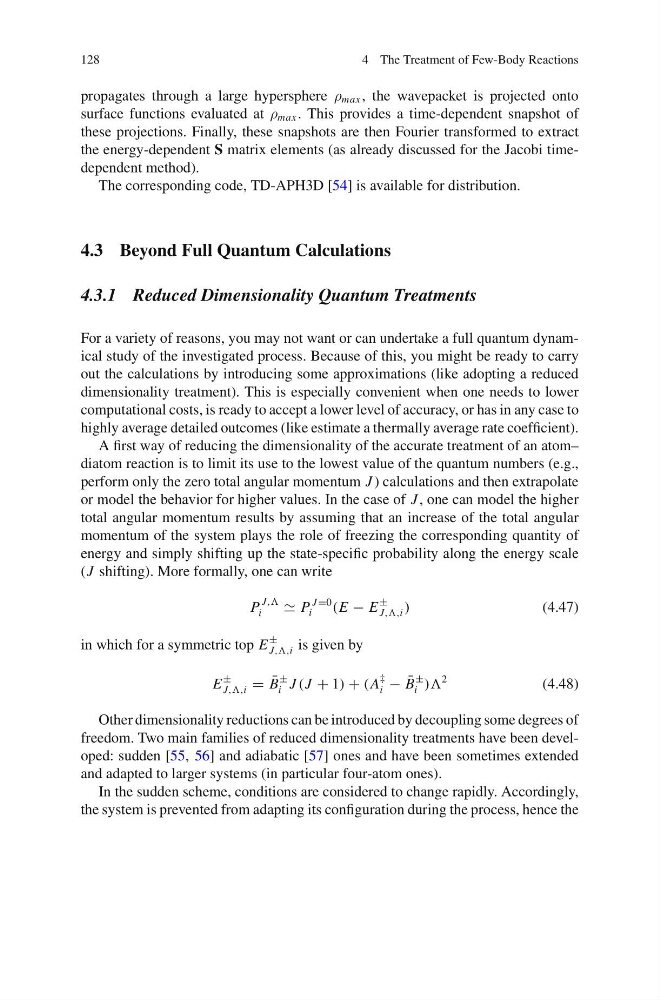
(J shifting). More formally, one can write
P
J,,
i
P
J =0
i
(E − E
±
J,,,i )
(4.47)
in which for a symmetric top E
±
J,,,i is given by
E
±
J,,,i = ¯
B
±
i J (J + 1) + (A
‡
i − ¯
B
±
i ))
2
(4.48)
Other dimensionality reductions can be introduced by decoupling some degrees of
freedom. Two main families of reduced dimensionality treatments have been developed: sudden [55, 56] and adiabatic [57] ones and have been sometimes extended
and adapted to larger systems (in particular four-atom ones).
In the sudden scheme, conditions are considered to change rapidly. Accordingly,
the system is prevented from adapting its configuration during the process, hence the
4 The Treatment of Few-Body Reactions
propagates through a large hypersphere ρ max , the wavepacket is projected onto
surface functions evaluated at ρ max . This provides a time-dependent snapshot of
these projections. Finally, these snapshots are then Fourier transformed to extract
the energy-dependent S matrix elements (as already discussed for the Jacobi timedependent method).
The corresponding code, TD-APH3D [54] is available for distribution.
4.3 Beyond Full Quantum Calculations
4.3.1 Reduced Dimensionality Quantum Treatments
For a variety of reasons, you may not want or can undertake a full quantum dynamical study of the investigated process. Because of this, you might be ready to carry
out the calculations by introducing some approximations (like adopting a reduced
dimensionality treatment). This is especially convenient when one needs to lower
computational costs, is ready to accept a lower level of accuracy, or has in any case to
highly average detailed outcomes (like estimate a thermally average rate coefficient).
A first way of reducing the dimensionality of the accurate treatment of an atom–
diatom reaction is to limit its use to the lowest value of the quantum numbers (e.g.,
perform only the zero total angular momentum J ) calculations and then extrapolate
or model the behavior for higher values. In the case of J , one can model the higher
total angular momentum results by assuming that an increase of the total angular
momentum of the system plays the role of freezing the corresponding quantity of
energy and simply shifting up the state-specific probability along the energy scale
(J shifting). More formally, one can write
P
J,,
i
P
J =0
i
(E − E
±
J,,,i )
(4.47)
in which for a symmetric top E
±
J,,,i is given by
E
±
J,,,i = ¯
B
±
i J (J + 1) + (A
‡
i − ¯
B
±
i ))
2
(4.48)
Other dimensionality reductions can be introduced by decoupling some degrees of
freedom. Two main families of reduced dimensionality treatments have been developed: sudden [55, 56] and adiabatic [57] ones and have been sometimes extended
and adapted to larger systems (in particular four-atom ones).
In the sudden scheme, conditions are considered to change rapidly. Accordingly,
the system is prevented from adapting its configuration during the process, hence the