

4.2 Three-Atom Systems
119
averaged quantum dynamics properties of multidimensional systems based on a
modified Lanczos iterative diagonalization of the thermal flux operator.
4.2.2 Atom–Diatom Reactive Scattering Jacobi Method
We have discussed earlier about the suitability of any kind of coordinates for classical mechanics treatments. As already mentioned, for time-independent quantum
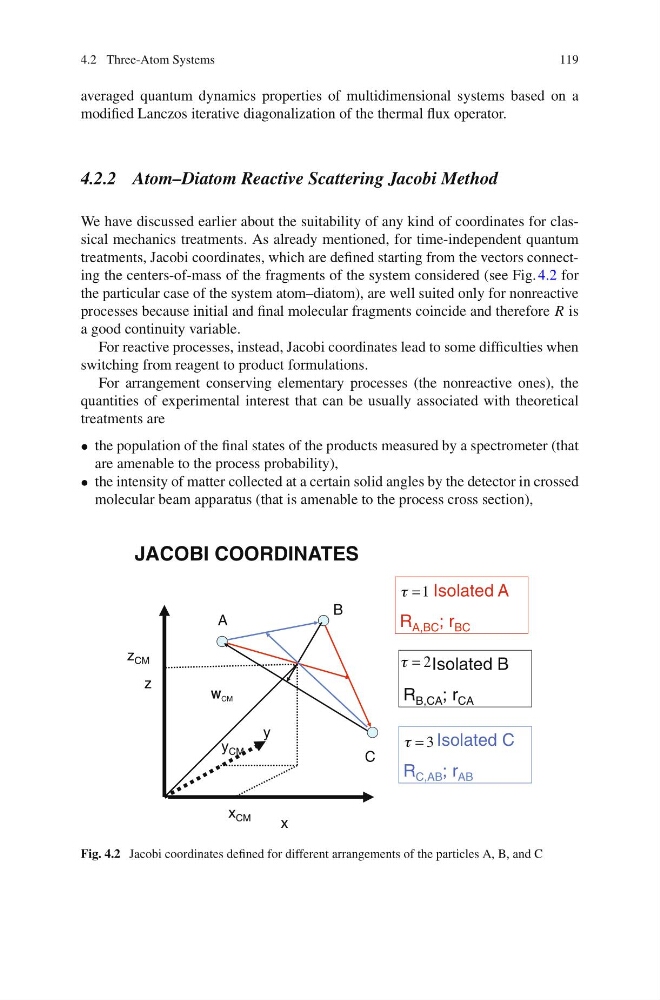
treatments, Jacobi coordinates, which are defined starting from the vectors connecting the centers-of-mass of the fragments of the system considered (see Fig. 4.2 for
the particular case of the system atom–diatom), are well suited only for nonreactive
processes because initial and final molecular fragments coincide and therefore R is
a good continuity variable.
For reactive processes, instead, Jacobi coordinates lead to some difficulties when
switching from reagent to product formulations.
For arrangement conserving elementary processes (the nonreactive ones), the
quantities of experimental interest that can be usually associated with theoretical
treatments are
• the population of the final states of the products measured by a spectrometer (that
are amenable to the process probability),
• the intensity of matter collected at a certain solid angles by the detector in crossed
molecular beam apparatus (that is amenable to the process cross section),
x
y
z
A
B
W CM
JACOBI COORDINATES
x CM
y CM
z CM
Isolated A
R A,BC ; r BC
C
Isolated B
R B,CA ; r CA
Isolated C
R C,AB ; r AB
= 1
= 2
= 3
Fig. 4.2 Jacobi coordinates defined for different arrangements of the particles A, B, and C
119
averaged quantum dynamics properties of multidimensional systems based on a
modified Lanczos iterative diagonalization of the thermal flux operator.
4.2.2 Atom–Diatom Reactive Scattering Jacobi Method
We have discussed earlier about the suitability of any kind of coordinates for classical mechanics treatments. As already mentioned, for time-independent quantum
treatments, Jacobi coordinates, which are defined starting from the vectors connecting the centers-of-mass of the fragments of the system considered (see Fig. 4.2 for
the particular case of the system atom–diatom), are well suited only for nonreactive
processes because initial and final molecular fragments coincide and therefore R is
a good continuity variable.
For reactive processes, instead, Jacobi coordinates lead to some difficulties when
switching from reagent to product formulations.
For arrangement conserving elementary processes (the nonreactive ones), the
quantities of experimental interest that can be usually associated with theoretical
treatments are
• the population of the final states of the products measured by a spectrometer (that
are amenable to the process probability),
• the intensity of matter collected at a certain solid angles by the detector in crossed
molecular beam apparatus (that is amenable to the process cross section),
x
y
z
A
B
W CM
JACOBI COORDINATES
x CM
y CM
z CM
Isolated A
R A,BC ; r BC
C
Isolated B
R B,CA ; r CA
Isolated C
R C,AB ; r AB
= 1
= 2
= 3
Fig. 4.2 Jacobi coordinates defined for different arrangements of the particles A, B, and C