

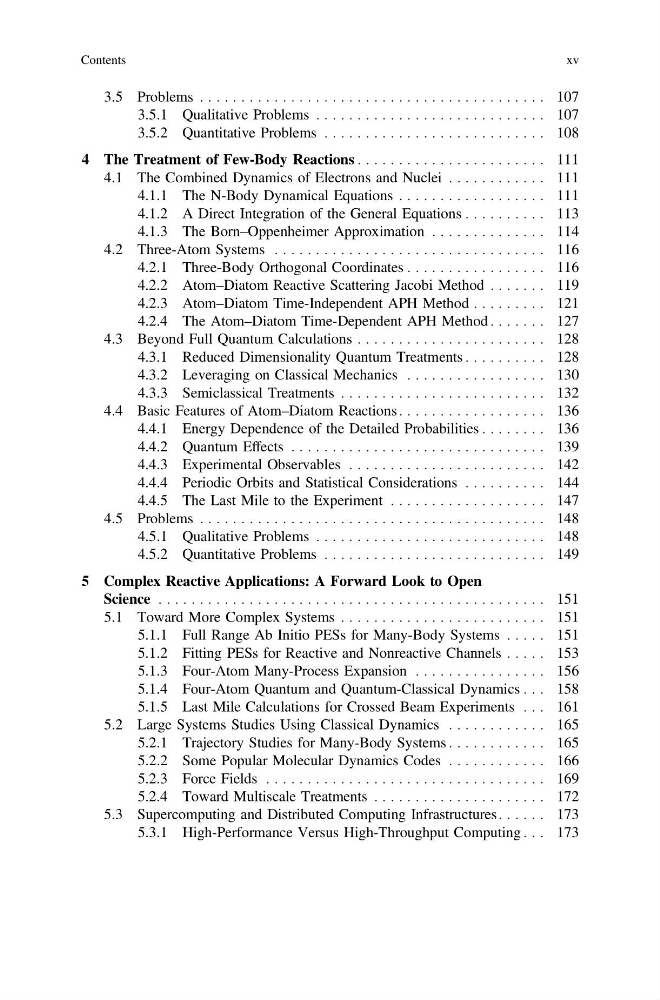
3.5 Problems . . . . . . . . . . . . . . . . . . . . . . . . . . . . . . . . . . . . . . . . . . 107
3.5.1 Qualitative Problems . . . . . . . . . . . . . . . . . . . . . . . . . . . . 107
3.5.2 Quantitative Problems . . . . . . . . . . . . . . . . . . . . . . . . . . . 108
4 The Treatment of Few-Body Reactions . . . . . . . . . . . . . . . . . . . . . . . 111
4.1 The Combined Dynamics of Electrons and Nuclei . . . . . . . . . . . . 111
4.1.1 The N-Body Dynamical Equations . . . . . . . . . . . . . . . . . . 111
4.1.2 A Direct Integration of the General Equations . . . . . . . . . . 113
4.1.3 The Born–Oppenheimer Approximation . . . . . . . . . . . . . . 114
4.2 Three-Atom Systems . . . . . . . . . . . . . . . . . . . . . . . . . . . . . . . . . 116
4.2.1 Three-Body Orthogonal Coordinates . . . . . . . . . . . . . . . . . 116
4.2.2 Atom–Diatom Reactive Scattering Jacobi Method . . . . . . . 119
4.2.3 Atom–Diatom Time-Independent APH Method . . . . . . . . . 121
4.2.4 The Atom–Diatom Time-Dependent APH Method . . . . . . . 127
4.3 Beyond Full Quantum Calculations . . . . . . . . . . . . . . . . . . . . . . . 128
4.3.1 Reduced Dimensionality Quantum Treatments . . . . . . . . . . 128
4.3.2 Leveraging on Classical Mechanics . . . . . . . . . . . . . . . . . 130
4.3.3 Semiclassical Treatments . . . . . . . . . . . . . . . . . . . . . . . . . 132
4.4 Basic Features of Atom–Diatom Reactions . . . . . . . . . . . . . . . . . . 136
4.4.1 Energy Dependence of the Detailed Probabilities . . . . . . . . 136
4.4.2 Quantum Effects . . . . . . . . . . . . . . . . . . . . . . . . . . . . . . . 139
4.4.3 Experimental Observables . . . . . . . . . . . . . . . . . . . . . . . . 142
4.4.4 Periodic Orbits and Statistical Considerations . . . . . . . . . . 144
4.4.5 The Last Mile to the Experiment . . . . . . . . . . . . . . . . . . . 147
4.5 Problems . . . . . . . . . . . . . . . . . . . . . . . . . . . . . . . . . . . . . . . . . . 148
4.5.1 Qualitative Problems . . . . . . . . . . . . . . . . . . . . . . . . . . . . 148
4.5.2 Quantitative Problems . . . . . . . . . . . . . . . . . . . . . . . . . . . 149
5 Complex Reactive Applications: A Forward Look to Open
Science . . . . . . . . . . . . . . . . . . . . . . . . . . . . . . . . . . . . . . . . . . . . . . . 151
5.1 Toward More Complex Systems . . . . . . . . . . . . . . . . . . . . . . . . . 151
5.1.1 Full Range Ab Initio PESs for Many-Body Systems . . . . . 151
5.1.2 Fitting PESs for Reactive and Nonreactive Channels . . . . . 153
5.1.3 Four-Atom Many-Process Expansion . . . . . . . . . . . . . . . . 156
5.1.4 Four-Atom Quantum and Quantum-Classical Dynamics . . . 158
5.1.5 Last Mile Calculations for Crossed Beam Experiments . . . 161
5.2 Large Systems Studies Using Classical Dynamics . . . . . . . . . . . . 165
5.2.1 Trajectory Studies for Many-Body Systems . . . . . . . . . . . . 165
5.2.2 Some Popular Molecular Dynamics Codes . . . . . . . . . . . . 166
5.2.3 Force Fields . . . . . . . . . . . . . . . . . . . . . . . . . . . . . . . . . . 169
5.2.4 Toward Multiscale Treatments . . . . . . . . . . . . . . . . . . . . . 172
5.3 Supercomputing and Distributed Computing Infrastructures . . . . . . 173
5.3.1 High-Performance Versus High-Throughput Computing . . . 173
Contents
xv
3.5.1 Qualitative Problems . . . . . . . . . . . . . . . . . . . . . . . . . . . . 107
3.5.2 Quantitative Problems . . . . . . . . . . . . . . . . . . . . . . . . . . . 108
4 The Treatment of Few-Body Reactions . . . . . . . . . . . . . . . . . . . . . . . 111
4.1 The Combined Dynamics of Electrons and Nuclei . . . . . . . . . . . . 111
4.1.1 The N-Body Dynamical Equations . . . . . . . . . . . . . . . . . . 111
4.1.2 A Direct Integration of the General Equations . . . . . . . . . . 113
4.1.3 The Born–Oppenheimer Approximation . . . . . . . . . . . . . . 114
4.2 Three-Atom Systems . . . . . . . . . . . . . . . . . . . . . . . . . . . . . . . . . 116
4.2.1 Three-Body Orthogonal Coordinates . . . . . . . . . . . . . . . . . 116
4.2.2 Atom–Diatom Reactive Scattering Jacobi Method . . . . . . . 119
4.2.3 Atom–Diatom Time-Independent APH Method . . . . . . . . . 121
4.2.4 The Atom–Diatom Time-Dependent APH Method . . . . . . . 127
4.3 Beyond Full Quantum Calculations . . . . . . . . . . . . . . . . . . . . . . . 128
4.3.1 Reduced Dimensionality Quantum Treatments . . . . . . . . . . 128
4.3.2 Leveraging on Classical Mechanics . . . . . . . . . . . . . . . . . 130
4.3.3 Semiclassical Treatments . . . . . . . . . . . . . . . . . . . . . . . . . 132
4.4 Basic Features of Atom–Diatom Reactions . . . . . . . . . . . . . . . . . . 136
4.4.1 Energy Dependence of the Detailed Probabilities . . . . . . . . 136
4.4.2 Quantum Effects . . . . . . . . . . . . . . . . . . . . . . . . . . . . . . . 139
4.4.3 Experimental Observables . . . . . . . . . . . . . . . . . . . . . . . . 142
4.4.4 Periodic Orbits and Statistical Considerations . . . . . . . . . . 144
4.4.5 The Last Mile to the Experiment . . . . . . . . . . . . . . . . . . . 147
4.5 Problems . . . . . . . . . . . . . . . . . . . . . . . . . . . . . . . . . . . . . . . . . . 148
4.5.1 Qualitative Problems . . . . . . . . . . . . . . . . . . . . . . . . . . . . 148
4.5.2 Quantitative Problems . . . . . . . . . . . . . . . . . . . . . . . . . . . 149
5 Complex Reactive Applications: A Forward Look to Open
Science . . . . . . . . . . . . . . . . . . . . . . . . . . . . . . . . . . . . . . . . . . . . . . . 151
5.1 Toward More Complex Systems . . . . . . . . . . . . . . . . . . . . . . . . . 151
5.1.1 Full Range Ab Initio PESs for Many-Body Systems . . . . . 151
5.1.2 Fitting PESs for Reactive and Nonreactive Channels . . . . . 153
5.1.3 Four-Atom Many-Process Expansion . . . . . . . . . . . . . . . . 156
5.1.4 Four-Atom Quantum and Quantum-Classical Dynamics . . . 158
5.1.5 Last Mile Calculations for Crossed Beam Experiments . . . 161
5.2 Large Systems Studies Using Classical Dynamics . . . . . . . . . . . . 165
5.2.1 Trajectory Studies for Many-Body Systems . . . . . . . . . . . . 165
5.2.2 Some Popular Molecular Dynamics Codes . . . . . . . . . . . . 166
5.2.3 Force Fields . . . . . . . . . . . . . . . . . . . . . . . . . . . . . . . . . . 169
5.2.4 Toward Multiscale Treatments . . . . . . . . . . . . . . . . . . . . . 172
5.3 Supercomputing and Distributed Computing Infrastructures . . . . . . 173
5.3.1 High-Performance Versus High-Throughput Computing . . . 173
Contents
xv