

112
4 The Treatment of Few-Body Reactions
i
∂
∂t
(W
‡
, w
‡
, t) = H tot (t))(W
‡
, w
‡
, t),
(4.1)
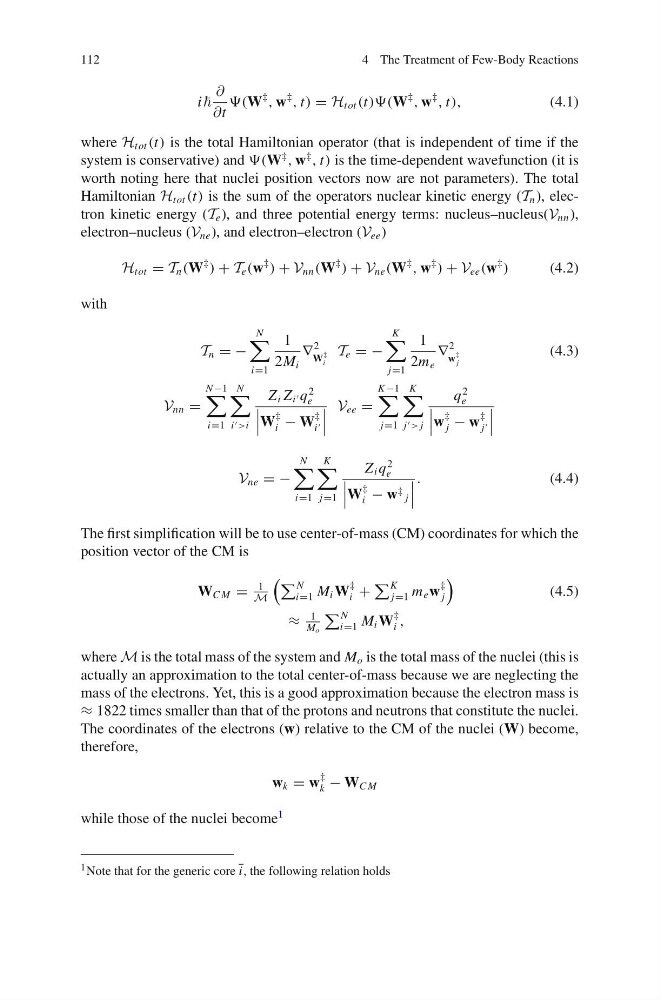
where H tot (t) is the total Hamiltonian operator (that is independent of time if the
system is conservative) and (W
‡
, w
‡
, t) is the time-dependent wavefunction (it is
worth noting here that nuclei position vectors now are not parameters). The total
Hamiltonian H tot (t) is the sum of the operators nuclear kinetic energy (T n ), electron kinetic energy (T e ), and three potential energy terms: nucleus–nucleus(V nn ),
electron–nucleus (V ne ), and electron–electron (V ee )
H tot = T n (W
‡
) + T e (w
‡
) + V nn (W
‡
) + V ne (W
‡
, w
‡
) + V ee (w
‡
)
(4.2)
with
T n = −
N
i=1
1
2M i
∇
2
W
‡
i
T e = −
K
j=1
1
2m e
∇
2
w
‡
j
(4.3)
V nn =
N −1
i=1
N
i >i
Z i Z i q
2
e
W
‡
i − W
‡
i
V ee =
K −1
j=1
K
j > j
q
2
e
w
‡
j − w
‡
j
V ne = −
N
i=1
K
j=1
Z i q
2
e
W
‡
i − w ‡ j
.
(4.4)
The first simplification will be to use center-of-mass (CM) coordinates for which the
position vector of the CM is
W C M =
1
M
N
i=1 M i W
‡
i +
K
j=1 m e w
‡
j
(4.5)
≈
1
M o
N
i=1 M i W
‡
i ,
where M is the total mass of the system and M o is the total mass of the nuclei (this is
actually an approximation to the total center-of-mass because we are neglecting the
mass of the electrons. Yet, this is a good approximation because the electron mass is
≈ 1822 times smaller than that of the protons and neutrons that constitute the nuclei.
The coordinates of the electrons (w) relative to the CM of the nuclei (W) become,
therefore,
w k = w
‡
k − W C M
while those of the nuclei become
1
1 Note that for the generic core i, the following relation holds
4 The Treatment of Few-Body Reactions
i
∂
∂t
(W
‡
, w
‡
, t) = H tot (t))(W
‡
, w
‡
, t),
(4.1)
where H tot (t) is the total Hamiltonian operator (that is independent of time if the
system is conservative) and (W
‡
, w
‡
, t) is the time-dependent wavefunction (it is
worth noting here that nuclei position vectors now are not parameters). The total
Hamiltonian H tot (t) is the sum of the operators nuclear kinetic energy (T n ), electron kinetic energy (T e ), and three potential energy terms: nucleus–nucleus(V nn ),
electron–nucleus (V ne ), and electron–electron (V ee )
H tot = T n (W
‡
) + T e (w
‡
) + V nn (W
‡
) + V ne (W
‡
, w
‡
) + V ee (w
‡
)
(4.2)
with
T n = −
N
i=1
1
2M i
∇
2
W
‡
i
T e = −
K
j=1
1
2m e
∇
2
w
‡
j
(4.3)
V nn =
N −1
i=1
N
i >i
Z i Z i q
2
e
W
‡
i − W
‡
i
V ee =
K −1
j=1
K
j > j
q
2
e
w
‡
j − w
‡
j
V ne = −
N
i=1
K
j=1
Z i q
2
e
W
‡
i − w ‡ j
.
(4.4)
The first simplification will be to use center-of-mass (CM) coordinates for which the
position vector of the CM is
W C M =
1
M
N
i=1 M i W
‡
i +
K
j=1 m e w
‡
j
(4.5)
≈
1
M o
N
i=1 M i W
‡
i ,
where M is the total mass of the system and M o is the total mass of the nuclei (this is
actually an approximation to the total center-of-mass because we are neglecting the
mass of the electrons. Yet, this is a good approximation because the electron mass is
≈ 1822 times smaller than that of the protons and neutrons that constitute the nuclei.
The coordinates of the electrons (w) relative to the CM of the nuclei (W) become,
therefore,
w k = w
‡
k − W C M
while those of the nuclei become
1
1 Note that for the generic core i, the following relation holds