

3.4 Full Range Process Potentials
107
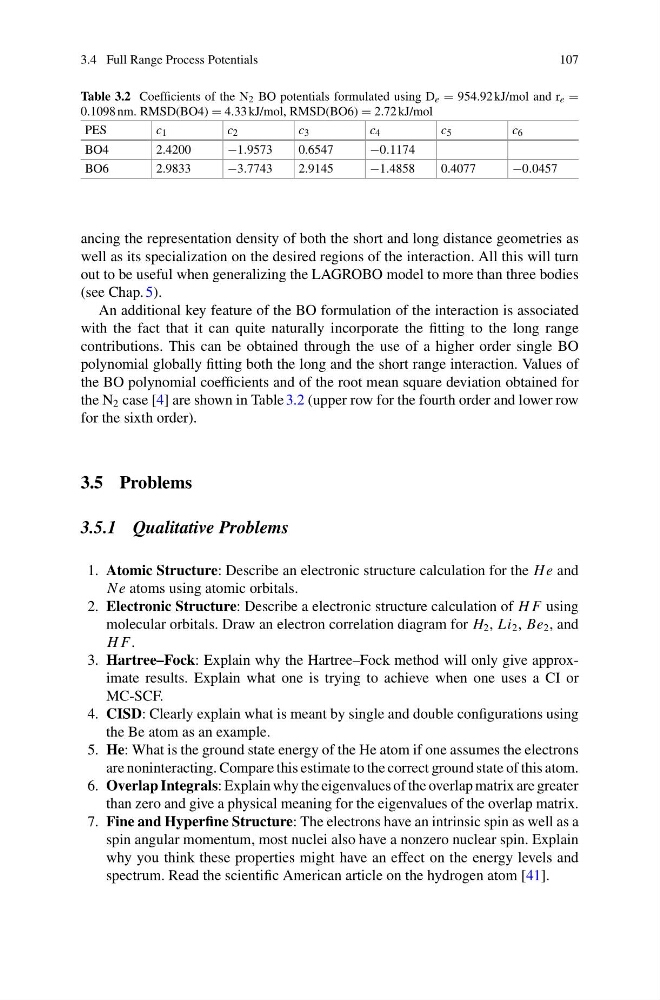
Table 3.2 Coefficients of the N 2 BO potentials formulated using D e = 954.92 kJ/mol and r e =
0.1098 nm. RMSD(BO4) = 4.33 kJ/mol, RMSD(BO6) = 2.72 kJ/mol
PES
c 1
c 2
c 3
c 4
c 5
c 6
BO4
2.4200
−1.9573
0.6547
−0.1174
BO6
2.9833
−3.7743
2.9145
−1.4858
0.4077
−0.0457
ancing the representation density of both the short and long distance geometries as
well as its specialization on the desired regions of the interaction. All this will turn
out to be useful when generalizing the LAGROBO model to more than three bodies
(see Chap. 5).
An additional key feature of the BO formulation of the interaction is associated
with the fact that it can quite naturally incorporate the fitting to the long range
contributions. This can be obtained through the use of a higher order single BO
polynomial globally fitting both the long and the short range interaction. Values of
the BO polynomial coefficients and of the root mean square deviation obtained for
the N 2 case [4] are shown in Table 3.2 (upper row for the fourth order and lower row
for the sixth order).
3.5 Problems
3.5.1 Qualitative Problems
1. Atomic Structure: Describe an electronic structure calculation for the He and
N e atoms using atomic orbitals.
2. Electronic Structure: Describe a electronic structure calculation of H F using
molecular orbitals. Draw an electron correlation diagram for H 2 , Li 2 , Be 2 , and
H F.
3. Hartree–Fock: Explain why the Hartree–Fock method will only give approximate results. Explain what one is trying to achieve when one uses a CI or
MC-SCF.
4. CISD: Clearly explain what is meant by single and double configurations using
the Be atom as an example.
5. He: What is the ground state energy of the He atom if one assumes the electrons
are noninteracting. Compare this estimate to the correct ground state of this atom.
6. Overlap Integrals: Explain why the eigenvalues of the overlap matrix are greater
than zero and give a physical meaning for the eigenvalues of the overlap matrix.
7. Fine and Hyperfine Structure: The electrons have an intrinsic spin as well as a
spin angular momentum, most nuclei also have a nonzero nuclear spin. Explain
why you think these properties might have an effect on the energy levels and
spectrum. Read the scientific American article on the hydrogen atom [41].
107
Table 3.2 Coefficients of the N 2 BO potentials formulated using D e = 954.92 kJ/mol and r e =
0.1098 nm. RMSD(BO4) = 4.33 kJ/mol, RMSD(BO6) = 2.72 kJ/mol
PES
c 1
c 2
c 3
c 4
c 5
c 6
BO4
2.4200
−1.9573
0.6547
−0.1174
BO6
2.9833
−3.7743
2.9145
−1.4858
0.4077
−0.0457
ancing the representation density of both the short and long distance geometries as
well as its specialization on the desired regions of the interaction. All this will turn
out to be useful when generalizing the LAGROBO model to more than three bodies
(see Chap. 5).
An additional key feature of the BO formulation of the interaction is associated
with the fact that it can quite naturally incorporate the fitting to the long range
contributions. This can be obtained through the use of a higher order single BO
polynomial globally fitting both the long and the short range interaction. Values of
the BO polynomial coefficients and of the root mean square deviation obtained for
the N 2 case [4] are shown in Table 3.2 (upper row for the fourth order and lower row
for the sixth order).
3.5 Problems
3.5.1 Qualitative Problems
1. Atomic Structure: Describe an electronic structure calculation for the He and
N e atoms using atomic orbitals.
2. Electronic Structure: Describe a electronic structure calculation of H F using
molecular orbitals. Draw an electron correlation diagram for H 2 , Li 2 , Be 2 , and
H F.
3. Hartree–Fock: Explain why the Hartree–Fock method will only give approximate results. Explain what one is trying to achieve when one uses a CI or
MC-SCF.
4. CISD: Clearly explain what is meant by single and double configurations using
the Be atom as an example.
5. He: What is the ground state energy of the He atom if one assumes the electrons
are noninteracting. Compare this estimate to the correct ground state of this atom.
6. Overlap Integrals: Explain why the eigenvalues of the overlap matrix are greater
than zero and give a physical meaning for the eigenvalues of the overlap matrix.
7. Fine and Hyperfine Structure: The electrons have an intrinsic spin as well as a
spin angular momentum, most nuclei also have a nonzero nuclear spin. Explain
why you think these properties might have an effect on the energy levels and
spectrum. Read the scientific American article on the hydrogen atom [41].