

104
3 Ab initio Electronic Structure for Few-Body Systems
V (r) = V
(2)
(r 1−2 ) + V
(2)
(r 2−3 ) + V
(2)
(r 3−1 ) + V
(3)
(r 1−2 , r 2−3 , r 3−1 ) (3.52)
while for a four-atom system this becomes six two-body terms, four three-body
terms, and one four-body term.
For example, it provides further motivations to the separate evolution of the three
or more body terms of the double MBE that are partitioned in a first term accounting
for the Hartree–Fock contribution and a second term accounting for dynamic correlation contributions to the interaction [33] despite the fact that the separation of the
different components is neither obvious nor unique.
3.4.4 Process-Driven Local and Mobile Fitting Methods
A strengthening of the local mobile fitting methods can be obtained by embodying
in the procedure a criterion for guiding the selection of c and f via the relevance of
the considered process to the so-called many-process expansion (MPE) [34] and the
possibility of leveraging on a flexible continuity variable driving the switch from one
molecular arrangement to another. In this respect, the Bond order coordinates turn
out to be particularly useful because of their correct behavior at both ends and of the
confinement of the interaction into a finite space (see, for example, the comparison
of the representation of the Morse potential in internuclear distance and in the BO
variable given in Fig. 3.2). In the BO space, the Morse potential has an inverse and
truncated Harmonic-like shape equal to zero at n = 0 and a minimum at n = 1. This
inverted nature of the BO space with respect to the physical one allows also a proper
formulation of the atom–diatom long range interactions using polynomials in the
related variables [4]. Accordingly, the B exchange process A + BC → AB + C (as
will be discussed in more detail below one can also consider the C exchange process
B + CA → BC + A and the A exchange process C + AB → CA + B) can be
formulated in terms of diatomic-like ROBO potentials rotating around the common
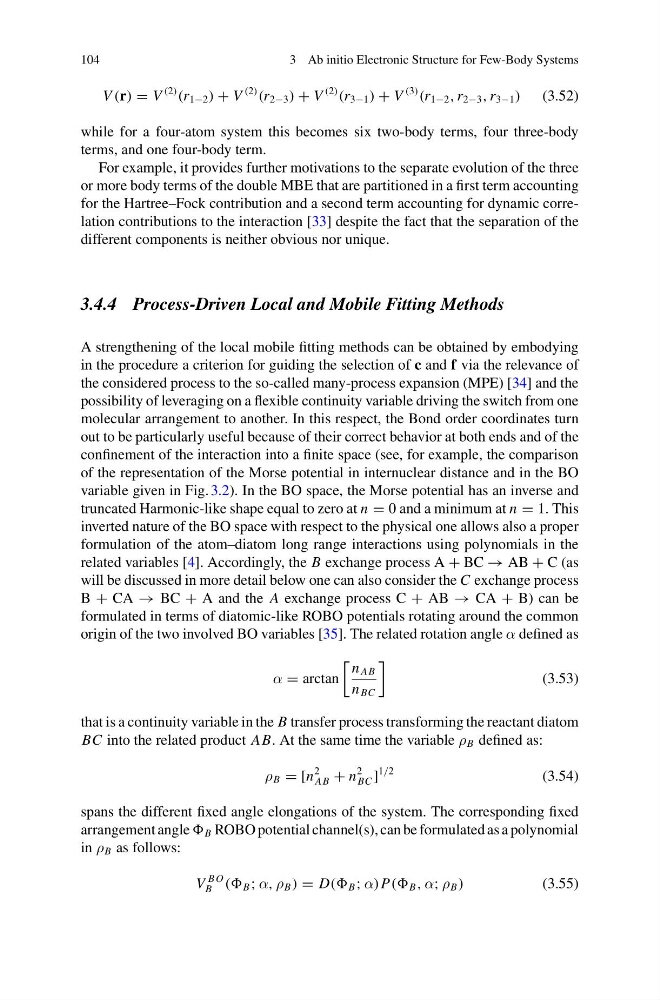
origin of the two involved BO variables [35]. The related rotation angle α defined as
α = arctan
n AB
n BC
(3.53)
that is a continuity variable in the B transfer process transforming the reactant diatom
BC into the related product AB. At the same time the variable ρ B defined as:
ρ B = [n
2
AB + n
2
BC ]
1/2
(3.54)
spans the different fixed angle elongations of the system. The corresponding fixed
arrangement angle B ROBO potential channel(s), can be formulated as a polynomial
in ρ B as follows:
V
B O
B (( B ; α, ρ B ) = D(( B ; α)P(( B , α; ρ B )
(3.55)
3 Ab initio Electronic Structure for Few-Body Systems
V (r) = V
(2)
(r 1−2 ) + V
(2)
(r 2−3 ) + V
(2)
(r 3−1 ) + V
(3)
(r 1−2 , r 2−3 , r 3−1 ) (3.52)
while for a four-atom system this becomes six two-body terms, four three-body
terms, and one four-body term.
For example, it provides further motivations to the separate evolution of the three
or more body terms of the double MBE that are partitioned in a first term accounting
for the Hartree–Fock contribution and a second term accounting for dynamic correlation contributions to the interaction [33] despite the fact that the separation of the
different components is neither obvious nor unique.
3.4.4 Process-Driven Local and Mobile Fitting Methods
A strengthening of the local mobile fitting methods can be obtained by embodying
in the procedure a criterion for guiding the selection of c and f via the relevance of
the considered process to the so-called many-process expansion (MPE) [34] and the
possibility of leveraging on a flexible continuity variable driving the switch from one
molecular arrangement to another. In this respect, the Bond order coordinates turn
out to be particularly useful because of their correct behavior at both ends and of the
confinement of the interaction into a finite space (see, for example, the comparison
of the representation of the Morse potential in internuclear distance and in the BO
variable given in Fig. 3.2). In the BO space, the Morse potential has an inverse and
truncated Harmonic-like shape equal to zero at n = 0 and a minimum at n = 1. This
inverted nature of the BO space with respect to the physical one allows also a proper
formulation of the atom–diatom long range interactions using polynomials in the
related variables [4]. Accordingly, the B exchange process A + BC → AB + C (as
will be discussed in more detail below one can also consider the C exchange process
B + CA → BC + A and the A exchange process C + AB → CA + B) can be
formulated in terms of diatomic-like ROBO potentials rotating around the common
origin of the two involved BO variables [35]. The related rotation angle α defined as
α = arctan
n AB
n BC
(3.53)
that is a continuity variable in the B transfer process transforming the reactant diatom
BC into the related product AB. At the same time the variable ρ B defined as:
ρ B = [n
2
AB + n
2
BC ]
1/2
(3.54)
spans the different fixed angle elongations of the system. The corresponding fixed
arrangement angle B ROBO potential channel(s), can be formulated as a polynomial
in ρ B as follows:
V
B O
B (( B ; α, ρ B ) = D(( B ; α)P(( B , α; ρ B )
(3.55)