

98
3 Ab initio Electronic Structure for Few-Body Systems
bi-electron integrals to be computed goes as the fourth power of the dimension of the
basis function adopted, has led to the development of methods cutting down on it.
For example, by taking into account that internal electrons (core) play a minor role
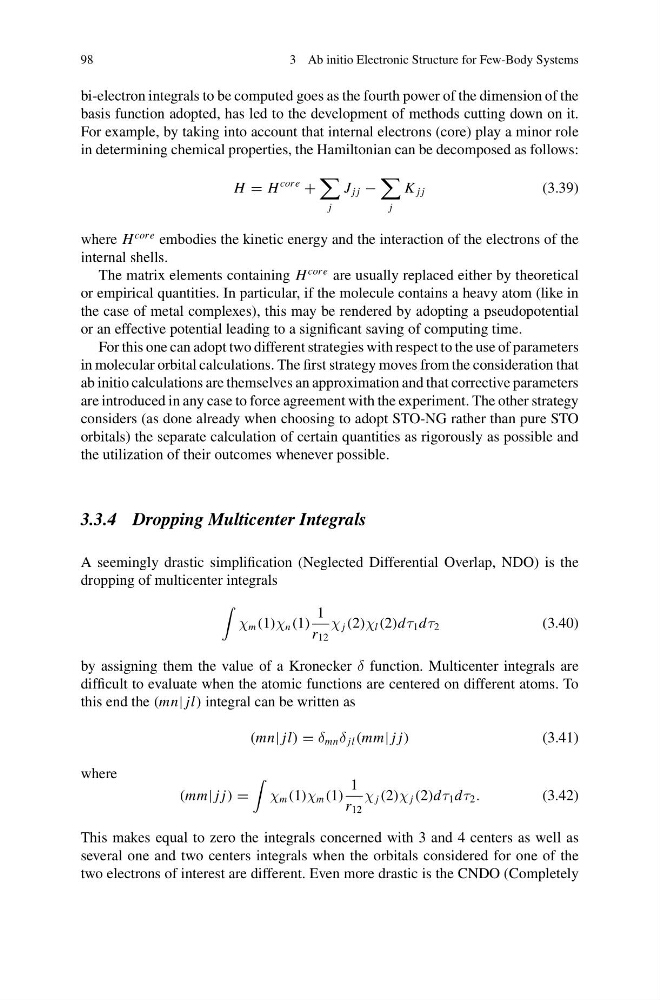
in determining chemical properties, the Hamiltonian can be decomposed as follows:
H = H
core
+
j
J j j −
j
K j j
(3.39)
where H
core embodies the kinetic energy and the interaction of the electrons of the
internal shells.
The matrix elements containing H
core are usually replaced either by theoretical
or empirical quantities. In particular, if the molecule contains a heavy atom (like in
the case of metal complexes), this may be rendered by adopting a pseudopotential
or an effective potential leading to a significant saving of computing time.
For this one can adopt two different strategies with respect to the use of parameters
in molecular orbital calculations. The first strategy moves from the consideration that
ab initio calculations are themselves an approximation and that corrective parameters
are introduced in any case to force agreement with the experiment. The other strategy
considers (as done already when choosing to adopt STO-NG rather than pure STO
orbitals) the separate calculation of certain quantities as rigorously as possible and
the utilization of their outcomes whenever possible.
3.3.4 Dropping Multicenter Integrals
A seemingly drastic simplification (Neglected Differential Overlap, NDO) is the
dropping of multicenter integrals
χ m (1)χ n (1)
1
r 12
χ j (2)χ l (2)dτ 1 dτ 2
(3.40)
by assigning them the value of a Kronecker δ function. Multicenter integrals are
difficult to evaluate when the atomic functions are centered on different atoms. To
this end the (mn| jl) integral can be written as
(mn| jl) = δ mn δ jl (mm| j j)
(3.41)
where
(mm| j j) =
χ m (1)χ m (1)
1
r 12
χ j (2)χ j (2)dτ 1 dτ 2 .
(3.42)
This makes equal to zero the integrals concerned with 3 and 4 centers as well as
several one and two centers integrals when the orbitals considered for one of the
two electrons of interest are different. Even more drastic is the CNDO (Completely
3 Ab initio Electronic Structure for Few-Body Systems
bi-electron integrals to be computed goes as the fourth power of the dimension of the
basis function adopted, has led to the development of methods cutting down on it.
For example, by taking into account that internal electrons (core) play a minor role
in determining chemical properties, the Hamiltonian can be decomposed as follows:
H = H
core
+
j
J j j −
j
K j j
(3.39)
where H
core embodies the kinetic energy and the interaction of the electrons of the
internal shells.
The matrix elements containing H
core are usually replaced either by theoretical
or empirical quantities. In particular, if the molecule contains a heavy atom (like in
the case of metal complexes), this may be rendered by adopting a pseudopotential
or an effective potential leading to a significant saving of computing time.
For this one can adopt two different strategies with respect to the use of parameters
in molecular orbital calculations. The first strategy moves from the consideration that
ab initio calculations are themselves an approximation and that corrective parameters
are introduced in any case to force agreement with the experiment. The other strategy
considers (as done already when choosing to adopt STO-NG rather than pure STO
orbitals) the separate calculation of certain quantities as rigorously as possible and
the utilization of their outcomes whenever possible.
3.3.4 Dropping Multicenter Integrals
A seemingly drastic simplification (Neglected Differential Overlap, NDO) is the
dropping of multicenter integrals
χ m (1)χ n (1)
1
r 12
χ j (2)χ l (2)dτ 1 dτ 2
(3.40)
by assigning them the value of a Kronecker δ function. Multicenter integrals are
difficult to evaluate when the atomic functions are centered on different atoms. To
this end the (mn| jl) integral can be written as
(mn| jl) = δ mn δ jl (mm| j j)
(3.41)
where
(mm| j j) =
χ m (1)χ m (1)
1
r 12
χ j (2)χ j (2)dτ 1 dτ 2 .
(3.42)
This makes equal to zero the integrals concerned with 3 and 4 centers as well as
several one and two centers integrals when the orbitals considered for one of the
two electrons of interest are different. Even more drastic is the CNDO (Completely