

3.3 Toward Extended Applications
97
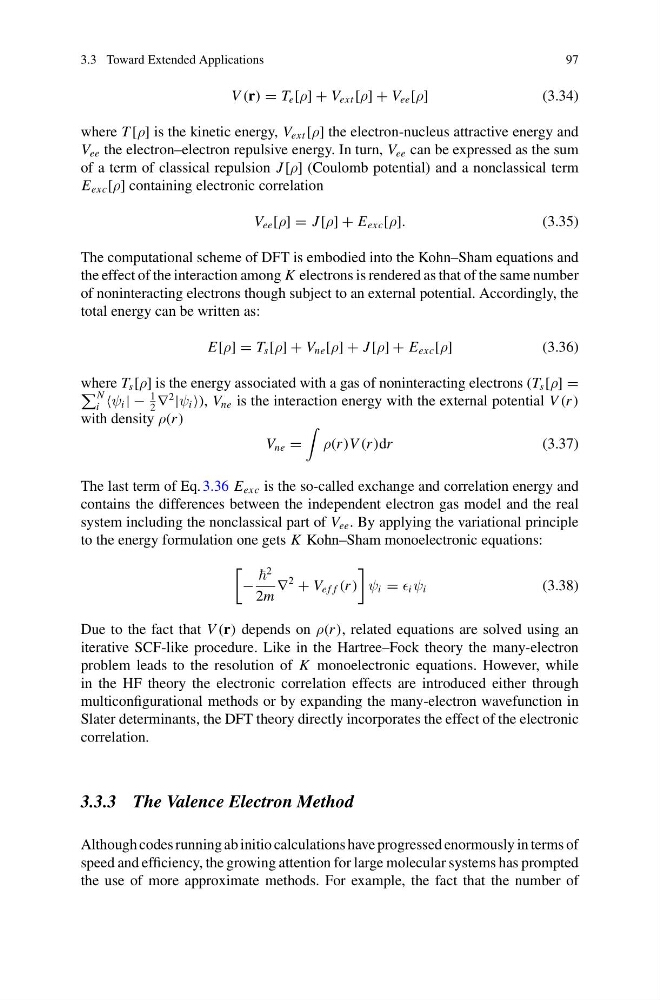
V (r) = T e [ρ] + V ext [ρ] + V ee [ρ]
(3.34)
where T [ρ] is the kinetic energy, V ext [ρ] the electron-nucleus attractive energy and
V ee the electron–electron repulsive energy. In turn, V ee can be expressed as the sum
of a term of classical repulsion J [ρ] (Coulomb potential) and a nonclassical term
E exc [ρ] containing electronic correlation
V ee [ρ] = J [ρ] + E exc [ρ].
(3.35)
The computational scheme of DFT is embodied into the Kohn–Sham equations and
the effect of the interaction among K electrons is rendered as that of the same number
of noninteracting electrons though subject to an external potential. Accordingly, the
total energy can be written as:
E[ρ] = T s [ρ] + V ne [ρ] + J [ρ] + E exc [ρ]
(3.36)
where T s [ρ] is the energy associated with a gas of noninteracting electrons (T s [ρ] =
N
i ψ i | −
1
2
∇
2
|ψ i ), V ne is the interaction energy with the external potential V (r )
with density ρ(r )
V ne =
ρ(r )V (r )dr
(3.37)
The last term of Eq. 3.36 E exc is the so-called exchange and correlation energy and
contains the differences between the independent electron gas model and the real
system including the nonclassical part of V ee . By applying the variational principle
to the energy formulation one gets K Kohn–Sham monoelectronic equations:
−
2
2m
∇
2
+ V e f f (r )
ψ i = i ψ i
(3.38)
Due to the fact that V (r) depends on ρ(r ), related equations are solved using an
iterative SCF-like procedure. Like in the Hartree–Fock theory the many-electron
problem leads to the resolution of K monoelectronic equations. However, while
in the HF theory the electronic correlation effects are introduced either through
multiconfigurational methods or by expanding the many-electron wavefunction in
Slater determinants, the DFT theory directly incorporates the effect of the electronic
correlation.
3.3.3 The Valence Electron Method
Although codes running ab initio calculations have progressed enormously in terms of
speed and efficiency, the growing attention for large molecular systems has prompted
the use of more approximate methods. For example, the fact that the number of
97
V (r) = T e [ρ] + V ext [ρ] + V ee [ρ]
(3.34)
where T [ρ] is the kinetic energy, V ext [ρ] the electron-nucleus attractive energy and
V ee the electron–electron repulsive energy. In turn, V ee can be expressed as the sum
of a term of classical repulsion J [ρ] (Coulomb potential) and a nonclassical term
E exc [ρ] containing electronic correlation
V ee [ρ] = J [ρ] + E exc [ρ].
(3.35)
The computational scheme of DFT is embodied into the Kohn–Sham equations and
the effect of the interaction among K electrons is rendered as that of the same number
of noninteracting electrons though subject to an external potential. Accordingly, the
total energy can be written as:
E[ρ] = T s [ρ] + V ne [ρ] + J [ρ] + E exc [ρ]
(3.36)
where T s [ρ] is the energy associated with a gas of noninteracting electrons (T s [ρ] =
N
i ψ i | −
1
2
∇
2
|ψ i ), V ne is the interaction energy with the external potential V (r )
with density ρ(r )
V ne =
ρ(r )V (r )dr
(3.37)
The last term of Eq. 3.36 E exc is the so-called exchange and correlation energy and
contains the differences between the independent electron gas model and the real
system including the nonclassical part of V ee . By applying the variational principle
to the energy formulation one gets K Kohn–Sham monoelectronic equations:
−
2
2m
∇
2
+ V e f f (r )
ψ i = i ψ i
(3.38)
Due to the fact that V (r) depends on ρ(r ), related equations are solved using an
iterative SCF-like procedure. Like in the Hartree–Fock theory the many-electron
problem leads to the resolution of K monoelectronic equations. However, while
in the HF theory the electronic correlation effects are introduced either through
multiconfigurational methods or by expanding the many-electron wavefunction in
Slater determinants, the DFT theory directly incorporates the effect of the electronic
correlation.
3.3.3 The Valence Electron Method
Although codes running ab initio calculations have progressed enormously in terms of
speed and efficiency, the growing attention for large molecular systems has prompted
the use of more approximate methods. For example, the fact that the number of