

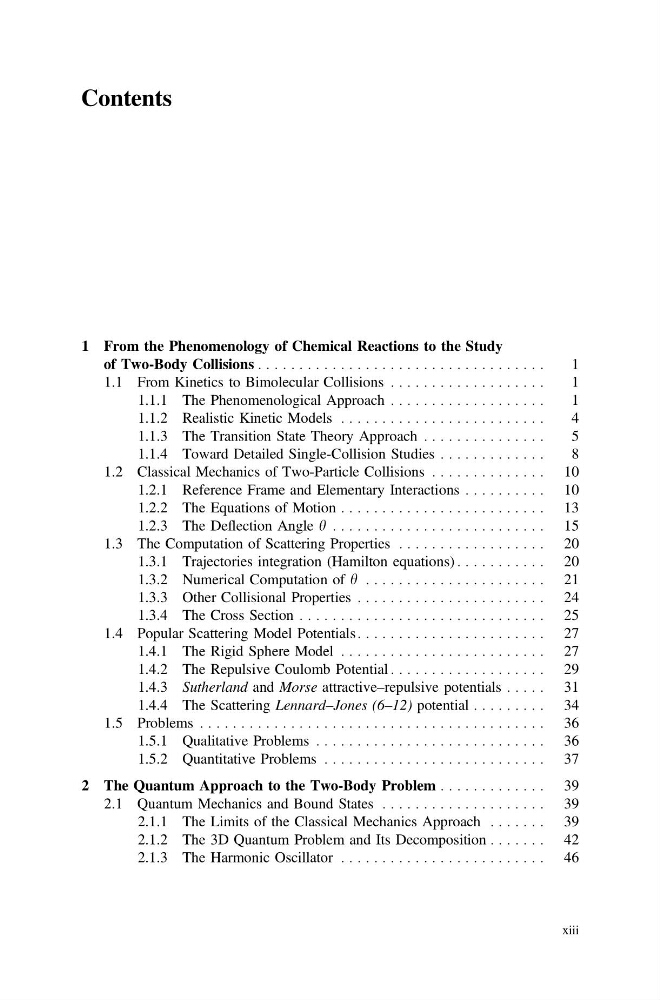
Contents
1 From the Phenomenology of Chemical Reactions to the Study
of Two-Body Collisions . . . . . . . . . . . . . . . . . . . . . . . . . . . . . . . . . . .
1
1.1 From Kinetics to Bimolecular Collisions . . . . . . . . . . . . . . . . . . .
1
1.1.1 The Phenomenological Approach . . . . . . . . . . . . . . . . . . .
1
1.1.2 Realistic Kinetic Models . . . . . . . . . . . . . . . . . . . . . . . . .
4
1.1.3 The Transition State Theory Approach . . . . . . . . . . . . . . .
5
1.1.4 Toward Detailed Single-Collision Studies . . . . . . . . . . . . .
8
1.2 Classical Mechanics of Two-Particle Collisions . . . . . . . . . . . . . . 10
1.2.1 Reference Frame and Elementary Interactions . . . . . . . . . . 10
1.2.2 The Equations of Motion . . . . . . . . . . . . . . . . . . . . . . . . . 13
1.2.3 The Deflection Angle h . . . . . . . . . . . . . . . . . . . . . . . . . . 15
1.3 The Computation of Scattering Properties . . . . . . . . . . . . . . . . . . 20
1.3.1 Trajectories integration (Hamilton equations) . . . . . . . . . . . 20
1.3.2 Numerical Computation of h . . . . . . . . . . . . . . . . . . . . . . 21
1.3.3 Other Collisional Properties . . . . . . . . . . . . . . . . . . . . . . . 24
1.3.4 The Cross Section . . . . . . . . . . . . . . . . . . . . . . . . . . . . . . 25
1.4 Popular Scattering Model Potentials . . . . . . . . . . . . . . . . . . . . . . . 27
1.4.1 The Rigid Sphere Model . . . . . . . . . . . . . . . . . . . . . . . . . 27
1.4.2 The Repulsive Coulomb Potential . . . . . . . . . . . . . . . . . . . 29
1.4.3 Sutherland and Morse attractive–repulsive potentials . . . . . 31
1.4.4 The Scattering Lennard–Jones (6–12) potential . . . . . . . . . 34
1.5 Problems . . . . . . . . . . . . . . . . . . . . . . . . . . . . . . . . . . . . . . . . . . 36
1.5.1 Qualitative Problems . . . . . . . . . . . . . . . . . . . . . . . . . . . . 36
1.5.2 Quantitative Problems . . . . . . . . . . . . . . . . . . . . . . . . . . . 37
2 The Quantum Approach to the Two-Body Problem . . . . . . . . . . . . . 39
2.1 Quantum Mechanics and Bound States . . . . . . . . . . . . . . . . . . . . 39
2.1.1 The Limits of the Classical Mechanics Approach . . . . . . . 39
2.1.2 The 3D Quantum Problem and Its Decomposition . . . . . . . 42
2.1.3 The Harmonic Oscillator . . . . . . . . . . . . . . . . . . . . . . . . . 46
xiii
1 From the Phenomenology of Chemical Reactions to the Study
of Two-Body Collisions . . . . . . . . . . . . . . . . . . . . . . . . . . . . . . . . . . .
1
1.1 From Kinetics to Bimolecular Collisions . . . . . . . . . . . . . . . . . . .
1
1.1.1 The Phenomenological Approach . . . . . . . . . . . . . . . . . . .
1
1.1.2 Realistic Kinetic Models . . . . . . . . . . . . . . . . . . . . . . . . .
4
1.1.3 The Transition State Theory Approach . . . . . . . . . . . . . . .
5
1.1.4 Toward Detailed Single-Collision Studies . . . . . . . . . . . . .
8
1.2 Classical Mechanics of Two-Particle Collisions . . . . . . . . . . . . . . 10
1.2.1 Reference Frame and Elementary Interactions . . . . . . . . . . 10
1.2.2 The Equations of Motion . . . . . . . . . . . . . . . . . . . . . . . . . 13
1.2.3 The Deflection Angle h . . . . . . . . . . . . . . . . . . . . . . . . . . 15
1.3 The Computation of Scattering Properties . . . . . . . . . . . . . . . . . . 20
1.3.1 Trajectories integration (Hamilton equations) . . . . . . . . . . . 20
1.3.2 Numerical Computation of h . . . . . . . . . . . . . . . . . . . . . . 21
1.3.3 Other Collisional Properties . . . . . . . . . . . . . . . . . . . . . . . 24
1.3.4 The Cross Section . . . . . . . . . . . . . . . . . . . . . . . . . . . . . . 25
1.4 Popular Scattering Model Potentials . . . . . . . . . . . . . . . . . . . . . . . 27
1.4.1 The Rigid Sphere Model . . . . . . . . . . . . . . . . . . . . . . . . . 27
1.4.2 The Repulsive Coulomb Potential . . . . . . . . . . . . . . . . . . . 29
1.4.3 Sutherland and Morse attractive–repulsive potentials . . . . . 31
1.4.4 The Scattering Lennard–Jones (6–12) potential . . . . . . . . . 34
1.5 Problems . . . . . . . . . . . . . . . . . . . . . . . . . . . . . . . . . . . . . . . . . . 36
1.5.1 Qualitative Problems . . . . . . . . . . . . . . . . . . . . . . . . . . . . 36
1.5.2 Quantitative Problems . . . . . . . . . . . . . . . . . . . . . . . . . . . 37
2 The Quantum Approach to the Two-Body Problem . . . . . . . . . . . . . 39
2.1 Quantum Mechanics and Bound States . . . . . . . . . . . . . . . . . . . . 39
2.1.1 The Limits of the Classical Mechanics Approach . . . . . . . 39
2.1.2 The 3D Quantum Problem and Its Decomposition . . . . . . . 42
2.1.3 The Harmonic Oscillator . . . . . . . . . . . . . . . . . . . . . . . . . 46
xiii