

94
3 Ab initio Electronic Structure for Few-Body Systems
and
E i =
n=0
λ
(n) E
(n)
i
(3.24)
with
E i (n) = =
(n)
i |H
(n)
|
(n)
i
(3.25)
and λ
(0)
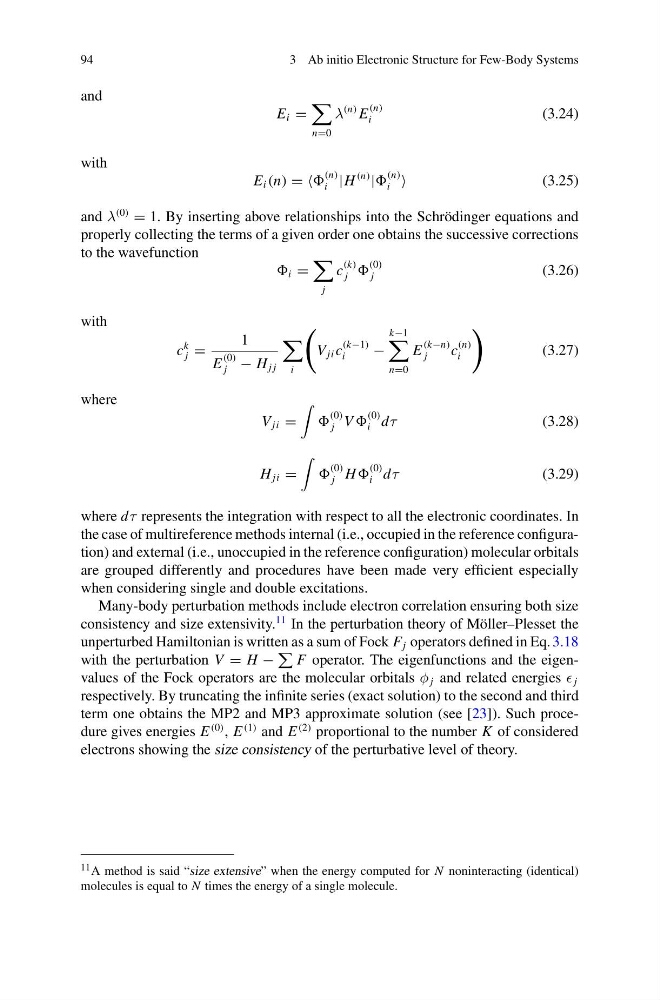
= 1. By inserting above relationships into the Schrödinger equations and
properly collecting the terms of a given order one obtains the successive corrections
to the wavefunction
i =
j
c
(k)
j
(0)
j
(3.26)
with
c
k
j =
1
E
(0)
j − H j j
i
V ji c
(k−1)
i
−
k−1
n=0
E
(k−n)
j
c
(n)
i
(3.27)
where
V ji =
(0)
j V
(0)
i dτ
(3.28)
H ji =
(0)
j H
(0)
i dτ
(3.29)
where dτ represents the integration with respect to all the electronic coordinates. In
the case of multireference methods internal (i.e., occupied in the reference configuration) and external (i.e., unoccupied in the reference configuration) molecular orbitals
are grouped differently and procedures have been made very efficient especially
when considering single and double excitations.
Many-body perturbation methods include electron correlation ensuring both size
consistency and size extensivity.
11 In the perturbation theory of Möller–Plesset the
unperturbed Hamiltonian is written as a sum of Fock F j operators defined in Eq. 3.18
with the perturbation V = H −
F operator. The eigenfunctions and the eigenvalues of the Fock operators are the molecular orbitals φ j and related energies j
respectively. By truncating the infinite series (exact solution) to the second and third
term one obtains the MP2 and MP3 approximate solution (see [23]). Such procedure gives energies E
(0) , E
(1) and E
(2) proportional to the number K of considered
electrons showing the size consistency of the perturbative level of theory.
11 A method is said “size extensive” when the energy computed for N noninteracting (identical)
molecules is equal to N times the energy of a single molecule.
3 Ab initio Electronic Structure for Few-Body Systems
and
E i =
n=0
λ
(n) E
(n)
i
(3.24)
with
E i (n) = =
(n)
i |H
(n)
|
(n)
i
(3.25)
and λ
(0)
= 1. By inserting above relationships into the Schrödinger equations and
properly collecting the terms of a given order one obtains the successive corrections
to the wavefunction
i =
j
c
(k)
j
(0)
j
(3.26)
with
c
k
j =
1
E
(0)
j − H j j
i
V ji c
(k−1)
i
−
k−1
n=0
E
(k−n)
j
c
(n)
i
(3.27)
where
V ji =
(0)
j V
(0)
i dτ
(3.28)
H ji =
(0)
j H
(0)
i dτ
(3.29)
where dτ represents the integration with respect to all the electronic coordinates. In
the case of multireference methods internal (i.e., occupied in the reference configuration) and external (i.e., unoccupied in the reference configuration) molecular orbitals
are grouped differently and procedures have been made very efficient especially
when considering single and double excitations.
Many-body perturbation methods include electron correlation ensuring both size
consistency and size extensivity.
11 In the perturbation theory of Möller–Plesset the
unperturbed Hamiltonian is written as a sum of Fock F j operators defined in Eq. 3.18
with the perturbation V = H −
F operator. The eigenfunctions and the eigenvalues of the Fock operators are the molecular orbitals φ j and related energies j
respectively. By truncating the infinite series (exact solution) to the second and third
term one obtains the MP2 and MP3 approximate solution (see [23]). Such procedure gives energies E
(0) , E
(1) and E
(2) proportional to the number K of considered
electrons showing the size consistency of the perturbative level of theory.
11 A method is said “size extensive” when the energy computed for N noninteracting (identical)
molecules is equal to N times the energy of a single molecule.