

90
3 Ab initio Electronic Structure for Few-Body Systems
the coordinates of electron 1),
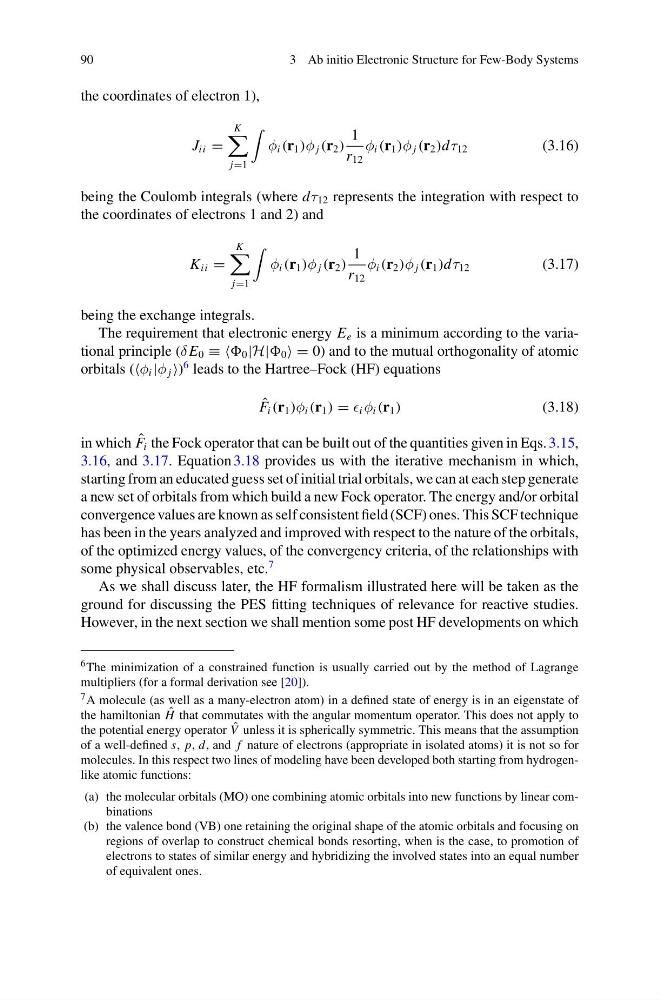
J ii =
K
j=1
φ i (r 1 )φ j (r 2 )
1
r 12
φ i (r 1 )φ j (r 2 )dτ 12
(3.16)
being the Coulomb integrals (where dτ 12 represents the integration with respect to
the coordinates of electrons 1 and 2) and
K ii =
K
j=1
φ i (r 1 )φ j (r 2 )
1
r 12
φ i (r 2 )φ j (r 1 )dτ 12
(3.17)
being the exchange integrals.
The requirement that electronic energy E e is a minimum according to the variational principle (δ E 0 ≡ ≡ 0 |H| 0 = 0) and to the mutual orthogonality of atomic
orbitals (φ i |φ j )
6 leads to the Hartree–Fock (HF) equations
ˆ
F i (r 1 )φ i (r 1 ) = i φ i (r 1 )
(3.18)
in which ˆ
F i the Fock operator that can be built out of the quantities given in Eqs. 3.15,
3.16, and 3.17. Equation 3.18 provides us with the iterative mechanism in which,
starting from an educated guess set of initial trial orbitals, we can at each step generate
a new set of orbitals from which build a new Fock operator. The energy and/or orbital
convergence values are known as self consistent field (SCF) ones. This SCF technique
has been in the years analyzed and improved with respect to the nature of the orbitals,
of the optimized energy values, of the convergency criteria, of the relationships with
some physical observables, etc.
7
As we shall discuss later, the HF formalism illustrated here will be taken as the
ground for discussing the PES fitting techniques of relevance for reactive studies.
However, in the next section we shall mention some post HF developments on which
6 The minimization of a constrained function is usually carried out by the method of Lagrange
multipliers (for a formal derivation see [20]).
7 A molecule (as well as a many-electron atom) in a defined state of energy is in an eigenstate of
the hamiltonian ˆ
H that commutates with the angular momentum operator. This does not apply to
the potential energy operator ˆ
V unless it is spherically symmetric. This means that the assumption
of a well-defined s, p, d, and f nature of electrons (appropriate in isolated atoms) it is not so for
molecules. In this respect two lines of modeling have been developed both starting from hydrogenlike atomic functions:
(a) the molecular orbitals (MO) one combining atomic orbitals into new functions by linear combinations
(b) the valence bond (VB) one retaining the original shape of the atomic orbitals and focusing on
regions of overlap to construct chemical bonds resorting, when is the case, to promotion of
electrons to states of similar energy and hybridizing the involved states into an equal number
of equivalent ones.
3 Ab initio Electronic Structure for Few-Body Systems
the coordinates of electron 1),
J ii =
K
j=1
φ i (r 1 )φ j (r 2 )
1
r 12
φ i (r 1 )φ j (r 2 )dτ 12
(3.16)
being the Coulomb integrals (where dτ 12 represents the integration with respect to
the coordinates of electrons 1 and 2) and
K ii =
K
j=1
φ i (r 1 )φ j (r 2 )
1
r 12
φ i (r 2 )φ j (r 1 )dτ 12
(3.17)
being the exchange integrals.
The requirement that electronic energy E e is a minimum according to the variational principle (δ E 0 ≡ ≡ 0 |H| 0 = 0) and to the mutual orthogonality of atomic
orbitals (φ i |φ j )
6 leads to the Hartree–Fock (HF) equations
ˆ
F i (r 1 )φ i (r 1 ) = i φ i (r 1 )
(3.18)
in which ˆ
F i the Fock operator that can be built out of the quantities given in Eqs. 3.15,
3.16, and 3.17. Equation 3.18 provides us with the iterative mechanism in which,
starting from an educated guess set of initial trial orbitals, we can at each step generate
a new set of orbitals from which build a new Fock operator. The energy and/or orbital
convergence values are known as self consistent field (SCF) ones. This SCF technique
has been in the years analyzed and improved with respect to the nature of the orbitals,
of the optimized energy values, of the convergency criteria, of the relationships with
some physical observables, etc.
7
As we shall discuss later, the HF formalism illustrated here will be taken as the
ground for discussing the PES fitting techniques of relevance for reactive studies.
However, in the next section we shall mention some post HF developments on which
6 The minimization of a constrained function is usually carried out by the method of Lagrange
multipliers (for a formal derivation see [20]).
7 A molecule (as well as a many-electron atom) in a defined state of energy is in an eigenstate of
the hamiltonian ˆ
H that commutates with the angular momentum operator. This does not apply to
the potential energy operator ˆ
V unless it is spherically symmetric. This means that the assumption
of a well-defined s, p, d, and f nature of electrons (appropriate in isolated atoms) it is not so for
molecules. In this respect two lines of modeling have been developed both starting from hydrogenlike atomic functions:
(a) the molecular orbitals (MO) one combining atomic orbitals into new functions by linear combinations
(b) the valence bond (VB) one retaining the original shape of the atomic orbitals and focusing on
regions of overlap to construct chemical bonds resorting, when is the case, to promotion of
electrons to states of similar energy and hybridizing the involved states into an equal number
of equivalent ones.