

88
3 Ab initio Electronic Structure for Few-Body Systems
closed shell ground state, one can obtain, therefore, both the χ 1sα (r 1 )χ 1sβ (r 2 ) and
the −χ 1sα (r 2 )χ 1sβ (r 1 ) products as well as their sum.
4
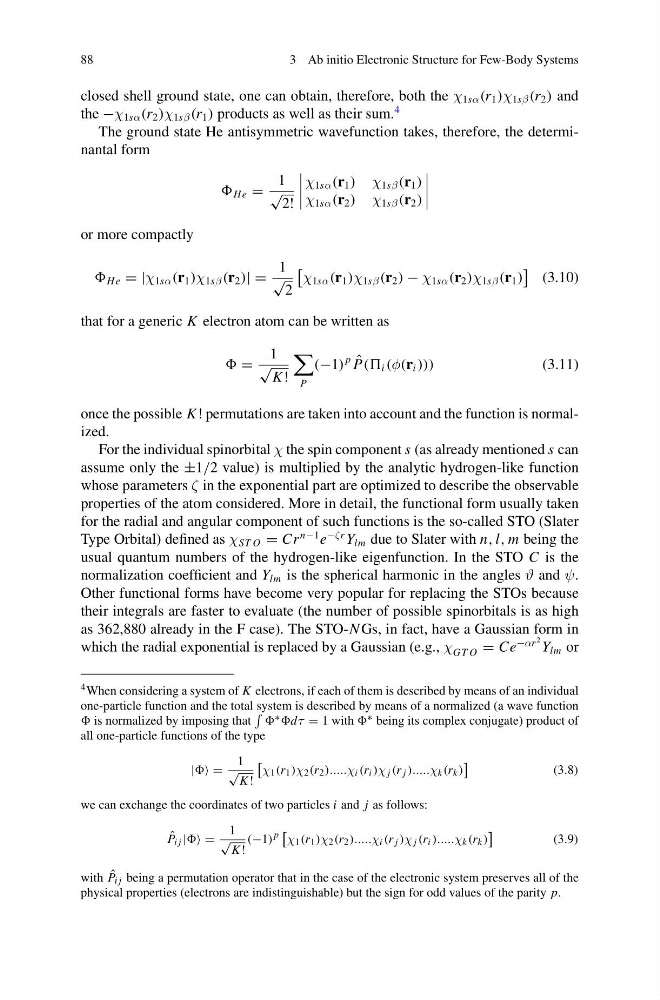
The ground state He antisymmetric wavefunction takes, therefore, the determinantal form
He =
1
√
2!
χ 1sα (r 1 ) χ 1sβ (r 1 )
χ 1sα (r 2 ) χ 1sβ (r 2 )
or more compactly
He = |χ 1sα (r 1 )χ 1sβ (r 2 )| =
1
√
2
χ 1sα (r 1 )χ 1sβ (r 2 ) − χ 1sα (r 2 )χ 1sβ (r 1 )
(3.10)
that for a generic K electron atom can be written as
=
1
√
K !
P
(−1)
p ˆ
P(( i (φ(r i )))
(3.11)
once the possible K ! permutations are taken into account and the function is normalized.
For the individual spinorbital χ the spin component s (as already mentioned s can
assume only the ±1/2 value) is multiplied by the analytic hydrogen-like function
whose parameters ζ in the exponential part are optimized to describe the observable
properties of the atom considered. More in detail, the functional form usually taken
for the radial and angular component of such functions is the so-called STO (Slater
Type Orbital) defined as χ ST O = Cr
n−1 e
−ζr Y lm due to Slater with n, l, m being the
usual quantum numbers of the hydrogen-like eigenfunction. In the STO C is the
normalization coefficient and Y lm is the spherical harmonic in the angles ϑ and ψ.
Other functional forms have become very popular for replacing the STOs because
their integrals are faster to evaluate (the number of possible spinorbitals is as high
as 362,880 already in the F case). The STO-N Gs, in fact, have a Gaussian form in
which the radial exponential is replaced by a Gaussian (e.g., χ GT O = Ce
−αr
2 Y lm or
4 When considering a system of K electrons, if each of them is described by means of an individual
one-particle function and the total system is described by means of a normalized (a wave function
is normalized by imposing that
∗ dτ = 1 with ∗ being its complex conjugate) product of
all one-particle functions of the type
| =
1
√
K !
χ 1 (r 1 )χ 2 (r 2 ).....χ i (r i )χ j (r j ).....χ k (r k )
(3.8)
we can exchange the coordinates of two particles i and j as follows:
ˆ
P i j | =
1
√
K !
(−1)
p
χ 1 (r 1 )χ 2 (r 2 ).....χ i (r j )χ j (r i ).....χ k (r k )
(3.9)
with ˆ
P i j being a permutation operator that in the case of the electronic system preserves all of the
physical properties (electrons are indistinguishable) but the sign for odd values of the parity p.
3 Ab initio Electronic Structure for Few-Body Systems
closed shell ground state, one can obtain, therefore, both the χ 1sα (r 1 )χ 1sβ (r 2 ) and
the −χ 1sα (r 2 )χ 1sβ (r 1 ) products as well as their sum.
4
The ground state He antisymmetric wavefunction takes, therefore, the determinantal form
He =
1
√
2!
χ 1sα (r 1 ) χ 1sβ (r 1 )
χ 1sα (r 2 ) χ 1sβ (r 2 )
or more compactly
He = |χ 1sα (r 1 )χ 1sβ (r 2 )| =
1
√
2
χ 1sα (r 1 )χ 1sβ (r 2 ) − χ 1sα (r 2 )χ 1sβ (r 1 )
(3.10)
that for a generic K electron atom can be written as
=
1
√
K !
P
(−1)
p ˆ
P(( i (φ(r i )))
(3.11)
once the possible K ! permutations are taken into account and the function is normalized.
For the individual spinorbital χ the spin component s (as already mentioned s can
assume only the ±1/2 value) is multiplied by the analytic hydrogen-like function
whose parameters ζ in the exponential part are optimized to describe the observable
properties of the atom considered. More in detail, the functional form usually taken
for the radial and angular component of such functions is the so-called STO (Slater
Type Orbital) defined as χ ST O = Cr
n−1 e
−ζr Y lm due to Slater with n, l, m being the
usual quantum numbers of the hydrogen-like eigenfunction. In the STO C is the
normalization coefficient and Y lm is the spherical harmonic in the angles ϑ and ψ.
Other functional forms have become very popular for replacing the STOs because
their integrals are faster to evaluate (the number of possible spinorbitals is as high
as 362,880 already in the F case). The STO-N Gs, in fact, have a Gaussian form in
which the radial exponential is replaced by a Gaussian (e.g., χ GT O = Ce
−αr
2 Y lm or
4 When considering a system of K electrons, if each of them is described by means of an individual
one-particle function and the total system is described by means of a normalized (a wave function
is normalized by imposing that
∗ dτ = 1 with ∗ being its complex conjugate) product of
all one-particle functions of the type
| =
1
√
K !
χ 1 (r 1 )χ 2 (r 2 ).....χ i (r i )χ j (r j ).....χ k (r k )
(3.8)
we can exchange the coordinates of two particles i and j as follows:
ˆ
P i j | =
1
√
K !
(−1)
p
χ 1 (r 1 )χ 2 (r 2 ).....χ i (r j )χ j (r i ).....χ k (r k )
(3.9)
with ˆ
P i j being a permutation operator that in the case of the electronic system preserves all of the
physical properties (electrons are indistinguishable) but the sign for odd values of the parity p.