

3.1 Structured Bodies
87
bitals.
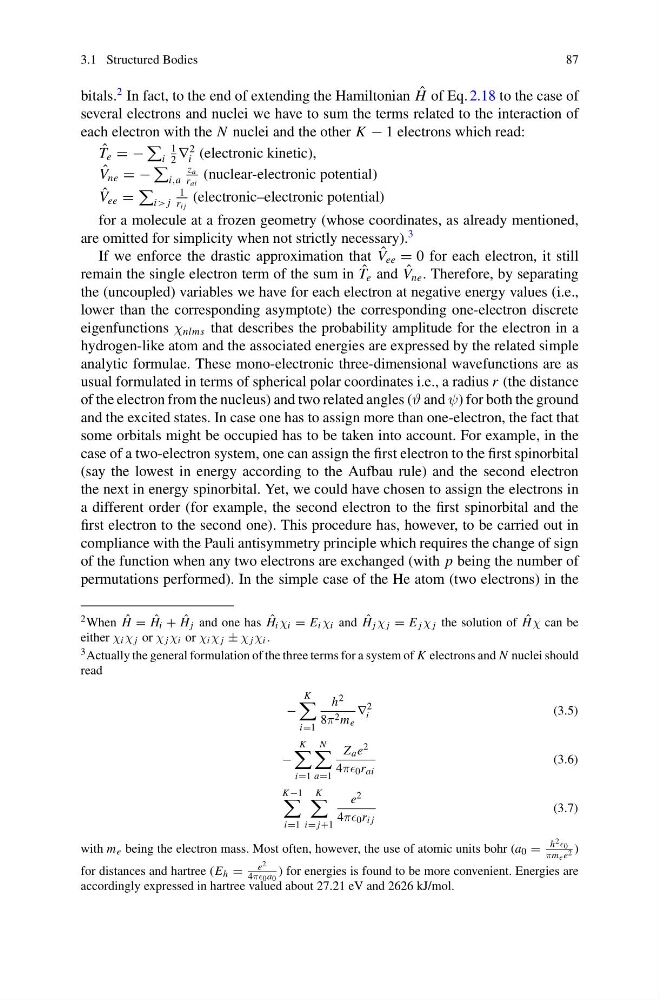
2 In fact, to the end of extending the Hamiltonian ˆ
H of Eq. 2.18 to the case of
several electrons and nuclei we have to sum the terms related to the interaction of
each electron with the N nuclei and the other K − 1 electrons which read:
ˆ
T e = −
i
1
2
∇
2
i (electronic kinetic),
ˆ
V ne = −
i,a
z a
r ai
(nuclear-electronic potential)
ˆ
V ee =
i> j
1
r i j
(electronic–electronic potential)
for a molecule at a frozen geometry (whose coordinates, as already mentioned,
are omitted for simplicity when not strictly necessary).
3
If we enforce the drastic approximation that ˆ
V ee = 0 for each electron, it still
remain the single electron term of the sum in ˆ
T e and ˆ
V ne . Therefore, by separating
the (uncoupled) variables we have for each electron at negative energy values (i.e.,
lower than the corresponding asymptote) the corresponding one-electron discrete
eigenfunctions χ nlms that describes the probability amplitude for the electron in a
hydrogen-like atom and the associated energies are expressed by the related simple
analytic formulae. These mono-electronic three-dimensional wavefunctions are as
usual formulated in terms of spherical polar coordinates i.e., a radius r (the distance
of the electron from the nucleus) and two related angles (ϑ and ψ) for both the ground
and the excited states. In case one has to assign more than one-electron, the fact that
some orbitals might be occupied has to be taken into account. For example, in the
case of a two-electron system, one can assign the first electron to the first spinorbital
(say the lowest in energy according to the Aufbau rule) and the second electron
the next in energy spinorbital. Yet, we could have chosen to assign the electrons in
a different order (for example, the second electron to the first spinorbital and the
first electron to the second one). This procedure has, however, to be carried out in
compliance with the Pauli antisymmetry principle which requires the change of sign
of the function when any two electrons are exchanged (with p being the number of
permutations performed). In the simple case of the He atom (two electrons) in the
2 When ˆ
H = ˆ
H i + ˆ
H j and one has ˆ
H i χ i = E i χ i and ˆ
H j χ j = E j χ j the solution of ˆ
H χ can be
either χ i χ j or χ j χ i or χ i χ j ± χ j χ i .
3 Actually the general formulation of the three terms for a system of K electrons and N nuclei should
read
−
K
i=1
h 2
8π 2 m e
∇
2
i
(3.5)
−
K
i=1
N
a=1
Z a e 2
4ππ 0 r ai
(3.6)
K −1
i=1
K
i= j+1
e 2
4ππ 0 r i j
(3.7)
with m e being the electron mass. Most often, however, the use of atomic units bohr (a 0 =
h 2 0
πmee 2 )
for distances and hartree (E h =
e 2
4ππ0a0 ) for energies is found to be more convenient. Energies are
accordingly expressed in hartree valued about 27.21 eV and 2626 kJ/mol.
87
bitals.
2 In fact, to the end of extending the Hamiltonian ˆ
H of Eq. 2.18 to the case of
several electrons and nuclei we have to sum the terms related to the interaction of
each electron with the N nuclei and the other K − 1 electrons which read:
ˆ
T e = −
i
1
2
∇
2
i (electronic kinetic),
ˆ
V ne = −
i,a
z a
r ai
(nuclear-electronic potential)
ˆ
V ee =
i> j
1
r i j
(electronic–electronic potential)
for a molecule at a frozen geometry (whose coordinates, as already mentioned,
are omitted for simplicity when not strictly necessary).
3
If we enforce the drastic approximation that ˆ
V ee = 0 for each electron, it still
remain the single electron term of the sum in ˆ
T e and ˆ
V ne . Therefore, by separating
the (uncoupled) variables we have for each electron at negative energy values (i.e.,
lower than the corresponding asymptote) the corresponding one-electron discrete
eigenfunctions χ nlms that describes the probability amplitude for the electron in a
hydrogen-like atom and the associated energies are expressed by the related simple
analytic formulae. These mono-electronic three-dimensional wavefunctions are as
usual formulated in terms of spherical polar coordinates i.e., a radius r (the distance
of the electron from the nucleus) and two related angles (ϑ and ψ) for both the ground
and the excited states. In case one has to assign more than one-electron, the fact that
some orbitals might be occupied has to be taken into account. For example, in the
case of a two-electron system, one can assign the first electron to the first spinorbital
(say the lowest in energy according to the Aufbau rule) and the second electron
the next in energy spinorbital. Yet, we could have chosen to assign the electrons in
a different order (for example, the second electron to the first spinorbital and the
first electron to the second one). This procedure has, however, to be carried out in
compliance with the Pauli antisymmetry principle which requires the change of sign
of the function when any two electrons are exchanged (with p being the number of
permutations performed). In the simple case of the He atom (two electrons) in the
2 When ˆ
H = ˆ
H i + ˆ
H j and one has ˆ
H i χ i = E i χ i and ˆ
H j χ j = E j χ j the solution of ˆ
H χ can be
either χ i χ j or χ j χ i or χ i χ j ± χ j χ i .
3 Actually the general formulation of the three terms for a system of K electrons and N nuclei should
read
−
K
i=1
h 2
8π 2 m e
∇
2
i
(3.5)
−
K
i=1
N
a=1
Z a e 2
4ππ 0 r ai
(3.6)
K −1
i=1
K
i= j+1
e 2
4ππ 0 r i j
(3.7)
with m e being the electron mass. Most often, however, the use of atomic units bohr (a 0 =
h 2 0
πmee 2 )
for distances and hartree (E h =
e 2
4ππ0a0 ) for energies is found to be more convenient. Energies are
accordingly expressed in hartree valued about 27.21 eV and 2626 kJ/mol.