

3.1 Localized Versus Delocalized Description of the Two-Electron/Two-Orbital Problem
61
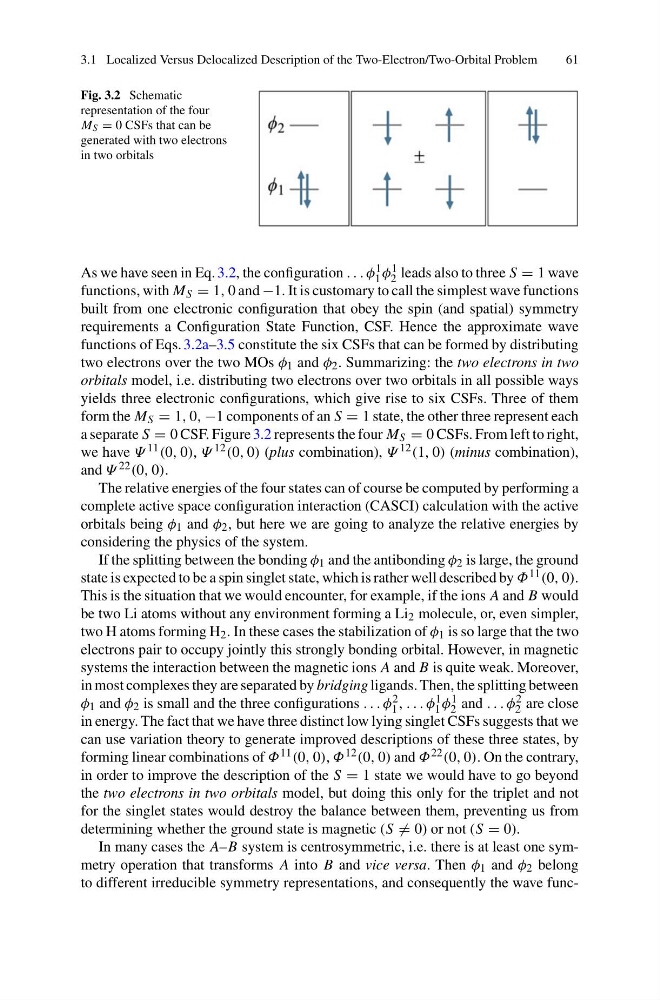
Fig. 3.2 Schematic
representation of the four
M S = 0 CSFs that can be
generated with two electrons
in two orbitals
As we have seen in Eq. 3.2, the configuration ...φ 1
1 φ 1
2 leads also to three S = 1wave
functions, with M S = 1, 0 and −1. It is customary to call the simplest wave functions
built from one electronic configuration that obey the spin (and spatial) symmetry
requirements a Configuration State Function, CSF. Hence the approximate wave
functions of Eqs. 3.2a–3.5 constitute the six CSFs that can be formed by distributing
two electrons over the two MOs φ 1 and φ 2 . Summarizing: the two electrons in two
orbitals model, i.e. distributing two electrons over two orbitals in all possible ways
yields three electronic configurations, which give rise to six CSFs. Three of them
form the M S = 1, 0, −1 components of an S = 1 state, the other three represent each
a separate S = 0 CSF. Figure 3.2 represents the four M S = 0 CSFs. From left to right,
we have Ψ 11 (0, 0), Ψ 12 (0, 0) (plus combination), Ψ 12 (1, 0) (minus combination),
and Ψ 22 (0, 0).
The relative energies of the four states can of course be computed by performing a
complete active space configuration interaction (CASCI) calculation with the active
orbitals being φ 1 and φ 2 , but here we are going to analyze the relative energies by
considering the physics of the system.
If the splitting between the bonding φ 1 and the antibonding φ 2 is large, the ground
state is expected to be a spin singlet state, which is rather well described by Φ 11 (0, 0).
This is the situation that we would encounter, for example, if the ions A and B would
be two Li atoms without any environment forming a Li 2 molecule, or, even simpler,
two H atoms forming H 2 . In these cases the stabilization of φ 1 is so large that the two
electrons pair to occupy jointly this strongly bonding orbital. However, in magnetic
systems the interaction between the magnetic ions A and B is quite weak. Moreover,
in most complexes they are separated by bridging ligands. Then, the splitting between
φ 1 and φ 2 is small and the three configurations ...φ 2
1 , ...φ 1
1 φ 1
2 and ...φ 2
2 are close
in energy. The fact that we have three distinct low lying singlet CSFs suggests that we
can use variation theory to generate improved descriptions of these three states, by
forming linear combinations of Φ 11 (0, 0), Φ 12 (0, 0) and Φ 22 (0, 0). On the contrary,
in order to improve the description of the S = 1 state we would have to go beyond
the two electrons in two orbitals model, but doing this only for the triplet and not
for the singlet states would destroy the balance between them, preventing us from
determining whether the ground state is magnetic (S = 0) or not (S = 0).
In many cases the A–B system is centrosymmetric, i.e. there is at least one symmetry operation that transforms A into B and vice versa. Then φ 1 and φ 2 belong
to different irreducible symmetry representations, and consequently the wave func-
61
Fig. 3.2 Schematic
representation of the four
M S = 0 CSFs that can be
generated with two electrons
in two orbitals
As we have seen in Eq. 3.2, the configuration ...φ 1
1 φ 1
2 leads also to three S = 1wave
functions, with M S = 1, 0 and −1. It is customary to call the simplest wave functions
built from one electronic configuration that obey the spin (and spatial) symmetry
requirements a Configuration State Function, CSF. Hence the approximate wave
functions of Eqs. 3.2a–3.5 constitute the six CSFs that can be formed by distributing
two electrons over the two MOs φ 1 and φ 2 . Summarizing: the two electrons in two
orbitals model, i.e. distributing two electrons over two orbitals in all possible ways
yields three electronic configurations, which give rise to six CSFs. Three of them
form the M S = 1, 0, −1 components of an S = 1 state, the other three represent each
a separate S = 0 CSF. Figure 3.2 represents the four M S = 0 CSFs. From left to right,
we have Ψ 11 (0, 0), Ψ 12 (0, 0) (plus combination), Ψ 12 (1, 0) (minus combination),
and Ψ 22 (0, 0).
The relative energies of the four states can of course be computed by performing a
complete active space configuration interaction (CASCI) calculation with the active
orbitals being φ 1 and φ 2 , but here we are going to analyze the relative energies by
considering the physics of the system.
If the splitting between the bonding φ 1 and the antibonding φ 2 is large, the ground
state is expected to be a spin singlet state, which is rather well described by Φ 11 (0, 0).
This is the situation that we would encounter, for example, if the ions A and B would
be two Li atoms without any environment forming a Li 2 molecule, or, even simpler,
two H atoms forming H 2 . In these cases the stabilization of φ 1 is so large that the two
electrons pair to occupy jointly this strongly bonding orbital. However, in magnetic
systems the interaction between the magnetic ions A and B is quite weak. Moreover,
in most complexes they are separated by bridging ligands. Then, the splitting between
φ 1 and φ 2 is small and the three configurations ...φ 2
1 , ...φ 1
1 φ 1
2 and ...φ 2
2 are close
in energy. The fact that we have three distinct low lying singlet CSFs suggests that we
can use variation theory to generate improved descriptions of these three states, by
forming linear combinations of Φ 11 (0, 0), Φ 12 (0, 0) and Φ 22 (0, 0). On the contrary,
in order to improve the description of the S = 1 state we would have to go beyond
the two electrons in two orbitals model, but doing this only for the triplet and not
for the singlet states would destroy the balance between them, preventing us from
determining whether the ground state is magnetic (S = 0) or not (S = 0).
In many cases the A–B system is centrosymmetric, i.e. there is at least one symmetry operation that transforms A into B and vice versa. Then φ 1 and φ 2 belong
to different irreducible symmetry representations, and consequently the wave func-