

60
3 Two (or More) Magnetic Centers
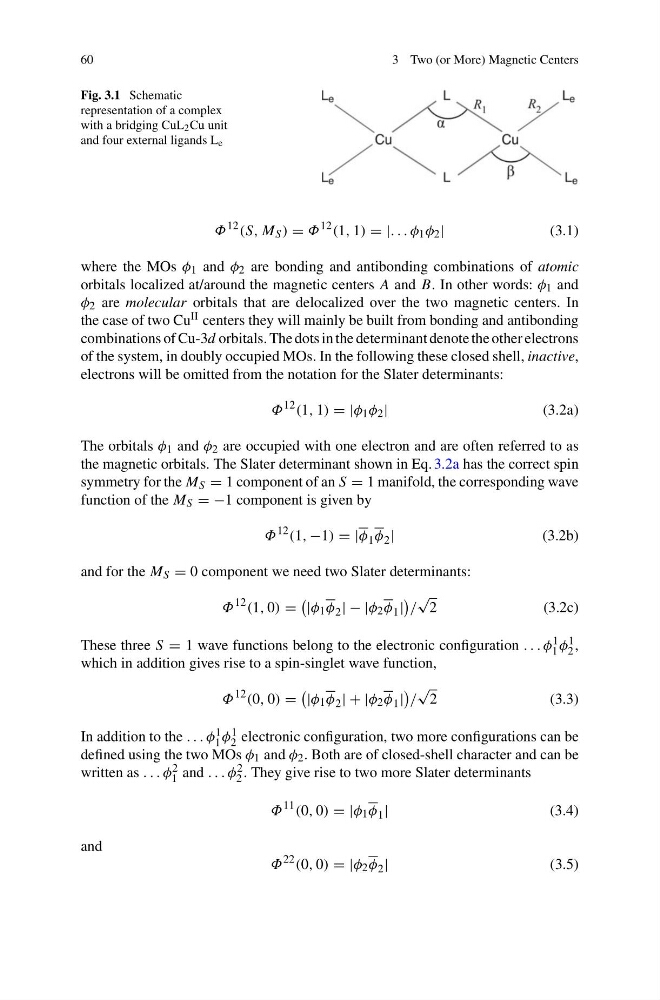
Fig. 3.1 Schematic
representation of a complex
with a bridging CuL 2 Cu unit
and four external ligands L e
Φ
12 (S, M S ) = Φ
12 (1, 1) =|...φ 1 φ 2 |
(3.1)
where the MOs φ 1 and φ 2 are bonding and antibonding combinations of atomic
orbitals localized at/around the magnetic centers A and B. In other words: φ 1 and
φ 2 are molecular orbitals that are delocalized over the two magnetic centers. In
the case of two Cu II centers they will mainly be built from bonding and antibonding
combinations of Cu-3d orbitals. The dots in the determinant denote the other electrons
of the system, in doubly occupied MOs. In the following these closed shell, inactive,
electrons will be omitted from the notation for the Slater determinants:
Φ
12 (1, 1) =|φ 1 φ 2 |
(3.2a)
The orbitals φ 1 and φ 2 are occupied with one electron and are often referred to as
the magnetic orbitals. The Slater determinant shown in Eq. 3.2a has the correct spin
symmetry for the M S = 1 component of an S = 1 manifold, the corresponding wave
function of the M S =−1 component is given by
Φ
12 (1, −1) =|φ 1 φ 2 |
(3.2b)
and for the M S = 0 component we need two Slater determinants:
Φ
12 (1, 0) =
|φ 1 φ 2 |−|φ 2 φ 1 |
/
√
2
(3.2c)
These three S = 1 wave functions belong to the electronic configuration ...φ 1
1 φ 1
2 ,
which in addition gives rise to a spin-singlet wave function,
Φ
12 (0, 0) =
|φ 1 φ 2 |+|φ 2 φ 1 |
/
√
2
(3.3)
In addition to the ...φ 1
1 φ 1
2 electronic configuration, two more configurations can be
defined using the two MOs φ 1 and φ 2 . Both are of closed-shell character and can be
written as ...φ 2
1 and ...φ 2
2 . They give rise to two more Slater determinants
Φ
11 (0, 0) =|φ 1 φ 1 |
(3.4)
and
Φ
22 (0, 0) =|φ 2 φ 2 |
(3.5)
3 Two (or More) Magnetic Centers
Fig. 3.1 Schematic
representation of a complex
with a bridging CuL 2 Cu unit
and four external ligands L e
Φ
12 (S, M S ) = Φ
12 (1, 1) =|...φ 1 φ 2 |
(3.1)
where the MOs φ 1 and φ 2 are bonding and antibonding combinations of atomic
orbitals localized at/around the magnetic centers A and B. In other words: φ 1 and
φ 2 are molecular orbitals that are delocalized over the two magnetic centers. In
the case of two Cu II centers they will mainly be built from bonding and antibonding
combinations of Cu-3d orbitals. The dots in the determinant denote the other electrons
of the system, in doubly occupied MOs. In the following these closed shell, inactive,
electrons will be omitted from the notation for the Slater determinants:
Φ
12 (1, 1) =|φ 1 φ 2 |
(3.2a)
The orbitals φ 1 and φ 2 are occupied with one electron and are often referred to as
the magnetic orbitals. The Slater determinant shown in Eq. 3.2a has the correct spin
symmetry for the M S = 1 component of an S = 1 manifold, the corresponding wave
function of the M S =−1 component is given by
Φ
12 (1, −1) =|φ 1 φ 2 |
(3.2b)
and for the M S = 0 component we need two Slater determinants:
Φ
12 (1, 0) =
|φ 1 φ 2 |−|φ 2 φ 1 |
/
√
2
(3.2c)
These three S = 1 wave functions belong to the electronic configuration ...φ 1
1 φ 1
2 ,
which in addition gives rise to a spin-singlet wave function,
Φ
12 (0, 0) =
|φ 1 φ 2 |+|φ 2 φ 1 |
/
√
2
(3.3)
In addition to the ...φ 1
1 φ 1
2 electronic configuration, two more configurations can be
defined using the two MOs φ 1 and φ 2 . Both are of closed-shell character and can be
written as ...φ 2
1 and ...φ 2
2 . They give rise to two more Slater determinants
Φ
11 (0, 0) =|φ 1 φ 1 |
(3.4)
and
Φ
22 (0, 0) =|φ 2 φ 2 |
(3.5)