

2.3 Further Removal of the Degeneracy of the N-electron States
47
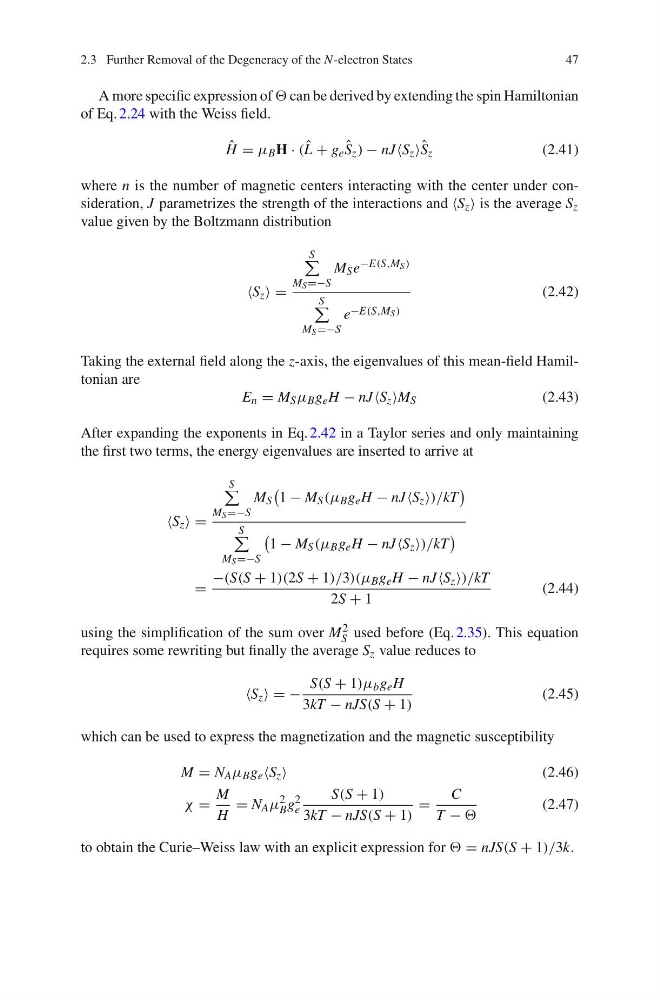
A more specific expression of can be derived by extending the spin Hamiltonian
of Eq. 2.24 with the Weiss field.
ˆ
H = μ B H · ( ˆ
L + g e ˆ
S z ) − nJS z ˆ
S z
(2.41)
where n is the number of magnetic centers interacting with the center under consideration, J parametrizes the strength of the interactions and S z is the average S z
value given by the Boltzmann distribution
S z =
S
M S =−S
M S e −E(S,M S )
S
M S =−S
e −E(S,M S )
(2.42)
Taking the external field along the z-axis, the eigenvalues of this mean-field Hamiltonian are
E n = M S μ B g e H − nJS z M S
(2.43)
After expanding the exponents in Eq. 2.42 in a Taylor series and only maintaining
the first two terms, the energy eigenvalues are inserted to arrive at
S z =
S
M S =−S
M S
1 − M S (μ B g e H − nJS z )/kT
S
M S =−S
1 − M S (μ B g e H − nJS z )/kT
=
−(S(S + 1)(2S + 1)/3)(μ B g e H − nJS z )/kT
2S + 1
(2.44)
using the simplification of the sum over M 2
S used before (Eq. 2.35). This equation
requires some rewriting but finally the average S z value reduces to
S z =−
S(S + 1)μ b g e H
3kT − nJS(S + 1)
(2.45)
which can be used to express the magnetization and the magnetic susceptibility
M = N A μ B g e S z
(2.46)
χ =
M
H
= N A μ
2
B g
2
e
S(S + 1)
3kT − nJS(S + 1)
=
C
T −
(2.47)
to obtain the Curie–Weiss law with an explicit expression for = nJS(S + 1)/3k.
47
A more specific expression of can be derived by extending the spin Hamiltonian
of Eq. 2.24 with the Weiss field.
ˆ
H = μ B H · ( ˆ
L + g e ˆ
S z ) − nJS z ˆ
S z
(2.41)
where n is the number of magnetic centers interacting with the center under consideration, J parametrizes the strength of the interactions and S z is the average S z
value given by the Boltzmann distribution
S z =
S
M S =−S
M S e −E(S,M S )
S
M S =−S
e −E(S,M S )
(2.42)
Taking the external field along the z-axis, the eigenvalues of this mean-field Hamiltonian are
E n = M S μ B g e H − nJS z M S
(2.43)
After expanding the exponents in Eq. 2.42 in a Taylor series and only maintaining
the first two terms, the energy eigenvalues are inserted to arrive at
S z =
S
M S =−S
M S
1 − M S (μ B g e H − nJS z )/kT
S
M S =−S
1 − M S (μ B g e H − nJS z )/kT
=
−(S(S + 1)(2S + 1)/3)(μ B g e H − nJS z )/kT
2S + 1
(2.44)
using the simplification of the sum over M 2
S used before (Eq. 2.35). This equation
requires some rewriting but finally the average S z value reduces to
S z =−
S(S + 1)μ b g e H
3kT − nJS(S + 1)
(2.45)
which can be used to express the magnetization and the magnetic susceptibility
M = N A μ B g e S z
(2.46)
χ =
M
H
= N A μ
2
B g
2
e
S(S + 1)
3kT − nJS(S + 1)
=
C
T −
(2.47)
to obtain the Curie–Weiss law with an explicit expression for = nJS(S + 1)/3k.