

32
1 Basic Concepts
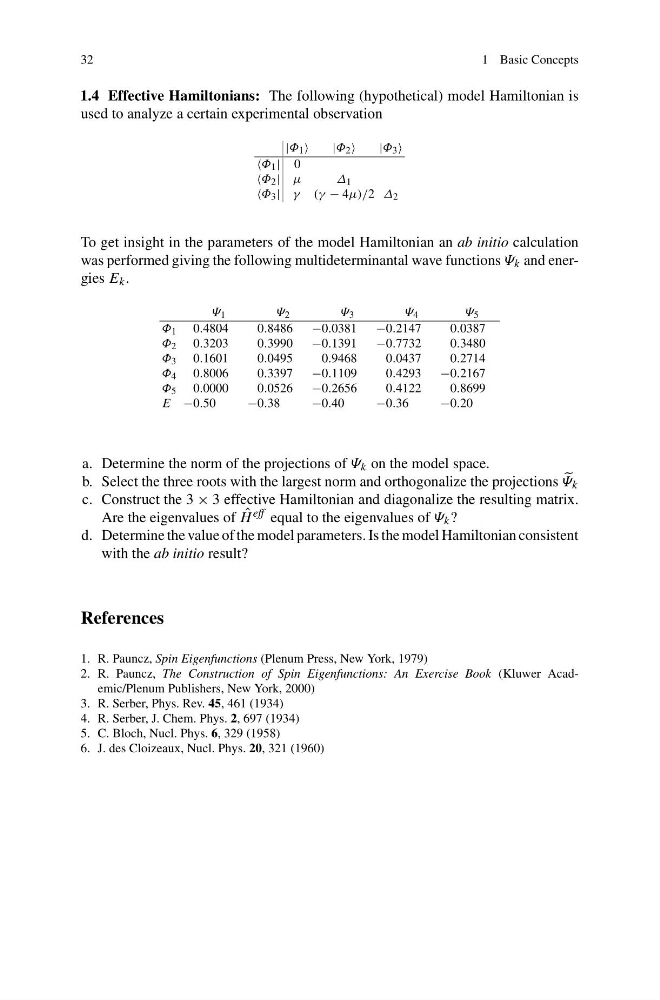
1.4 Effective Hamiltonians: The following (hypothetical) model Hamiltonian is
used to analyze a certain experimental observation
|Φ 1 | Φ 2 | Φ 3
Φ 1 | 0
Φ 2 | µ∆ 1
Φ 3 | γ( γ − 4µ)/2 ∆ 2
To get insight in the parameters of the model Hamiltonian an ab initio calculation
was performed giving the following multideterminantal wave functions Ψ k and energies E k .
Ψ 1
Ψ 2
Ψ 3
Ψ 4
Ψ 5
Φ 1 0.4804
0.8486 −0.0381 −0.2147
0.0387
Φ 2 0.3203
0.3990 −0.1391 −0.7732
0.3480
Φ 3 0.1601
0.0495
0.9468
0.0437
0.2714
Φ 4 0.8006
0.3397 −0.1109
0.4293 −0.2167
Φ 5 0.0000
0.0526 −0.2656
0.4122
0.8699
E −0.50
−0.38
−0.40
−0.36
−0.20
a. Determine the norm of the projections of Ψ k on the model space.
b. Select the three roots with the largest norm and orthogonalize the projections
Ψ k
c. Construct the 3 × 3 effective Hamiltonian and diagonalize the resulting matrix.
Are the eigenvalues of ˆ
H eff equal to the eigenvalues of Ψ k ?
d. Determine the value of the model parameters. Is the model Hamiltonian consistent
with the ab initio result?
References
1. R. Pauncz, Spin Eigenfunctions (Plenum Press, New York, 1979)
2. R. Pauncz, The Construction of Spin Eigenfunctions: An Exercise Book (Kluwer Academic/Plenum Publishers, New York, 2000)
3. R. Serber, Phys. Rev. 45, 461 (1934)
4. R. Serber, J. Chem. Phys. 2, 697 (1934)
5. C. Bloch, Nucl. Phys. 6, 329 (1958)
6. J. des Cloizeaux, Nucl. Phys. 20, 321 (1960)
1 Basic Concepts
1.4 Effective Hamiltonians: The following (hypothetical) model Hamiltonian is
used to analyze a certain experimental observation
|Φ 1 | Φ 2 | Φ 3
Φ 1 | 0
Φ 2 | µ∆ 1
Φ 3 | γ( γ − 4µ)/2 ∆ 2
To get insight in the parameters of the model Hamiltonian an ab initio calculation
was performed giving the following multideterminantal wave functions Ψ k and energies E k .
Ψ 1
Ψ 2
Ψ 3
Ψ 4
Ψ 5
Φ 1 0.4804
0.8486 −0.0381 −0.2147
0.0387
Φ 2 0.3203
0.3990 −0.1391 −0.7732
0.3480
Φ 3 0.1601
0.0495
0.9468
0.0437
0.2714
Φ 4 0.8006
0.3397 −0.1109
0.4293 −0.2167
Φ 5 0.0000
0.0526 −0.2656
0.4122
0.8699
E −0.50
−0.38
−0.40
−0.36
−0.20
a. Determine the norm of the projections of Ψ k on the model space.
b. Select the three roots with the largest norm and orthogonalize the projections
Ψ k
c. Construct the 3 × 3 effective Hamiltonian and diagonalize the resulting matrix.
Are the eigenvalues of ˆ
H eff equal to the eigenvalues of Ψ k ?
d. Determine the value of the model parameters. Is the model Hamiltonian consistent
with the ab initio result?
References
1. R. Pauncz, Spin Eigenfunctions (Plenum Press, New York, 1979)
2. R. Pauncz, The Construction of Spin Eigenfunctions: An Exercise Book (Kluwer Academic/Plenum Publishers, New York, 2000)
3. R. Serber, Phys. Rev. 45, 461 (1934)
4. R. Serber, J. Chem. Phys. 2, 697 (1934)
5. C. Bloch, Nucl. Phys. 6, 329 (1958)
6. J. des Cloizeaux, Nucl. Phys. 20, 321 (1960)