

22
1 Basic Concepts
The first term is the Hamiltonian of a model system with a complete set of known
(normalized) solutions
ˆ
H
(0) ψ
(0)
i
= E
(0)
i ψ
(0)
i
(1.59)
and ˆ
V is the perturbation operator, which perturbs the model system. The parameter λ
can be varied from zero (no perturbation) to one (complete Hamiltonian). In addition
to this splitting of the Hamiltonian, the energy and the wave function are expanded
in Taylor series writing the exact solutions as the sum of the model system solutions
and corrections in the first, second, third, and higher order of the perturbation
ψ 0 = ψ
(0)
0 + λψ
(1)
0 + λ
2 ψ
(2)
0 + λ
3 ψ
(3)
0 +···
E 0 = E
(0)
0 + λE
(1)
0 + λ
2 E
(2)
0 + λ
3 E
(3)
0 +···
(1.60)
where the subscript “0” makes reference to the ground state. The substitution of
Eqs. 1.58 and 1.60 in the Schrödinger equation of the full system leads to
( ˆ
H
(0) + λ ˆ
V )
ψ
(0)
0 + λψ
(1)
0 + λ
2 ψ
(2)
0 +···
=
E
(0)
0 + λE
(1)
0 + λ
2 E
(2)
0 +···
ψ
(0)
0 + λψ
(1)
0 + λ
2 ψ
(2)
0 +···
(1.61)
Since λ can in principle take any value between 0 and 1, this equation only has a
solution when the sum of the left-hand terms of a certain power of λ are equal to
the sum of the right-hand terms of the same power of λ. This permits us to split the
equation and group the terms by the power of λ
λ
0 : ˆ
H
(0) ψ
(0)
0 = E
(0)
0 ψ
(0)
0
(1.62a)
λ
1 : ˆ
H
(0) ψ
(1)
0 + ˆ
V ψ
(0)
0 = E
(0)
0 ψ
(1)
0 + E
(1)
0 ψ
(0)
0
(1.62b)
λ
2 : ˆ
H
(0) ψ
(2)
0 + ˆ
V ψ
(1)
0 = E
(0)
0 ψ
(2)
0 + E
(1)
0 ψ
(1)
0 + E
(2)
0 ψ
(0)
0
(1.62c)
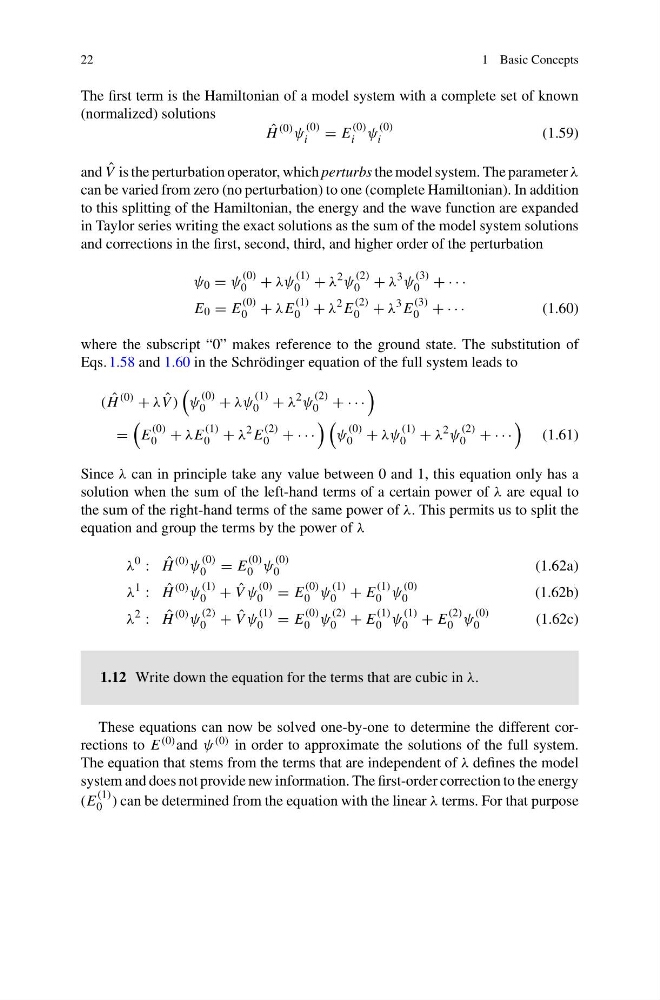
1.12 Write down the equation for the terms that are cubic in λ.
These equations can now be solved one-by-one to determine the different corrections to E (0) and ψ (0) in order to approximate the solutions of the full system.
The equation that stems from the terms that are independent of λ defines the model
system and does not provide new information. The first-order correction to the energy
(E
(1)
0 ) can be determined from the equation with the linear λ terms. For that purpose
1 Basic Concepts
The first term is the Hamiltonian of a model system with a complete set of known
(normalized) solutions
ˆ
H
(0) ψ
(0)
i
= E
(0)
i ψ
(0)
i
(1.59)
and ˆ
V is the perturbation operator, which perturbs the model system. The parameter λ
can be varied from zero (no perturbation) to one (complete Hamiltonian). In addition
to this splitting of the Hamiltonian, the energy and the wave function are expanded
in Taylor series writing the exact solutions as the sum of the model system solutions
and corrections in the first, second, third, and higher order of the perturbation
ψ 0 = ψ
(0)
0 + λψ
(1)
0 + λ
2 ψ
(2)
0 + λ
3 ψ
(3)
0 +···
E 0 = E
(0)
0 + λE
(1)
0 + λ
2 E
(2)
0 + λ
3 E
(3)
0 +···
(1.60)
where the subscript “0” makes reference to the ground state. The substitution of
Eqs. 1.58 and 1.60 in the Schrödinger equation of the full system leads to
( ˆ
H
(0) + λ ˆ
V )
ψ
(0)
0 + λψ
(1)
0 + λ
2 ψ
(2)
0 +···
=
E
(0)
0 + λE
(1)
0 + λ
2 E
(2)
0 +···
ψ
(0)
0 + λψ
(1)
0 + λ
2 ψ
(2)
0 +···
(1.61)
Since λ can in principle take any value between 0 and 1, this equation only has a
solution when the sum of the left-hand terms of a certain power of λ are equal to
the sum of the right-hand terms of the same power of λ. This permits us to split the
equation and group the terms by the power of λ
λ
0 : ˆ
H
(0) ψ
(0)
0 = E
(0)
0 ψ
(0)
0
(1.62a)
λ
1 : ˆ
H
(0) ψ
(1)
0 + ˆ
V ψ
(0)
0 = E
(0)
0 ψ
(1)
0 + E
(1)
0 ψ
(0)
0
(1.62b)
λ
2 : ˆ
H
(0) ψ
(2)
0 + ˆ
V ψ
(1)
0 = E
(0)
0 ψ
(2)
0 + E
(1)
0 ψ
(1)
0 + E
(2)
0 ψ
(0)
0
(1.62c)
1.12 Write down the equation for the terms that are cubic in λ.
These equations can now be solved one-by-one to determine the different corrections to E (0) and ψ (0) in order to approximate the solutions of the full system.
The equation that stems from the terms that are independent of λ defines the model
system and does not provide new information. The first-order correction to the energy
(E
(1)
0 ) can be determined from the equation with the linear λ terms. For that purpose