

20
1 Basic Concepts
1.2.4 Final Remarks
The examples given in the precedent paragraphs cover many real-world cases. The
two-electrons in two-orbitals case discussed in Sect. 1.2.1 is representative of all types
of Cu II binuclear complexes or organic biradicals. It is important to remind that the
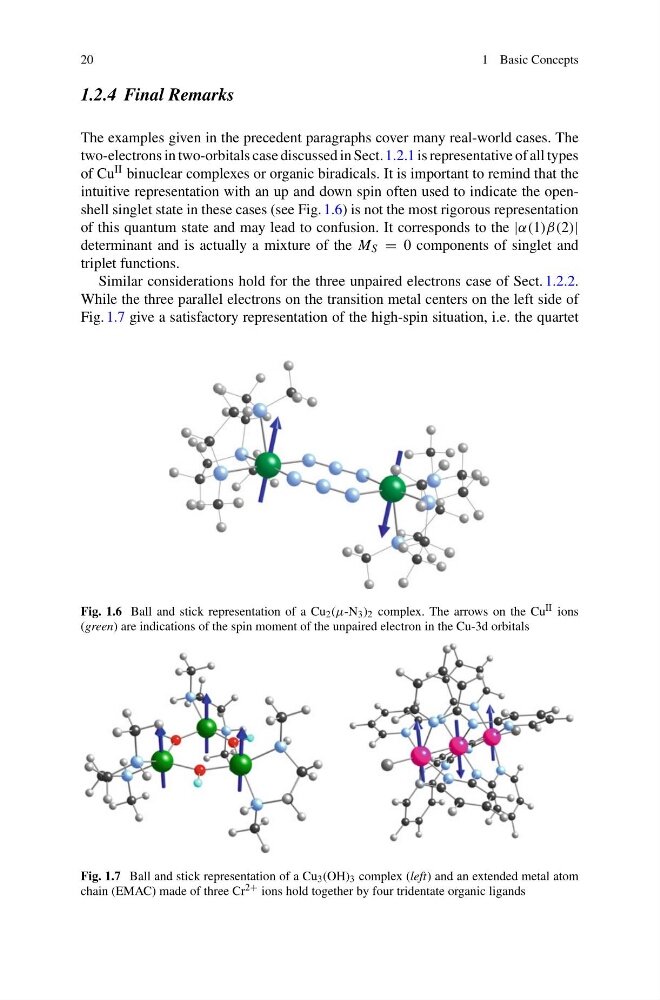
intuitive representation with an up and down spin often used to indicate the openshell singlet state in these cases (see Fig. 1.6) is not the most rigorous representation
of this quantum state and may lead to confusion. It corresponds to the |α(1)β(2)|
determinant and is actually a mixture of the M S = 0 components of singlet and
triplet functions.
Similar considerations hold for the three unpaired electrons case of Sect. 1.2.2.
While the three parallel electrons on the transition metal centers on the left side of
Fig. 1.7 give a satisfactory representation of the high-spin situation, i.e. the quartet
Fig. 1.6 Ball and stick representation of a Cu 2 (µ-N 3 ) 2 complex. The arrows on the Cu II ions
(green) are indications of the spin moment of the unpaired electron in the Cu-3d orbitals
Fig. 1.7 Ball and stick representation of a Cu 3 (OH) 3 complex (left) and an extended metal atom
chain (EMAC) made of three Cr 2+ ions hold together by four tridentate organic ligands
1 Basic Concepts
1.2.4 Final Remarks
The examples given in the precedent paragraphs cover many real-world cases. The
two-electrons in two-orbitals case discussed in Sect. 1.2.1 is representative of all types
of Cu II binuclear complexes or organic biradicals. It is important to remind that the
intuitive representation with an up and down spin often used to indicate the openshell singlet state in these cases (see Fig. 1.6) is not the most rigorous representation
of this quantum state and may lead to confusion. It corresponds to the |α(1)β(2)|
determinant and is actually a mixture of the M S = 0 components of singlet and
triplet functions.
Similar considerations hold for the three unpaired electrons case of Sect. 1.2.2.
While the three parallel electrons on the transition metal centers on the left side of
Fig. 1.7 give a satisfactory representation of the high-spin situation, i.e. the quartet
Fig. 1.6 Ball and stick representation of a Cu 2 (µ-N 3 ) 2 complex. The arrows on the Cu II ions
(green) are indications of the spin moment of the unpaired electron in the Cu-3d orbitals
Fig. 1.7 Ball and stick representation of a Cu 3 (OH) 3 complex (left) and an extended metal atom
chain (EMAC) made of three Cr 2+ ions hold together by four tridentate organic ligands