

226
Appendix E: Solutions
{−0.9184, −0.0898, 0.3853}.( c )Φ k | ˆ
H eff |Φ l =
i ˜
c ⊥
i (k)˜ c ⊥
i (l)E i
ˆ
H eff =
Φ 2
Φ 3
Φ 4
−0.379595
−0.003368 −0.403011
−0.047489 −0.018051 −0.477394
Diagonalization gives −0.5, −0.4 and −0.36 as eigenvalues. (d) µ ==Φ 1 | ˆ
H eff |Φ 2 =
−0.003368, γ == Φ 1 | ˆ
H eff |Φ 3 =− 0.047489. (γ − 4µ)/2 =− 0.017009 ≈
Φ 2 | ˆ
H eff |Φ 3 .
Exercises and Problems of Chap. 2
Exercise 2.1 R = 13.6056925 eV
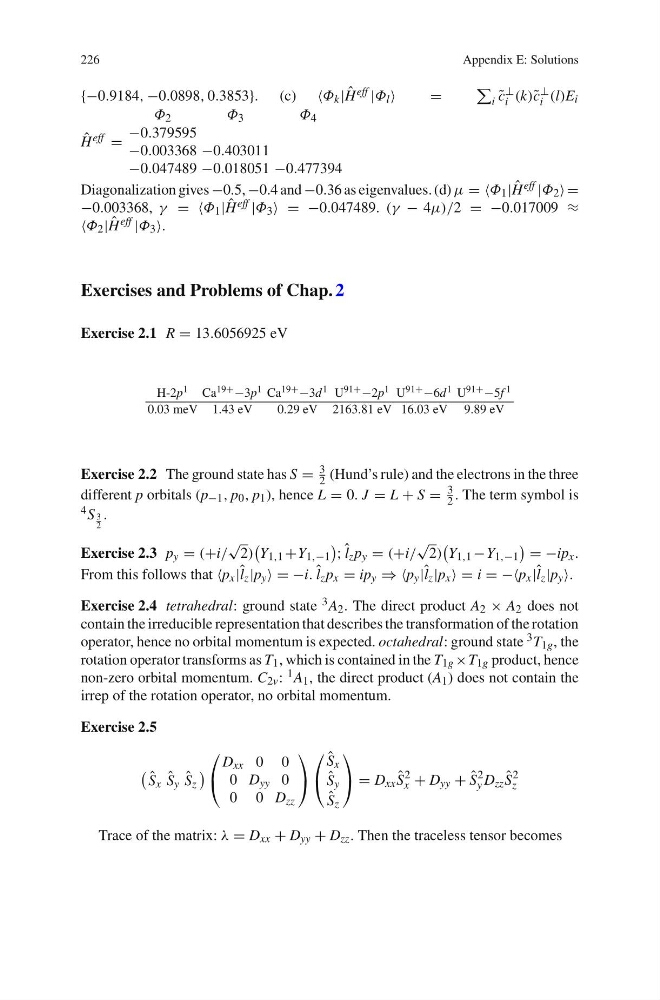
H-2p 1 Ca 19+ −3p 1 Ca 19+ −3d 1 U 91+ −2p 1 U 91+ −6d 1 U 91+ −5f 1
0.03 meV 1.43 eV
0.29 eV 2163.81 eV 16.03 eV 9.89 eV
Exercise 2.2 The ground state has S =
3
2 (Hund’s rule) and the electrons in the three
different p orbitals (p −1 , p 0 , p 1 ), hence L = 0. J = L + S =
3
2 . The term symbol is
4 S 3
2
.
Exercise 2.3 p y = (+i/
√
2)
Y 1,1 +Y 1,−1
; ˆ l z p y = (+i/
√
2)
Y 1,1 −Y 1,−1
=−ip x .
From this follows that p x | ˆ l z |p y =−i. ˆ l z p x = ip y ⇒⇒p y | ˆ l z |p x =i =−−p x | ˆ l z |p y .
Exercise 2.4 tetrahedral: ground state 3 A 2 . The direct product A 2 × A 2 does not
contain the irreducible representation that describes the transformation of the rotation
operator, hence no orbital momentum is expected. octahedral: ground state 3 T 1g ,the
rotation operator transforms as T 1 , which is contained in the T 1g ×T 1g product, hence
non-zero orbital momentum. C 2v : 1 A 1 , the direct product (A 1 ) does not contain the
irrep of the rotation operator, no orbital momentum.
Exercise 2.5
ˆ
S x ˆ
S y ˆ
S z
⎛
⎝
D xx 00
0 D yy 0
00 D zz
⎞
⎠
⎛
⎝
ˆ
S x
ˆ
S y
ˆ
S z
⎞
⎠ = D xx ˆ
S
2
x + D yy + ˆ
S
2
y D zz ˆ
S
2
z
Trace of the matrix: λ = D xx + D yy + D zz . Then the traceless tensor becomes
Appendix E: Solutions
{−0.9184, −0.0898, 0.3853}.( c )Φ k | ˆ
H eff |Φ l =
i ˜
c ⊥
i (k)˜ c ⊥
i (l)E i
ˆ
H eff =
Φ 2
Φ 3
Φ 4
−0.379595
−0.003368 −0.403011
−0.047489 −0.018051 −0.477394
Diagonalization gives −0.5, −0.4 and −0.36 as eigenvalues. (d) µ ==Φ 1 | ˆ
H eff |Φ 2 =
−0.003368, γ == Φ 1 | ˆ
H eff |Φ 3 =− 0.047489. (γ − 4µ)/2 =− 0.017009 ≈
Φ 2 | ˆ
H eff |Φ 3 .
Exercises and Problems of Chap. 2
Exercise 2.1 R = 13.6056925 eV
H-2p 1 Ca 19+ −3p 1 Ca 19+ −3d 1 U 91+ −2p 1 U 91+ −6d 1 U 91+ −5f 1
0.03 meV 1.43 eV
0.29 eV 2163.81 eV 16.03 eV 9.89 eV
Exercise 2.2 The ground state has S =
3
2 (Hund’s rule) and the electrons in the three
different p orbitals (p −1 , p 0 , p 1 ), hence L = 0. J = L + S =
3
2 . The term symbol is
4 S 3
2
.
Exercise 2.3 p y = (+i/
√
2)
Y 1,1 +Y 1,−1
; ˆ l z p y = (+i/
√
2)
Y 1,1 −Y 1,−1
=−ip x .
From this follows that p x | ˆ l z |p y =−i. ˆ l z p x = ip y ⇒⇒p y | ˆ l z |p x =i =−−p x | ˆ l z |p y .
Exercise 2.4 tetrahedral: ground state 3 A 2 . The direct product A 2 × A 2 does not
contain the irreducible representation that describes the transformation of the rotation
operator, hence no orbital momentum is expected. octahedral: ground state 3 T 1g ,the
rotation operator transforms as T 1 , which is contained in the T 1g ×T 1g product, hence
non-zero orbital momentum. C 2v : 1 A 1 , the direct product (A 1 ) does not contain the
irrep of the rotation operator, no orbital momentum.
Exercise 2.5
ˆ
S x ˆ
S y ˆ
S z
⎛
⎝
D xx 00
0 D yy 0
00 D zz
⎞
⎠
⎛
⎝
ˆ
S x
ˆ
S y
ˆ
S z
⎞
⎠ = D xx ˆ
S
2
x + D yy + ˆ
S
2
y D zz ˆ
S
2
z
Trace of the matrix: λ = D xx + D yy + D zz . Then the traceless tensor becomes