

Appendix E: Solutions
225
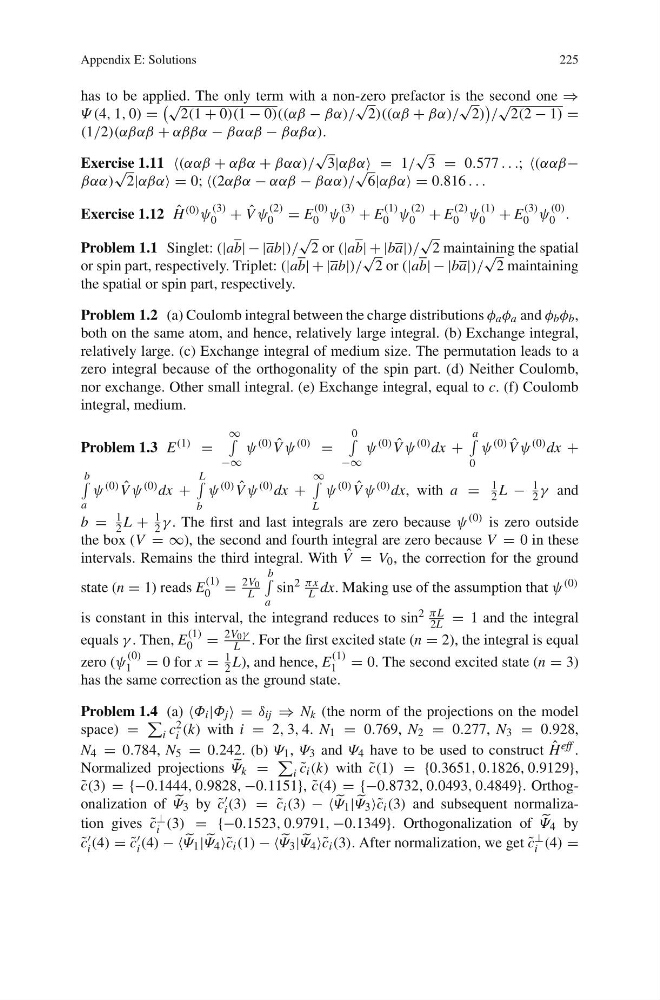
has to be applied. The only term with a non-zero prefactor is the second one ⇒
Ψ(4, 1, 0) =
√
2(1 + 0)(1 − 0)((αβ − βα)/
√
2)((αβ + βα)/
√
2)
/
√
2(2 − 1) =
(1/2)(αβαβ + αββα − βααβ − βαβα).
Exercise 1.11 (ααβ + αβα + βαα)/
√
3|αβα=1/
√
3 = 0.577 ...; (ααβ−
βαα)
√
2|αβα=0; (2αβα − ααβ − βαα)/
√
6|αβα=0.816 ...
Exercise 1.12 ˆ
H (0) ψ
(3)
0 + ˆ
V ψ
(2)
0 = E
(0)
0 ψ
(3)
0 + E
(1)
0 ψ
(2)
0 + E
(2)
0 ψ
(1)
0 + E
(3)
0 ψ
(0)
0 .
Problem 1.1 Singlet: (|ab|−|ab|)/
√
2or(|ab|+|ba|)/
√
2 maintaining the spatial
or spin part, respectively. Triplet: (|ab|+|ab|)/
√
2or(|ab|−|ba|)/
√
2 maintaining
the spatial or spin part, respectively.
Problem 1.2 (a) Coulomb integral between the charge distributions φ a φ a and φ b φ b ,
both on the same atom, and hence, relatively large integral. (b) Exchange integral,
relatively large. (c) Exchange integral of medium size. The permutation leads to a
zero integral because of the orthogonality of the spin part. (d) Neither Coulomb,
nor exchange. Other small integral. (e) Exchange integral, equal to c. (f) Coulomb
integral, medium.
Problem 1.3 E (1) =
∞
−∞
ψ (0) ˆ
V ψ (0) =
0
−∞
ψ (0) ˆ
V ψ (0) dx +
a
0
ψ (0) ˆ
V ψ (0) dx +
b
a
ψ (0) ˆ
V ψ (0) dx +
L
b
ψ (0) ˆ
V ψ (0) dx +
∞
L
ψ (0) ˆ
V ψ (0) dx, with a =
1
2 L −
1
2 γ and
b =
1
2 L +
1
2 γ . The first and last integrals are zero because ψ (0) is zero outside
the box (V =∞ ), the second and fourth integral are zero because V = 0 in these
intervals. Remains the third integral. With ˆ
V = V 0 , the correction for the ground
state (n = 1) reads E
(1)
0 =
2V 0
L
b
a
sin 2 π x
L dx. Making use of the assumption that ψ (0)
is constant in this interval, the integrand reduces to sin 2 π L
2L = 1 and the integral
equals γ . Then, E
(1)
0 =
2V 0 γ
L . For the first excited state (n = 2), the integral is equal
zero (ψ
(0)
1 = 0forx =
1
2 L), and hence, E
(1)
1 = 0. The second excited state (n = 3)
has the same correction as the ground state.
Problem 1.4 (a) Φ i |Φ j =δ ij ⇒ N k (the norm of the projections on the model
space) =
i c 2
i (k) with i = 2, 3, 4. N 1 = 0.769, N 2 = 0.277, N 3 = 0.928,
N 4 = 0.784, N 5 = 0.242. (b) Ψ 1 , Ψ 3 and Ψ 4 have to be used to construct ˆ
H eff .
Normalized projections
Ψ k =
i ˜
c i (k) with ˜
c(1) ={ 0.3651, 0.1826, 0.9129},
˜
c(3) ={ − 0.1444, 0.9828, −0.1151}, ˜
c(4) ={ − 0.8732, 0.0493, 0.4849}. Orthogonalization of
Ψ 3 by ˜
c ′
i (3) =˜ c i (3) −−
Ψ 1 |
Ψ 3 ˜ c i (3) and subsequent normalization gives ˜
c ⊥
i (3) ={ − 0.1523, 0.9791, −0.1349}. Orthogonalization of
Ψ 4 by
˜
c ′
i (4) =˜ c ′
i (4) −−
Ψ 1 |
Ψ 4 ˜ c i (1) −−
Ψ 3 |
Ψ 4 ˜ c i (3). After normalization, we get ˜
c ⊥
i (4) =
225
has to be applied. The only term with a non-zero prefactor is the second one ⇒
Ψ(4, 1, 0) =
√
2(1 + 0)(1 − 0)((αβ − βα)/
√
2)((αβ + βα)/
√
2)
/
√
2(2 − 1) =
(1/2)(αβαβ + αββα − βααβ − βαβα).
Exercise 1.11 (ααβ + αβα + βαα)/
√
3|αβα=1/
√
3 = 0.577 ...; (ααβ−
βαα)
√
2|αβα=0; (2αβα − ααβ − βαα)/
√
6|αβα=0.816 ...
Exercise 1.12 ˆ
H (0) ψ
(3)
0 + ˆ
V ψ
(2)
0 = E
(0)
0 ψ
(3)
0 + E
(1)
0 ψ
(2)
0 + E
(2)
0 ψ
(1)
0 + E
(3)
0 ψ
(0)
0 .
Problem 1.1 Singlet: (|ab|−|ab|)/
√
2or(|ab|+|ba|)/
√
2 maintaining the spatial
or spin part, respectively. Triplet: (|ab|+|ab|)/
√
2or(|ab|−|ba|)/
√
2 maintaining
the spatial or spin part, respectively.
Problem 1.2 (a) Coulomb integral between the charge distributions φ a φ a and φ b φ b ,
both on the same atom, and hence, relatively large integral. (b) Exchange integral,
relatively large. (c) Exchange integral of medium size. The permutation leads to a
zero integral because of the orthogonality of the spin part. (d) Neither Coulomb,
nor exchange. Other small integral. (e) Exchange integral, equal to c. (f) Coulomb
integral, medium.
Problem 1.3 E (1) =
∞
−∞
ψ (0) ˆ
V ψ (0) =
0
−∞
ψ (0) ˆ
V ψ (0) dx +
a
0
ψ (0) ˆ
V ψ (0) dx +
b
a
ψ (0) ˆ
V ψ (0) dx +
L
b
ψ (0) ˆ
V ψ (0) dx +
∞
L
ψ (0) ˆ
V ψ (0) dx, with a =
1
2 L −
1
2 γ and
b =
1
2 L +
1
2 γ . The first and last integrals are zero because ψ (0) is zero outside
the box (V =∞ ), the second and fourth integral are zero because V = 0 in these
intervals. Remains the third integral. With ˆ
V = V 0 , the correction for the ground
state (n = 1) reads E
(1)
0 =
2V 0
L
b
a
sin 2 π x
L dx. Making use of the assumption that ψ (0)
is constant in this interval, the integrand reduces to sin 2 π L
2L = 1 and the integral
equals γ . Then, E
(1)
0 =
2V 0 γ
L . For the first excited state (n = 2), the integral is equal
zero (ψ
(0)
1 = 0forx =
1
2 L), and hence, E
(1)
1 = 0. The second excited state (n = 3)
has the same correction as the ground state.
Problem 1.4 (a) Φ i |Φ j =δ ij ⇒ N k (the norm of the projections on the model
space) =
i c 2
i (k) with i = 2, 3, 4. N 1 = 0.769, N 2 = 0.277, N 3 = 0.928,
N 4 = 0.784, N 5 = 0.242. (b) Ψ 1 , Ψ 3 and Ψ 4 have to be used to construct ˆ
H eff .
Normalized projections
Ψ k =
i ˜
c i (k) with ˜
c(1) ={ 0.3651, 0.1826, 0.9129},
˜
c(3) ={ − 0.1444, 0.9828, −0.1151}, ˜
c(4) ={ − 0.8732, 0.0493, 0.4849}. Orthogonalization of
Ψ 3 by ˜
c ′
i (3) =˜ c i (3) −−
Ψ 1 |
Ψ 3 ˜ c i (3) and subsequent normalization gives ˜
c ⊥
i (3) ={ − 0.1523, 0.9791, −0.1349}. Orthogonalization of
Ψ 4 by
˜
c ′
i (4) =˜ c ′
i (4) −−
Ψ 1 |
Ψ 4 ˜ c i (1) −−
Ψ 3 |
Ψ 4 ˜ c i (3). After normalization, we get ˜
c ⊥
i (4) =