

6.1 Electron Hopping
179
The probability for these hopping processes is normally condensed into a single
parameter referred to as t ab ,butV ab and β (Hückel theory) are also used. Intuitively
one would say that the hopping parameter is the same for all three processes, since
one electron moves from a to b, while the rest of the occupations stay the same in
all cases. But the calculation of the Φ I | ˆ
H|Φ F matrix element shows that this is not
exactly the case. The interaction matrix elements of the initial and final states are
easily determined with the Slater–Condon rules. In the first case, the hopping of an
electron to an empty orbital is defined by
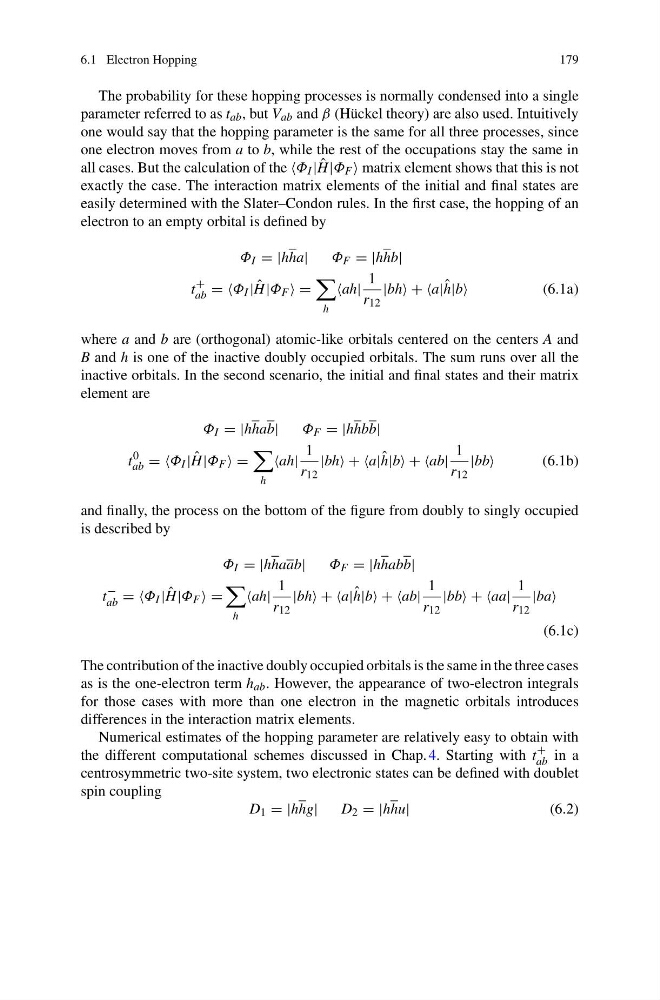
Φ I =|hha|
Φ F =|hhb|
t
+
ab ==Φ I | ˆ
H|Φ F =
h
ah|
1
r 12
|bh++a| ˆ
h|b
(6.1a)
where a and b are (orthogonal) atomic-like orbitals centered on the centers A and
B and h is one of the inactive doubly occupied orbitals. The sum runs over all the
inactive orbitals. In the second scenario, the initial and final states and their matrix
element are
Φ I =|hhab|
Φ F =|hhbb|
t
0
ab ==Φ I | ˆ
H|Φ F =
h
ah|
1
r 12
|bh++a| ˆ
h|b++ab|
1
r 12
|bb
(6.1b)
and finally, the process on the bottom of the figure from doubly to singly occupied
is described by
Φ I =|hhaab|
Φ F =|hhabb|
t
−
ab ==Φ I | ˆ
H|Φ F =
h
ah|
1
r 12
|bh++a| ˆ
h|b++ab|
1
r 12
|bb++aa|
1
r 12
|ba
(6.1c)
The contribution of the inactive doubly occupied orbitals is the same in the three cases
as is the one-electron term h ab . However, the appearance of two-electron integrals
for those cases with more than one electron in the magnetic orbitals introduces
differences in the interaction matrix elements.
Numerical estimates of the hopping parameter are relatively easy to obtain with
the different computational schemes discussed in Chap. 4. Starting with t
+
ab in a
centrosymmetric two-site system, two electronic states can be defined with doublet
spin coupling
D 1 =|hhg|
D 2 =|hhu|
(6.2)
179
The probability for these hopping processes is normally condensed into a single
parameter referred to as t ab ,butV ab and β (Hückel theory) are also used. Intuitively
one would say that the hopping parameter is the same for all three processes, since
one electron moves from a to b, while the rest of the occupations stay the same in
all cases. But the calculation of the Φ I | ˆ
H|Φ F matrix element shows that this is not
exactly the case. The interaction matrix elements of the initial and final states are
easily determined with the Slater–Condon rules. In the first case, the hopping of an
electron to an empty orbital is defined by
Φ I =|hha|
Φ F =|hhb|
t
+
ab ==Φ I | ˆ
H|Φ F =
h
ah|
1
r 12
|bh++a| ˆ
h|b
(6.1a)
where a and b are (orthogonal) atomic-like orbitals centered on the centers A and
B and h is one of the inactive doubly occupied orbitals. The sum runs over all the
inactive orbitals. In the second scenario, the initial and final states and their matrix
element are
Φ I =|hhab|
Φ F =|hhbb|
t
0
ab ==Φ I | ˆ
H|Φ F =
h
ah|
1
r 12
|bh++a| ˆ
h|b++ab|
1
r 12
|bb
(6.1b)
and finally, the process on the bottom of the figure from doubly to singly occupied
is described by
Φ I =|hhaab|
Φ F =|hhabb|
t
−
ab ==Φ I | ˆ
H|Φ F =
h
ah|
1
r 12
|bh++a| ˆ
h|b++ab|
1
r 12
|bb++aa|
1
r 12
|ba
(6.1c)
The contribution of the inactive doubly occupied orbitals is the same in the three cases
as is the one-electron term h ab . However, the appearance of two-electron integrals
for those cases with more than one electron in the magnetic orbitals introduces
differences in the interaction matrix elements.
Numerical estimates of the hopping parameter are relatively easy to obtain with
the different computational schemes discussed in Chap. 4. Starting with t
+
ab in a
centrosymmetric two-site system, two electronic states can be defined with doublet
spin coupling
D 1 =|hhg|
D 2 =|hhu|
(6.2)