

178
6 Magnetism and Conduction
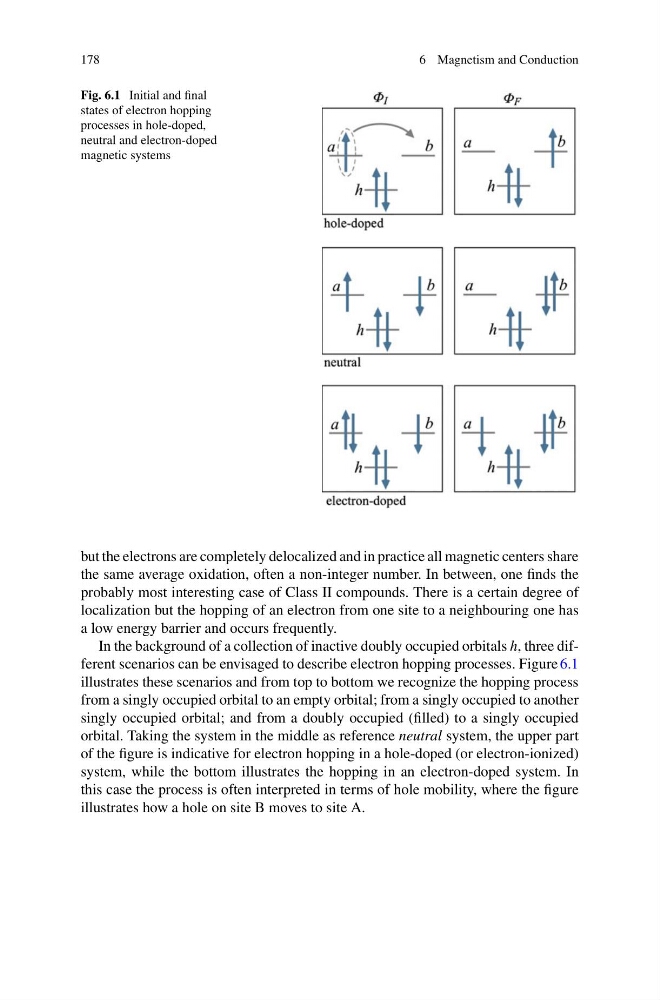
Fig. 6.1 Initial and final
states of electron hopping
processes in hole-doped,
neutral and electron-doped
magnetic systems
but the electrons are completely delocalized and in practice all magnetic centers share
the same average oxidation, often a non-integer number. In between, one finds the
probably most interesting case of Class II compounds. There is a certain degree of
localization but the hopping of an electron from one site to a neighbouring one has
a low energy barrier and occurs frequently.
In the background of a collection of inactive doubly occupied orbitals h, three different scenarios can be envisaged to describe electron hopping processes. Figure 6.1
illustrates these scenarios and from top to bottom we recognize the hopping process
from a singly occupied orbital to an empty orbital; from a singly occupied to another
singly occupied orbital; and from a doubly occupied (filled) to a singly occupied
orbital. Taking the system in the middle as reference neutral system, the upper part
of the figure is indicative for electron hopping in a hole-doped (or electron-ionized)
system, while the bottom illustrates the hopping in an electron-doped system. In
this case the process is often interpreted in terms of hole mobility, where the figure
illustrates how a hole on site B moves to site A.
6 Magnetism and Conduction
Fig. 6.1 Initial and final
states of electron hopping
processes in hole-doped,
neutral and electron-doped
magnetic systems
but the electrons are completely delocalized and in practice all magnetic centers share
the same average oxidation, often a non-integer number. In between, one finds the
probably most interesting case of Class II compounds. There is a certain degree of
localization but the hopping of an electron from one site to a neighbouring one has
a low energy barrier and occurs frequently.
In the background of a collection of inactive doubly occupied orbitals h, three different scenarios can be envisaged to describe electron hopping processes. Figure 6.1
illustrates these scenarios and from top to bottom we recognize the hopping process
from a singly occupied orbital to an empty orbital; from a singly occupied to another
singly occupied orbital; and from a doubly occupied (filled) to a singly occupied
orbital. Taking the system in the middle as reference neutral system, the upper part
of the figure is indicative for electron hopping in a hole-doped (or electron-ionized)
system, while the bottom illustrates the hopping in an electron-doped system. In
this case the process is often interpreted in terms of hole mobility, where the figure
illustrates how a hole on site B moves to site A.