

172
5 Towards a Quantitative Understanding
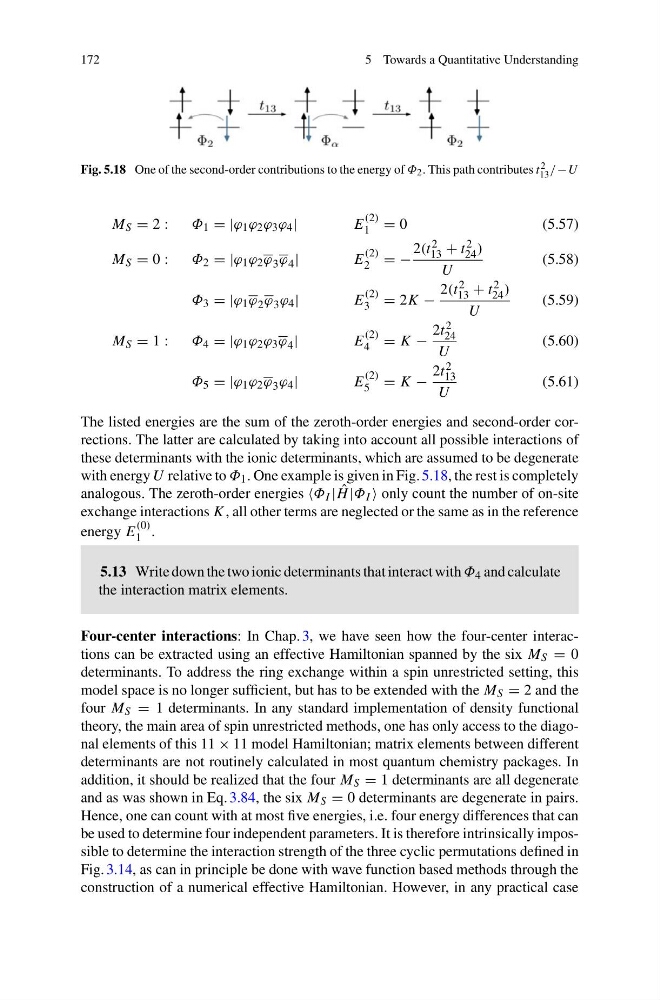
Fig. 5.18 One of the second-order contributions to the energy of Φ 2 . This path contributes t 2
13 /−U
M S = 2 :
Φ 1 =|ϕ 1 ϕ 2 ϕ 3 ϕ 4 |
E
(2)
1 = 0
(5.57)
M S = 0 :
Φ 2 =|ϕ 1 ϕ 2 ϕ 3 ϕ 4 |
E
(2)
2 =−
2(t 2
13 + t 2
24 )
U
(5.58)
Φ 3 =|ϕ 1 ϕ 2 ϕ 3 ϕ 4 |
E
(2)
3 = 2K −
2(t 2
13 + t 2
24 )
U
(5.59)
M S = 1 :
Φ 4 =|ϕ 1 ϕ 2 ϕ 3 ϕ 4 |
E
(2)
4 = K −
2t 2
24
U
(5.60)
Φ 5 =|ϕ 1 ϕ 2 ϕ 3 ϕ 4 |
E
(2)
5 = K −
2t 2
13
U
(5.61)
The listed energies are the sum of the zeroth-order energies and second-order corrections. The latter are calculated by taking into account all possible interactions of
these determinants with the ionic determinants, which are assumed to be degenerate
with energy U relative to Φ 1 . One example is given in Fig. 5.18, the rest is completely
analogous. The zeroth-order energies Φ I | ˆ
H |Φ I only count the number of on-site
exchange interactions K , all other terms are neglected or the same as in the reference
energy E
(0)
1 .
5.13 Write down the two ionic determinants that interact with Φ 4 and calculate
the interaction matrix elements.
Four-center interactions: In Chap. 3, we have seen how the four-center interactions can be extracted using an effective Hamiltonian spanned by the six M S = 0
determinants. To address the ring exchange within a spin unrestricted setting, this
model space is no longer sufficient, but has to be extended with the M S = 2 and the
four M S = 1 determinants. In any standard implementation of density functional
theory, the main area of spin unrestricted methods, one has only access to the diagonal elements of this 11 × 11 model Hamiltonian; matrix elements between different
determinants are not routinely calculated in most quantum chemistry packages. In
addition, it should be realized that the four M S = 1 determinants are all degenerate
and as was shown in Eq. 3.84,thesixM S = 0 determinants are degenerate in pairs.
Hence, one can count with at most five energies, i.e. four energy differences that can
be used to determine four independent parameters. It is therefore intrinsically impossible to determine the interaction strength of the three cyclic permutations defined in
Fig. 3.14, as can in principle be done with wave function based methods through the
construction of a numerical effective Hamiltonian. However, in any practical case
5 Towards a Quantitative Understanding
Fig. 5.18 One of the second-order contributions to the energy of Φ 2 . This path contributes t 2
13 /−U
M S = 2 :
Φ 1 =|ϕ 1 ϕ 2 ϕ 3 ϕ 4 |
E
(2)
1 = 0
(5.57)
M S = 0 :
Φ 2 =|ϕ 1 ϕ 2 ϕ 3 ϕ 4 |
E
(2)
2 =−
2(t 2
13 + t 2
24 )
U
(5.58)
Φ 3 =|ϕ 1 ϕ 2 ϕ 3 ϕ 4 |
E
(2)
3 = 2K −
2(t 2
13 + t 2
24 )
U
(5.59)
M S = 1 :
Φ 4 =|ϕ 1 ϕ 2 ϕ 3 ϕ 4 |
E
(2)
4 = K −
2t 2
24
U
(5.60)
Φ 5 =|ϕ 1 ϕ 2 ϕ 3 ϕ 4 |
E
(2)
5 = K −
2t 2
13
U
(5.61)
The listed energies are the sum of the zeroth-order energies and second-order corrections. The latter are calculated by taking into account all possible interactions of
these determinants with the ionic determinants, which are assumed to be degenerate
with energy U relative to Φ 1 . One example is given in Fig. 5.18, the rest is completely
analogous. The zeroth-order energies Φ I | ˆ
H |Φ I only count the number of on-site
exchange interactions K , all other terms are neglected or the same as in the reference
energy E
(0)
1 .
5.13 Write down the two ionic determinants that interact with Φ 4 and calculate
the interaction matrix elements.
Four-center interactions: In Chap. 3, we have seen how the four-center interactions can be extracted using an effective Hamiltonian spanned by the six M S = 0
determinants. To address the ring exchange within a spin unrestricted setting, this
model space is no longer sufficient, but has to be extended with the M S = 2 and the
four M S = 1 determinants. In any standard implementation of density functional
theory, the main area of spin unrestricted methods, one has only access to the diagonal elements of this 11 × 11 model Hamiltonian; matrix elements between different
determinants are not routinely calculated in most quantum chemistry packages. In
addition, it should be realized that the four M S = 1 determinants are all degenerate
and as was shown in Eq. 3.84,thesixM S = 0 determinants are degenerate in pairs.
Hence, one can count with at most five energies, i.e. four energy differences that can
be used to determine four independent parameters. It is therefore intrinsically impossible to determine the interaction strength of the three cyclic permutations defined in
Fig. 3.14, as can in principle be done with wave function based methods through the
construction of a numerical effective Hamiltonian. However, in any practical case