

5.4 Analysis of Complex Interactions
171
E T = E
(2)
T + E
(4)
T =−
2t 2
13
U
−
2t 2
24
U ′ −
2B 2
K
= 2J
(2) −
2B 2
K
(5.52)
E S = E
(2)
S + E
(4)
S =−
3t 2
13
U
−
3t 2
24
U ′ −
3J 2
4K
= 3J
(2) −
3J (2)2
4K
(5.53)
The comparison with the expression for the singlet and triplet energy eigenvalues of
the Heisenberg Hamiltonian with biquadratic terms leads to a fourth-order estimate
of J as
J = J
(2) −
B 2
K
(5.54)
Then from the singlet energy we get
E S = 3J + 3λ = 3
J
(2) −
B 2
K
+ 3λ = 3J
(2) −
3J (2)2
4K
(5.55)
from which the perturbative expression for λ in terms of t, U and K can be extracted
λ =
B 2
3K
−
J (2)2
4K
(5.56)
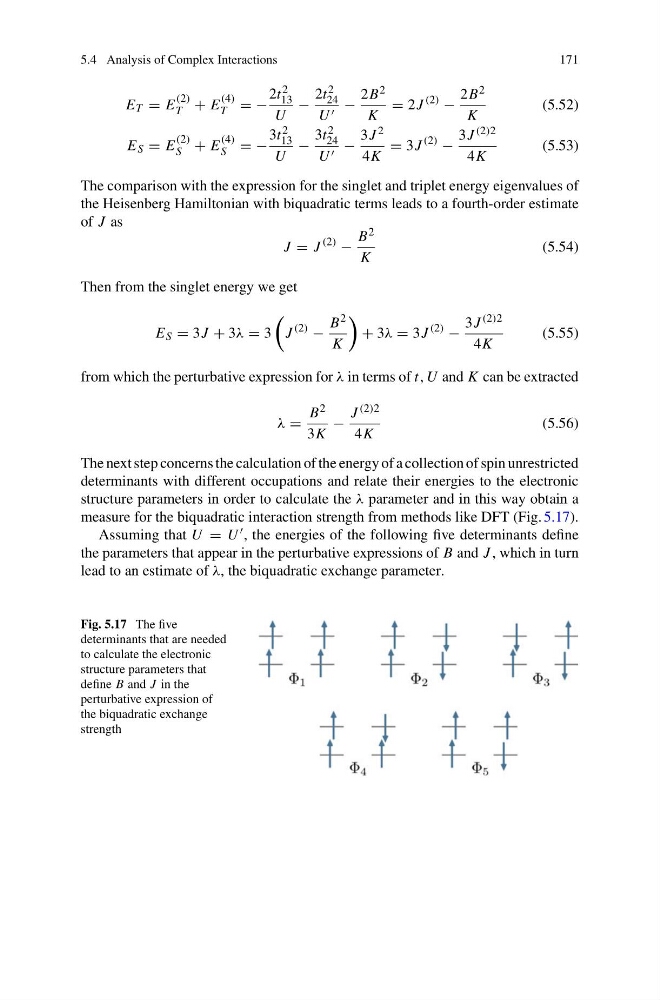
The next step concerns the calculation of the energy of a collection of spin unrestricted
determinants with different occupations and relate their energies to the electronic
structure parameters in order to calculate the λ parameter and in this way obtain a
measure for the biquadratic interaction strength from methods like DFT (Fig. 5.17).
Assuming that U = U ′ , the energies of the following five determinants define
the parameters that appear in the perturbative expressions of B and J , which in turn
lead to an estimate of λ, the biquadratic exchange parameter.
Fig. 5.17 The five
determinants that are needed
to calculate the electronic
structure parameters that
define B and J in the
perturbative expression of
the biquadratic exchange
strength
171
E T = E
(2)
T + E
(4)
T =−
2t 2
13
U
−
2t 2
24
U ′ −
2B 2
K
= 2J
(2) −
2B 2
K
(5.52)
E S = E
(2)
S + E
(4)
S =−
3t 2
13
U
−
3t 2
24
U ′ −
3J 2
4K
= 3J
(2) −
3J (2)2
4K
(5.53)
The comparison with the expression for the singlet and triplet energy eigenvalues of
the Heisenberg Hamiltonian with biquadratic terms leads to a fourth-order estimate
of J as
J = J
(2) −
B 2
K
(5.54)
Then from the singlet energy we get
E S = 3J + 3λ = 3
J
(2) −
B 2
K
+ 3λ = 3J
(2) −
3J (2)2
4K
(5.55)
from which the perturbative expression for λ in terms of t, U and K can be extracted
λ =
B 2
3K
−
J (2)2
4K
(5.56)
The next step concerns the calculation of the energy of a collection of spin unrestricted
determinants with different occupations and relate their energies to the electronic
structure parameters in order to calculate the λ parameter and in this way obtain a
measure for the biquadratic interaction strength from methods like DFT (Fig. 5.17).
Assuming that U = U ′ , the energies of the following five determinants define
the parameters that appear in the perturbative expressions of B and J , which in turn
lead to an estimate of λ, the biquadratic exchange parameter.
Fig. 5.17 The five
determinants that are needed
to calculate the electronic
structure parameters that
define B and J in the
perturbative expression of
the biquadratic exchange
strength