

156
5 Towards a Quantitative Understanding
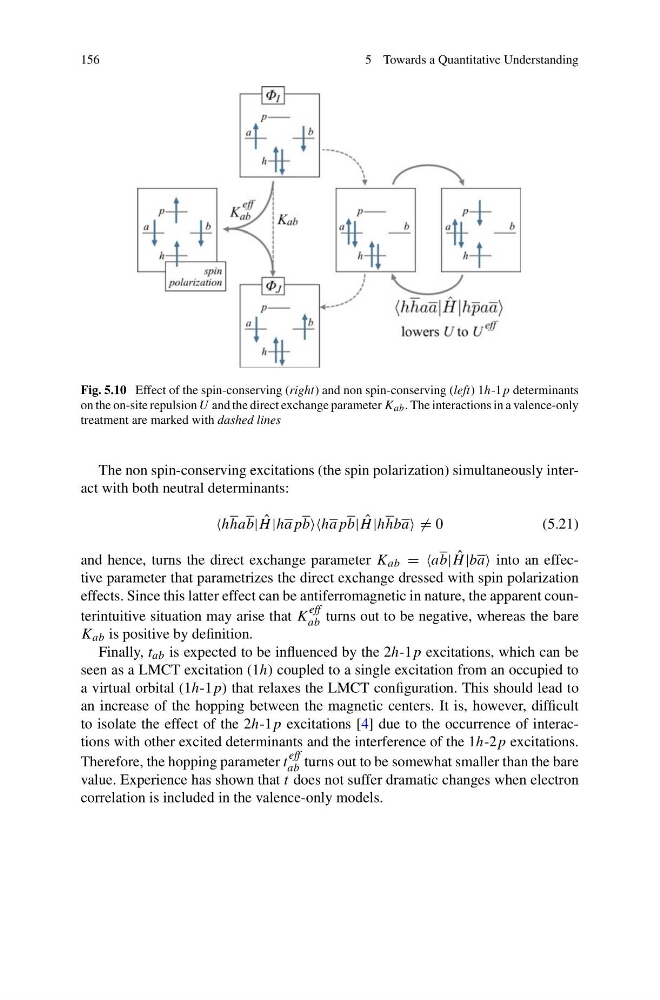
Fig. 5.10 Effect of the spin-conserving (right) and non spin-conserving (left)1h-1 p determinants
on the on-site repulsion U and the direct exchange parameter K ab . The interactions in a valence-only
treatment are marked with dashed lines
The non spin-conserving excitations (the spin polarization) simultaneously interact with both neutral determinants:
hhab| ˆ
H |hapbhapb| ˆ
H |hhba = 0
(5.21)
and hence, turns the direct exchange parameter K ab == ab| ˆ
H |ba into an effective parameter that parametrizes the direct exchange dressed with spin polarization
effects. Since this latter effect can be antiferromagnetic in nature, the apparent counterintuitive situation may arise that K
eff
ab turns out to be negative, whereas the bare
K ab is positive by definition.
Finally, t ab is expected to be influenced by the 2h-1 p excitations, which can be
seen as a LMCT excitation (1h) coupled to a single excitation from an occupied to
a virtual orbital (1h-1 p) that relaxes the LMCT configuration. This should lead to
an increase of the hopping between the magnetic centers. It is, however, difficult
to isolate the effect of the 2h-1 p excitations [4] due to the occurrence of interactions with other excited determinants and the interference of the 1h-2 p excitations.
Therefore, the hopping parameter t
eff
ab turns out to be somewhat smaller than the bare
value. Experience has shown that t does not suffer dramatic changes when electron
correlation is included in the valence-only models.
5 Towards a Quantitative Understanding
Fig. 5.10 Effect of the spin-conserving (right) and non spin-conserving (left)1h-1 p determinants
on the on-site repulsion U and the direct exchange parameter K ab . The interactions in a valence-only
treatment are marked with dashed lines
The non spin-conserving excitations (the spin polarization) simultaneously interact with both neutral determinants:
hhab| ˆ
H |hapbhapb| ˆ
H |hhba = 0
(5.21)
and hence, turns the direct exchange parameter K ab == ab| ˆ
H |ba into an effective parameter that parametrizes the direct exchange dressed with spin polarization
effects. Since this latter effect can be antiferromagnetic in nature, the apparent counterintuitive situation may arise that K
eff
ab turns out to be negative, whereas the bare
K ab is positive by definition.
Finally, t ab is expected to be influenced by the 2h-1 p excitations, which can be
seen as a LMCT excitation (1h) coupled to a single excitation from an occupied to
a virtual orbital (1h-1 p) that relaxes the LMCT configuration. This should lead to
an increase of the hopping between the magnetic centers. It is, however, difficult
to isolate the effect of the 2h-1 p excitations [4] due to the occurrence of interactions with other excited determinants and the interference of the 1h-2 p excitations.
Therefore, the hopping parameter t
eff
ab turns out to be somewhat smaller than the bare
value. Experience has shown that t does not suffer dramatic changes when electron
correlation is included in the valence-only models.