

5.2 Mapping Back on a Valence-Only Model
155
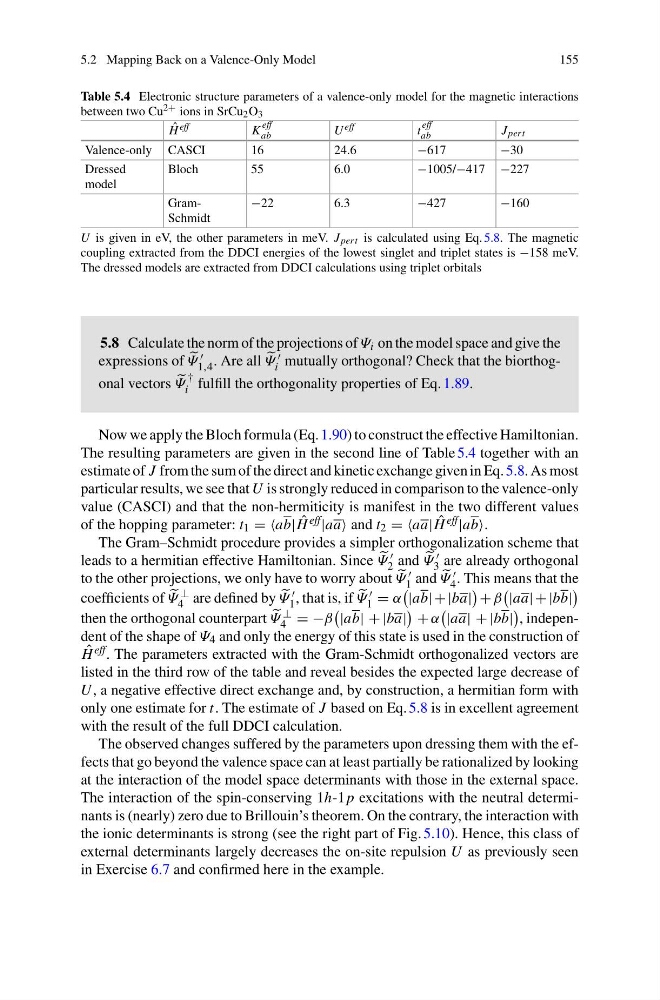
Table 5.4 Electronic structure parameters of a valence-only model for the magnetic interactions
between two Cu 2+ ions in SrCu 2 O 3
ˆ
H eff
K
eff
ab
U eff
t
eff
ab
J pert
Valence-only CASCI
16
24.6
−617
−30
Dressed
model
Bloch
55
6.0
−1005/−417 −227
GramSchmidt
−22
6.3
−427
−160
U is given in eV, the other parameters in meV. J pert is calculated using Eq. 5.8. The magnetic
coupling extracted from the DDCI energies of the lowest singlet and triplet states is −158 meV.
The dressed models are extracted from DDCI calculations using triplet orbitals
5.8 Calculate the norm of the projections of Ψ i on the model space and give the
expressions of
Ψ ′
1,4 .Areall
Ψ ′
i mutually orthogonal? Check that the biorthogonal vectors
Ψ
†
i fulfill the orthogonality properties of Eq. 1.89.
Now we apply the Bloch formula (Eq. 1.90) to construct the effective Hamiltonian.
The resulting parameters are given in the second line of Table 5.4 together with an
estimate of J from the sum of the direct and kinetic exchange given in Eq. 5.8.Asmost
particular results, we see that U is strongly reduced in comparison to the valence-only
value (CASCI) and that the non-hermiticity is manifest in the two different values
of the hopping parameter: t 1 ==ab| ˆ
H eff |aa and t 2 ==aa| ˆ
H eff |ab.
The Gram–Schmidt procedure provides a simpler orthogonalization scheme that
leads to a hermitian effective Hamiltonian. Since
Ψ ′
2 and
Ψ ′
3 are already orthogonal
to the other projections, we only have to worry about
Ψ ′
1 and
Ψ ′
4 . This means that the
coefficients of
Ψ ⊥
4 are defined by
Ψ ′
1 ,thatis,if
Ψ ′
1 = α
|ab|+|ba|
+ β
|aa|+|bb|
then the orthogonal counterpart
Ψ ⊥
4 =−β
|ab|+| ba|
+ α
|aa|+| bb|
, independent of the shape of Ψ 4 and only the energy of this state is used in the construction of
ˆ
H eff . The parameters extracted with the Gram-Schmidt orthogonalized vectors are
listed in the third row of the table and reveal besides the expected large decrease of
U , a negative effective direct exchange and, by construction, a hermitian form with
only one estimate for t. The estimate of J based on Eq. 5.8 is in excellent agreement
with the result of the full DDCI calculation.
The observed changes suffered by the parameters upon dressing them with the effects that go beyond the valence space can at least partially be rationalized by looking
at the interaction of the model space determinants with those in the external space.
The interaction of the spin-conserving 1h-1 p excitations with the neutral determinants is (nearly) zero due to Brillouin’s theorem. On the contrary, the interaction with
the ionic determinants is strong (see the right part of Fig. 5.10). Hence, this class of
external determinants largely decreases the on-site repulsion U as previously seen
in Exercise 6.7 and confirmed here in the example.
155
Table 5.4 Electronic structure parameters of a valence-only model for the magnetic interactions
between two Cu 2+ ions in SrCu 2 O 3
ˆ
H eff
K
eff
ab
U eff
t
eff
ab
J pert
Valence-only CASCI
16
24.6
−617
−30
Dressed
model
Bloch
55
6.0
−1005/−417 −227
GramSchmidt
−22
6.3
−427
−160
U is given in eV, the other parameters in meV. J pert is calculated using Eq. 5.8. The magnetic
coupling extracted from the DDCI energies of the lowest singlet and triplet states is −158 meV.
The dressed models are extracted from DDCI calculations using triplet orbitals
5.8 Calculate the norm of the projections of Ψ i on the model space and give the
expressions of
Ψ ′
1,4 .Areall
Ψ ′
i mutually orthogonal? Check that the biorthogonal vectors
Ψ
†
i fulfill the orthogonality properties of Eq. 1.89.
Now we apply the Bloch formula (Eq. 1.90) to construct the effective Hamiltonian.
The resulting parameters are given in the second line of Table 5.4 together with an
estimate of J from the sum of the direct and kinetic exchange given in Eq. 5.8.Asmost
particular results, we see that U is strongly reduced in comparison to the valence-only
value (CASCI) and that the non-hermiticity is manifest in the two different values
of the hopping parameter: t 1 ==ab| ˆ
H eff |aa and t 2 ==aa| ˆ
H eff |ab.
The Gram–Schmidt procedure provides a simpler orthogonalization scheme that
leads to a hermitian effective Hamiltonian. Since
Ψ ′
2 and
Ψ ′
3 are already orthogonal
to the other projections, we only have to worry about
Ψ ′
1 and
Ψ ′
4 . This means that the
coefficients of
Ψ ⊥
4 are defined by
Ψ ′
1 ,thatis,if
Ψ ′
1 = α
|ab|+|ba|
+ β
|aa|+|bb|
then the orthogonal counterpart
Ψ ⊥
4 =−β
|ab|+| ba|
+ α
|aa|+| bb|
, independent of the shape of Ψ 4 and only the energy of this state is used in the construction of
ˆ
H eff . The parameters extracted with the Gram-Schmidt orthogonalized vectors are
listed in the third row of the table and reveal besides the expected large decrease of
U , a negative effective direct exchange and, by construction, a hermitian form with
only one estimate for t. The estimate of J based on Eq. 5.8 is in excellent agreement
with the result of the full DDCI calculation.
The observed changes suffered by the parameters upon dressing them with the effects that go beyond the valence space can at least partially be rationalized by looking
at the interaction of the model space determinants with those in the external space.
The interaction of the spin-conserving 1h-1 p excitations with the neutral determinants is (nearly) zero due to Brillouin’s theorem. On the contrary, the interaction with
the ionic determinants is strong (see the right part of Fig. 5.10). Hence, this class of
external determinants largely decreases the on-site repulsion U as previously seen
in Exercise 6.7 and confirmed here in the example.