

5.2 Mapping Back on a Valence-Only Model
153
the qualitative valence models discussed in Chap. 4, which are capable of explaining
many magnetostructural correlations and rationalize the relative size of J in large
families of compounds. These models seem to contain all the essential physics but
their parametrization with ab initio calculations is deficient. Hence, it may be advantageous to construct a simple valence-only picture in which the values of the
parameters t ab , U and K ab are replaced by effective values that absorb all the effects
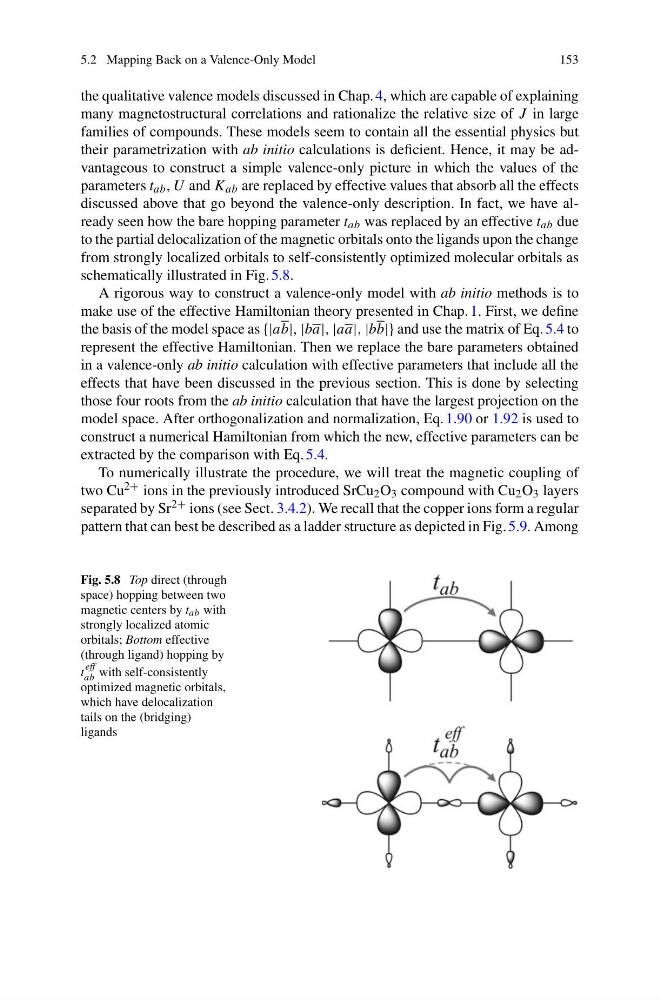
discussed above that go beyond the valence-only description. In fact, we have already seen how the bare hopping parameter t ab was replaced by an effective t ab due
to the partial delocalization of the magnetic orbitals onto the ligands upon the change
from strongly localized orbitals to self-consistently optimized molecular orbitals as
schematically illustrated in Fig. 5.8.
A rigorous way to construct a valence-only model with ab initio methods is to
make use of the effective Hamiltonian theory presented in Chap. 1. First, we define
the basis of the model space as {|ab|, |ba|, |aa|, |bb|} and use the matrix of Eq. 5.4 to
represent the effective Hamiltonian. Then we replace the bare parameters obtained
in a valence-only ab initio calculation with effective parameters that include all the
effects that have been discussed in the previous section. This is done by selecting
those four roots from the ab initio calculation that have the largest projection on the
model space. After orthogonalization and normalization, Eq. 1.90 or 1.92 is used to
construct a numerical Hamiltonian from which the new, effective parameters can be
extracted by the comparison with Eq. 5.4.
To numerically illustrate the procedure, we will treat the magnetic coupling of
two Cu 2+ ions in the previously introduced SrCu 2 O 3 compound with Cu 2 O 3 layers
separated by Sr 2+ ions (see Sect. 3.4.2). We recall that the copper ions form a regular
pattern that can best be described as a ladder structure as depicted in Fig. 5.9. Among
Fig. 5.8 Top direct (through
space) hopping between two
magnetic centers by t ab with
strongly localized atomic
orbitals; Bottom effective
(through ligand) hopping by
t
eff
ab with self-consistently
optimized magnetic orbitals,
which have delocalization
tails on the (bridging)
ligands
153
the qualitative valence models discussed in Chap. 4, which are capable of explaining
many magnetostructural correlations and rationalize the relative size of J in large
families of compounds. These models seem to contain all the essential physics but
their parametrization with ab initio calculations is deficient. Hence, it may be advantageous to construct a simple valence-only picture in which the values of the
parameters t ab , U and K ab are replaced by effective values that absorb all the effects
discussed above that go beyond the valence-only description. In fact, we have already seen how the bare hopping parameter t ab was replaced by an effective t ab due
to the partial delocalization of the magnetic orbitals onto the ligands upon the change
from strongly localized orbitals to self-consistently optimized molecular orbitals as
schematically illustrated in Fig. 5.8.
A rigorous way to construct a valence-only model with ab initio methods is to
make use of the effective Hamiltonian theory presented in Chap. 1. First, we define
the basis of the model space as {|ab|, |ba|, |aa|, |bb|} and use the matrix of Eq. 5.4 to
represent the effective Hamiltonian. Then we replace the bare parameters obtained
in a valence-only ab initio calculation with effective parameters that include all the
effects that have been discussed in the previous section. This is done by selecting
those four roots from the ab initio calculation that have the largest projection on the
model space. After orthogonalization and normalization, Eq. 1.90 or 1.92 is used to
construct a numerical Hamiltonian from which the new, effective parameters can be
extracted by the comparison with Eq. 5.4.
To numerically illustrate the procedure, we will treat the magnetic coupling of
two Cu 2+ ions in the previously introduced SrCu 2 O 3 compound with Cu 2 O 3 layers
separated by Sr 2+ ions (see Sect. 3.4.2). We recall that the copper ions form a regular
pattern that can best be described as a ladder structure as depicted in Fig. 5.9. Among
Fig. 5.8 Top direct (through
space) hopping between two
magnetic centers by t ab with
strongly localized atomic
orbitals; Bottom effective
(through ligand) hopping by
t
eff
ab with self-consistently
optimized magnetic orbitals,
which have delocalization
tails on the (bridging)
ligands