

132
4 From Orbital Models to Accurate Predictions
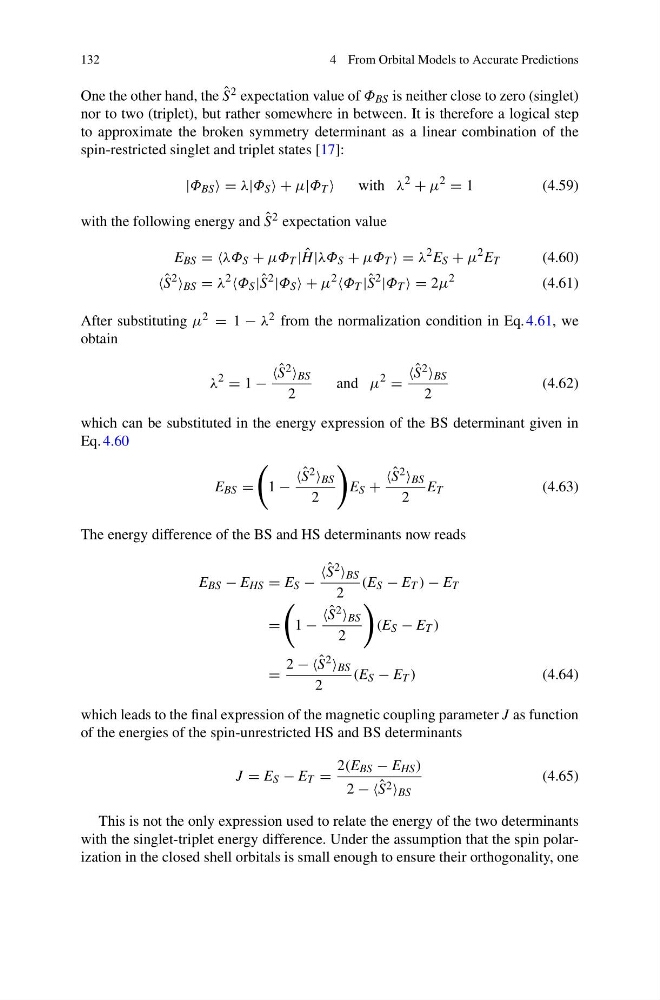
One the other hand, the ˆ
S 2 expectation value of Φ BS is neither close to zero (singlet)
nor to two (triplet), but rather somewhere in between. It is therefore a logical step
to approximate the broken symmetry determinant as a linear combination of the
spin-restricted singlet and triplet states [17]:
|Φ BS =λ|Φ S +µ|Φ T
with λ
2 + µ
2 = 1
(4.59)
with the following energy and ˆ
S 2 expectation value
E BS ==λΦ S + µΦ T | ˆ
H|λΦ S + µΦ T =λ
2 E S + µ
2 E T
(4.60)
ˆ
S
2 BS = λ
2 Φ S | ˆ
S
2 |Φ S +µ
2 Φ T | ˆ
S
2 |Φ T =2µ
2
(4.61)
After substituting µ 2 = 1 − λ 2 from the normalization condition in Eq. 4.61,w e
obtain
λ
2 = 1 −
ˆ
S 2 BS
2
and µ
2 =
ˆ
S 2 BS
2
(4.62)
which can be substituted in the energy expression of the BS determinant given in
Eq. 4.60
E BS =
1 −
ˆ
S 2 BS
2
E S +
ˆ
S 2 BS
2
E T
(4.63)
The energy difference of the BS and HS determinants now reads
E BS − E HS = E S −
ˆ
S 2 BS
2
(E S − E T ) − E T
=
1 −
ˆ
S 2 BS
2
(E S − E T )
=
2 −− ˆ
S 2 BS
2
(E S − E T )
(4.64)
which leads to the final expression of the magnetic coupling parameter J as function
of the energies of the spin-unrestricted HS and BS determinants
J = E S − E T =
2(E BS − E HS )
2 −− ˆ
S 2 BS
(4.65)
This is not the only expression used to relate the energy of the two determinants
with the singlet-triplet energy difference. Under the assumption that the spin polarization in the closed shell orbitals is small enough to ensure their orthogonality, one
4 From Orbital Models to Accurate Predictions
One the other hand, the ˆ
S 2 expectation value of Φ BS is neither close to zero (singlet)
nor to two (triplet), but rather somewhere in between. It is therefore a logical step
to approximate the broken symmetry determinant as a linear combination of the
spin-restricted singlet and triplet states [17]:
|Φ BS =λ|Φ S +µ|Φ T
with λ
2 + µ
2 = 1
(4.59)
with the following energy and ˆ
S 2 expectation value
E BS ==λΦ S + µΦ T | ˆ
H|λΦ S + µΦ T =λ
2 E S + µ
2 E T
(4.60)
ˆ
S
2 BS = λ
2 Φ S | ˆ
S
2 |Φ S +µ
2 Φ T | ˆ
S
2 |Φ T =2µ
2
(4.61)
After substituting µ 2 = 1 − λ 2 from the normalization condition in Eq. 4.61,w e
obtain
λ
2 = 1 −
ˆ
S 2 BS
2
and µ
2 =
ˆ
S 2 BS
2
(4.62)
which can be substituted in the energy expression of the BS determinant given in
Eq. 4.60
E BS =
1 −
ˆ
S 2 BS
2
E S +
ˆ
S 2 BS
2
E T
(4.63)
The energy difference of the BS and HS determinants now reads
E BS − E HS = E S −
ˆ
S 2 BS
2
(E S − E T ) − E T
=
1 −
ˆ
S 2 BS
2
(E S − E T )
=
2 −− ˆ
S 2 BS
2
(E S − E T )
(4.64)
which leads to the final expression of the magnetic coupling parameter J as function
of the energies of the spin-unrestricted HS and BS determinants
J = E S − E T =
2(E BS − E HS )
2 −− ˆ
S 2 BS
(4.65)
This is not the only expression used to relate the energy of the two determinants
with the singlet-triplet energy difference. Under the assumption that the spin polarization in the closed shell orbitals is small enough to ensure their orthogonality, one